Past Exam Questions
← Back9709 P13 - Jun 2022 - Q10
The function \(f\) is defined by \(f(x) = (4x + 2)^{-2}\) for \(x > -\frac{1}{2}\).
Find \(\int_{1}^{\infty} f(x) \, dx\).

9709 P1 - Jun 2003 - Q3
Find \(\int \left( 4x + \frac{6}{x^2} \right) \, dx\).

9709 P11 - Nov 2021 - Q10
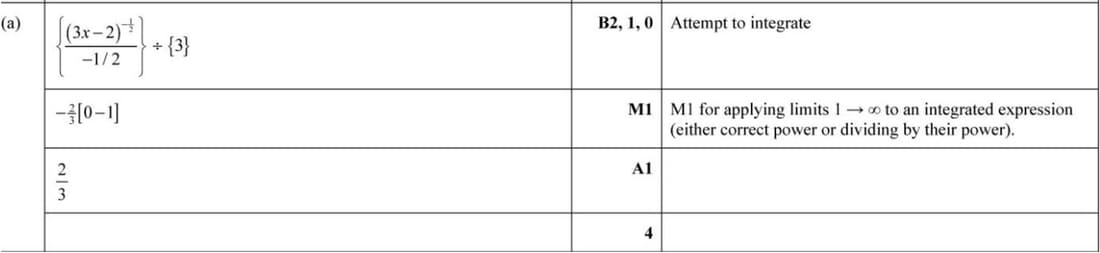
Find \(\int_{1}^{\infty} \frac{1}{(3x - 2)^{\frac{3}{2}}} \, dx\).
9709 P13 - Nov 2020 - Q10
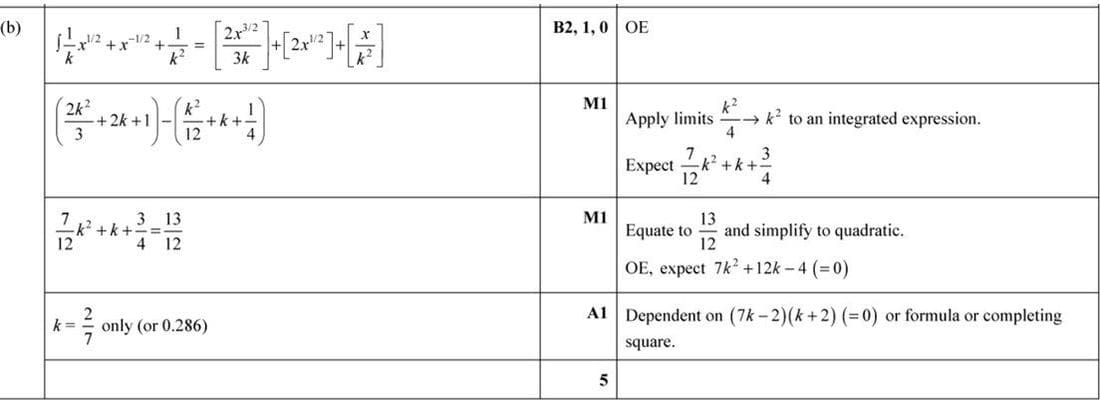
A curve has equation \(y = \frac{1}{k} x^{\frac{1}{2}} + x^{-\frac{1}{2}} + \frac{1}{k^2}\) where \(x > 0\) and \(k\) is a positive constant.
It is given instead that \(\int_{\frac{1}{4}k^2}^{k^2} \left( \frac{1}{k} x^{\frac{1}{2}} + x^{-\frac{1}{2}} + \frac{1}{k^2} \right) \, dx = \frac{13}{12}\).
Find the value of \(k\).
9709 P12 - Nov 2018 - Q2
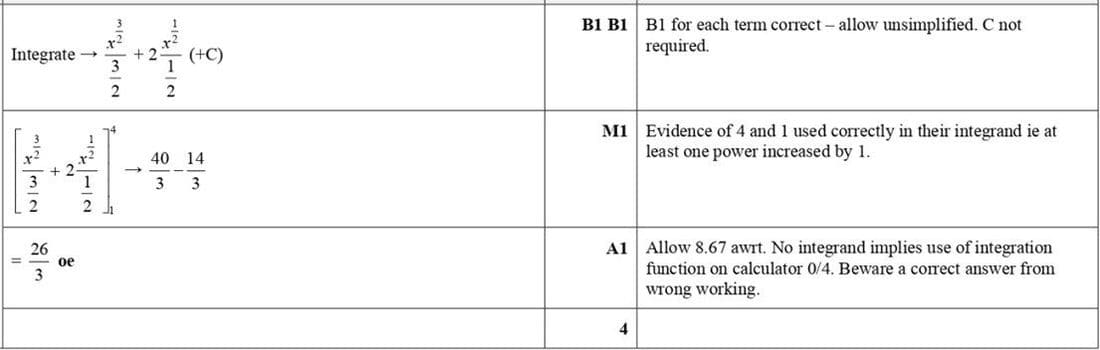
Showing all necessary working, find \(\int_{1}^{4} \left( \sqrt{x} + \frac{2}{\sqrt{x}} \right) \, dx\).
9709 P12 - Nov 2013 - Q3
Find \(\int \frac{2}{\sqrt{5x - 6}} \, dx\) and hence evaluate \(\int_{2}^{3} \frac{2}{\sqrt{5x - 6}} \, dx\).

9709 P13 - Jun 2011 - Q4
Find \(\int (3x - 2)^5 \, dx\) and hence find the value of \(\int_0^1 (3x - 2)^5 \, dx\).

9709 P12 - Jun 2011 - Q1
Find \(\int \left( x^3 + \frac{1}{x^3} \right) \, dx\).

9709 P11 - Nov 2010 - Q1
Find \(\int \left( x + \frac{1}{x} \right)^2 \, dx\).

9709 P1 - Jun 2004 - Q2
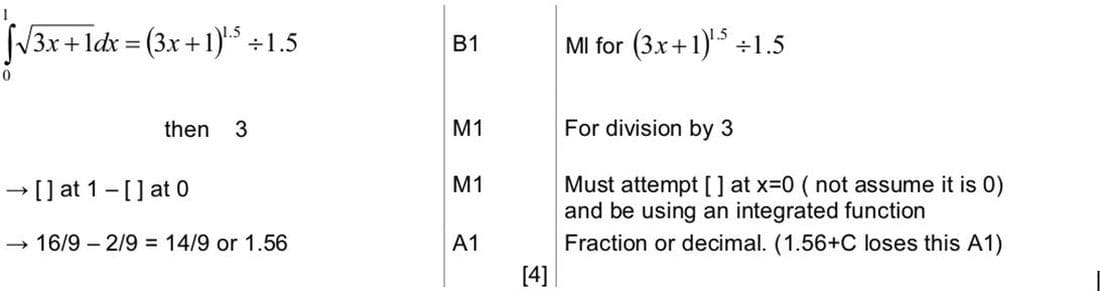
Evaluate \(\int_{0}^{1} \sqrt{3x + 1} \, dx\).
9709 P13 - Nov 2023 - Q1
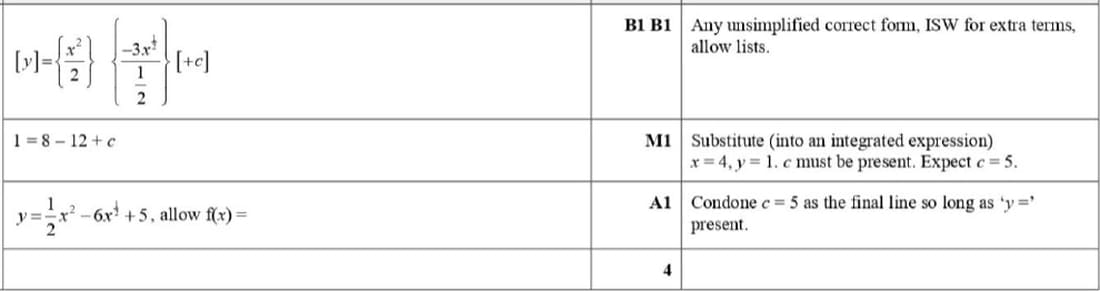
A curve is such that its gradient at a point \((x, y)\) is given by \(\frac{dy}{dx} = x - 3x^{-\frac{1}{2}}\). It is given that the curve passes through the point \((4, 1)\).
Find the equation of the curve.
9709 P11 - Nov 2022 - Q2
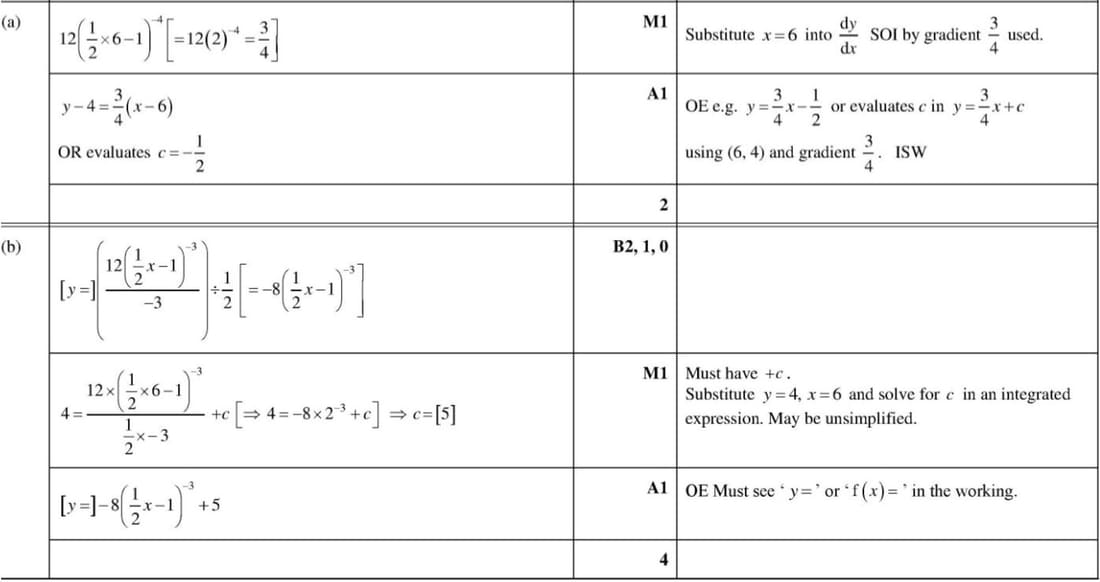
The equation of a curve is such that \(\frac{dy}{dx} = 12\left(\frac{1}{2}x - 1\right)^{-4}\). It is given that the curve passes through the point \(P(6, 4)\).
(a) Find the equation of the tangent to the curve at \(P\).
(b) Find the equation of the curve.
9709 P12 - Jun 2022 - Q3
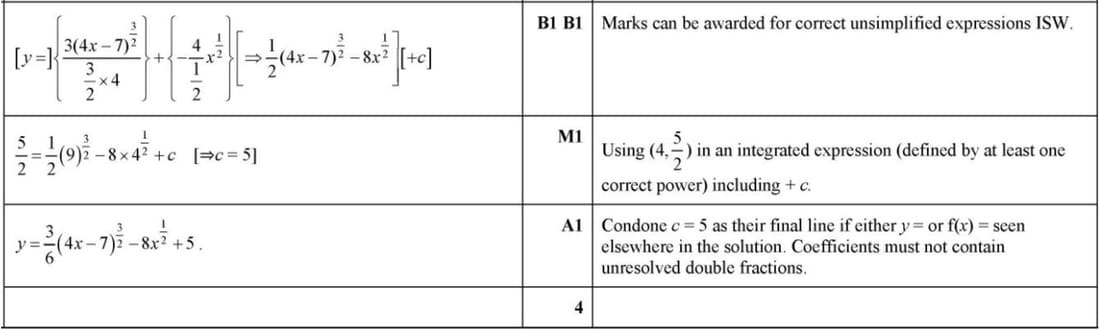
The equation of a curve is such that \(\frac{dy}{dx} = 3(4x - 7)^{\frac{1}{2}} - 4x^{-\frac{1}{2}}\). It is given that the curve passes through the point \((4, \frac{5}{2})\).
Find the equation of the curve.
9709 P11 - Jun 2022 - Q10
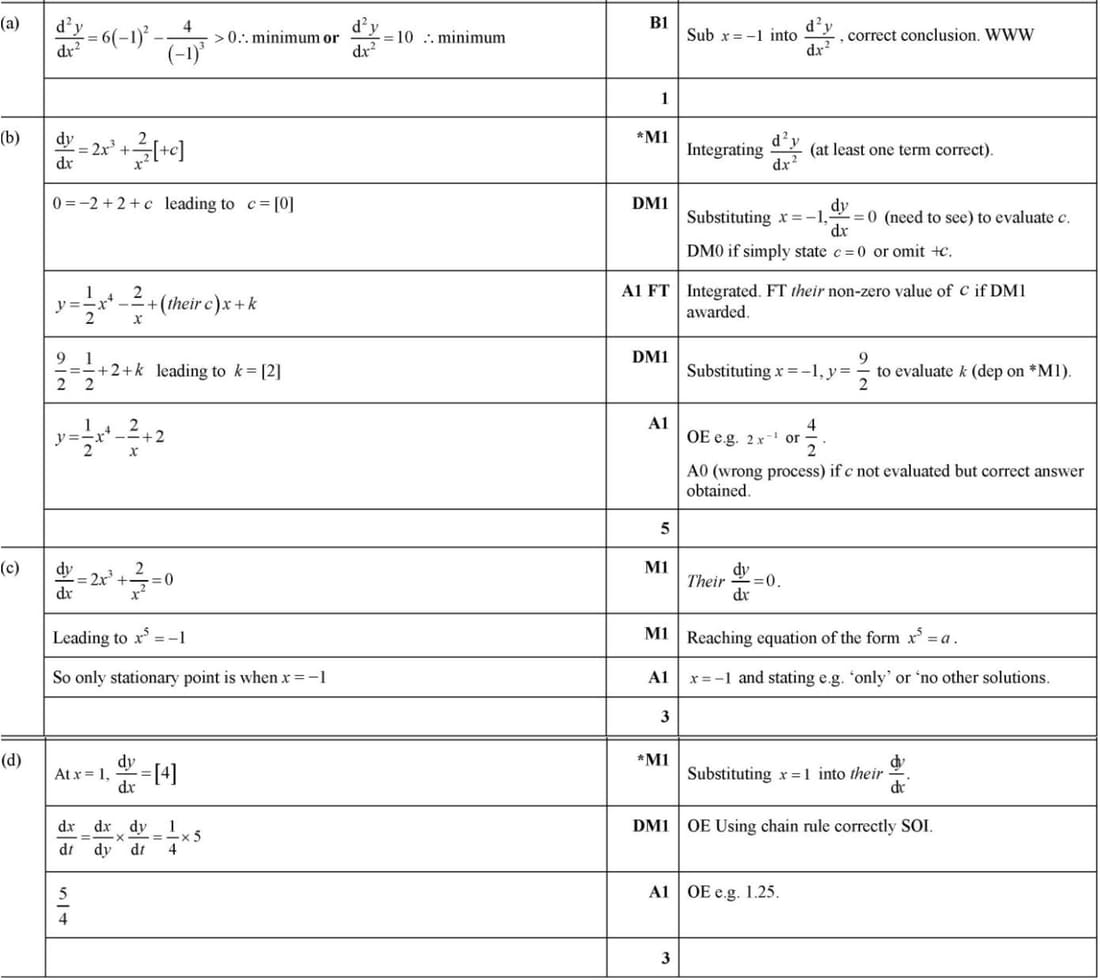
The equation of a curve is such that \(\frac{d^2y}{dx^2} = 6x^2 - \frac{4}{x^3}\). The curve has a stationary point at \((-1, \frac{9}{2})\).
(a) Determine the nature of the stationary point at \((-1, \frac{9}{2})\).
(b) Find the equation of the curve.
(c) Show that the curve has no other stationary points.
(d) A point \(A\) is moving along the curve and the \(y\)-coordinate of \(A\) is increasing at a rate of 5 units per second. Find the rate of increase of the \(x\)-coordinate of \(A\) at the point where \(x = 1\).
9709 P12 - Mar 2022 - Q1
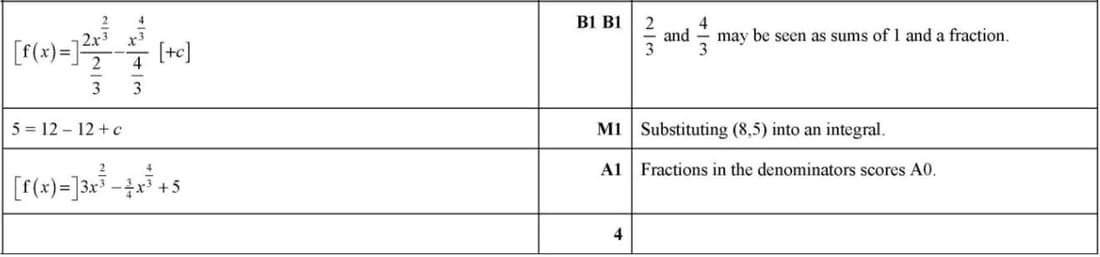
A curve with equation \(y = f(x)\) is such that \(f'(x) = 2x^{-\frac{1}{3}} - x^{\frac{1}{3}}\). It is given that \(f(8) = 5\).
Find \(f(x)\).
9709 P12 - Nov 2021 - Q4
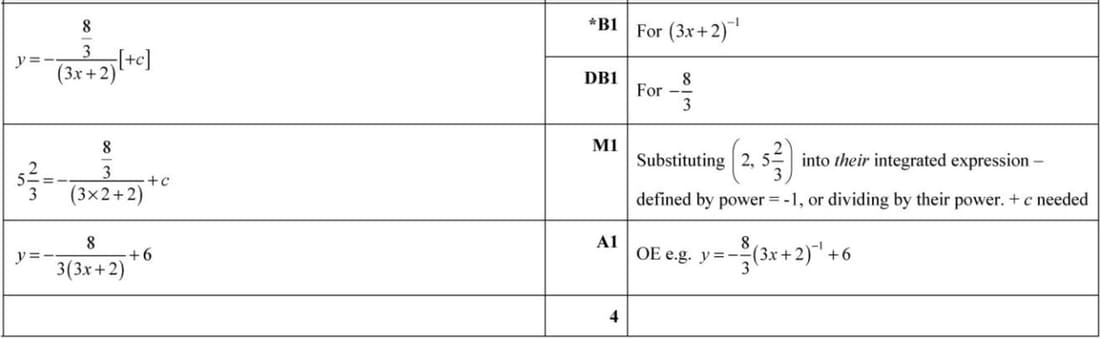
A curve is such that \(\frac{dy}{dx} = \frac{8}{(3x + 2)^2}\). The curve passes through the point \((2, 5\frac{2}{3})\).
Find the equation of the curve.
9709 P13 - Jun 2021 - Q1
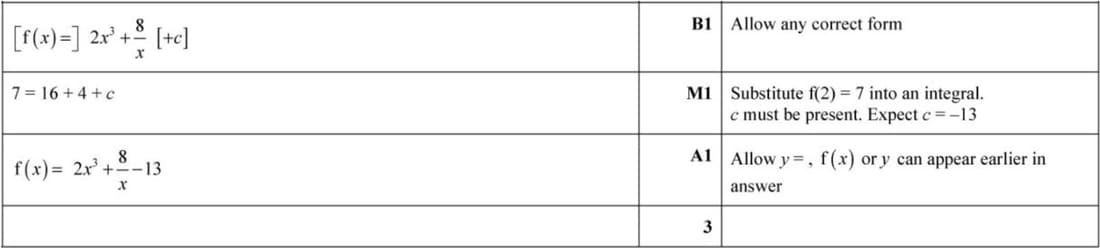
A curve with equation \(y = f(x)\) is such that \(f'(x) = 6x^2 - \frac{8}{x^2}\). It is given that the curve passes through the point \((2, 7)\).
Find \(f(x)\).
9709 P12 - Jun 2021 - Q11
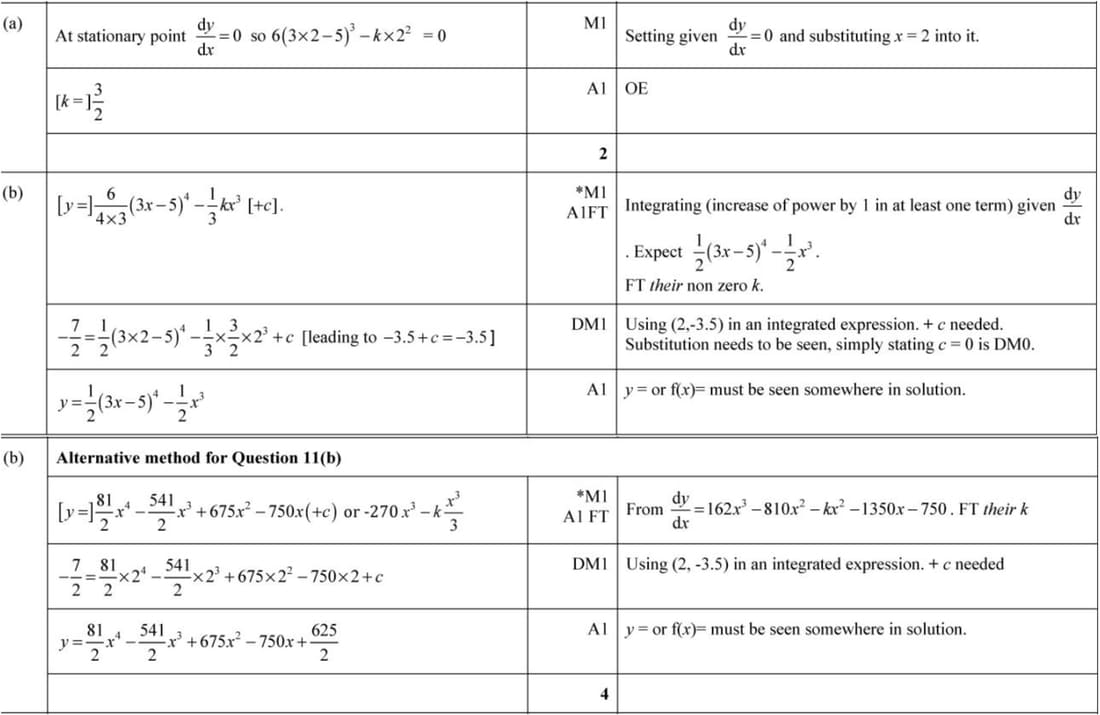
The gradient of a curve is given by \(\frac{dy}{dx} = 6(3x-5)^3 - kx^2\), where \(k\) is a constant. The curve has a stationary point at \((2, -3.5)\).
(a) Find the value of \(k\).
(b) Find the equation of the curve.
9709 P11 - Jun 2021 - Q1
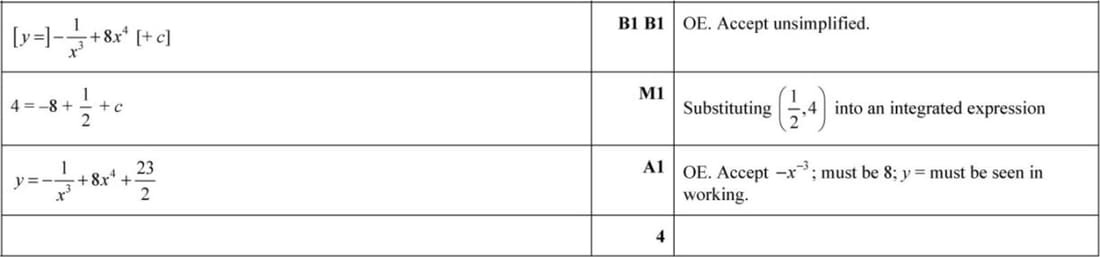
The equation of a curve is such that \(\frac{dy}{dx} = \frac{3}{x^4} + 32x^3\). It is given that the curve passes through the point \(\left( \frac{1}{2}, 4 \right)\).
Find the equation of the curve.
9709 P12 - Mar 2021 - Q6
A curve is such that \(\frac{dy}{dx} = \frac{6}{(3x - 2)^3}\) and \(A(1, -3)\) lies on the curve.
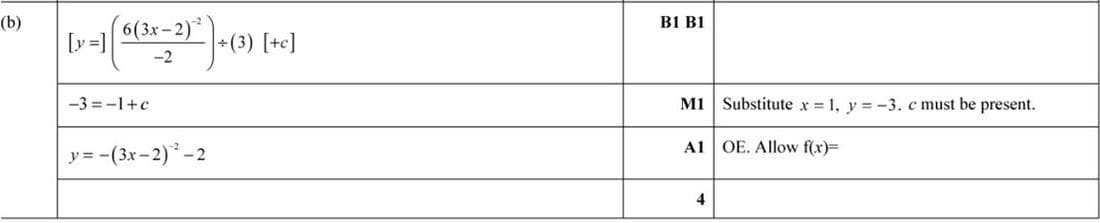
Find the equation of the curve.