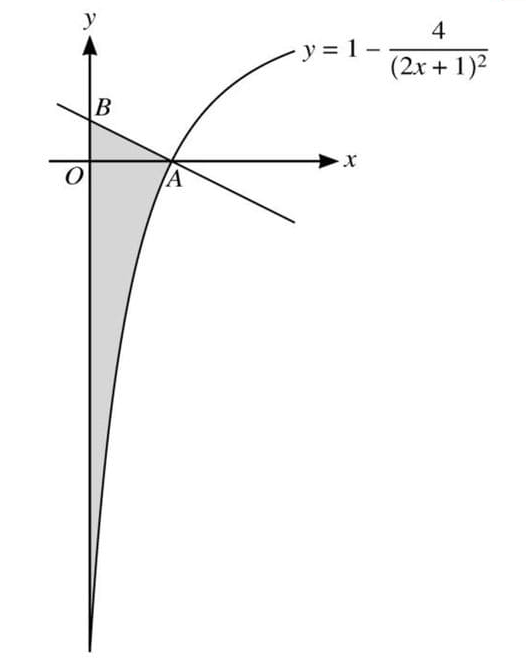
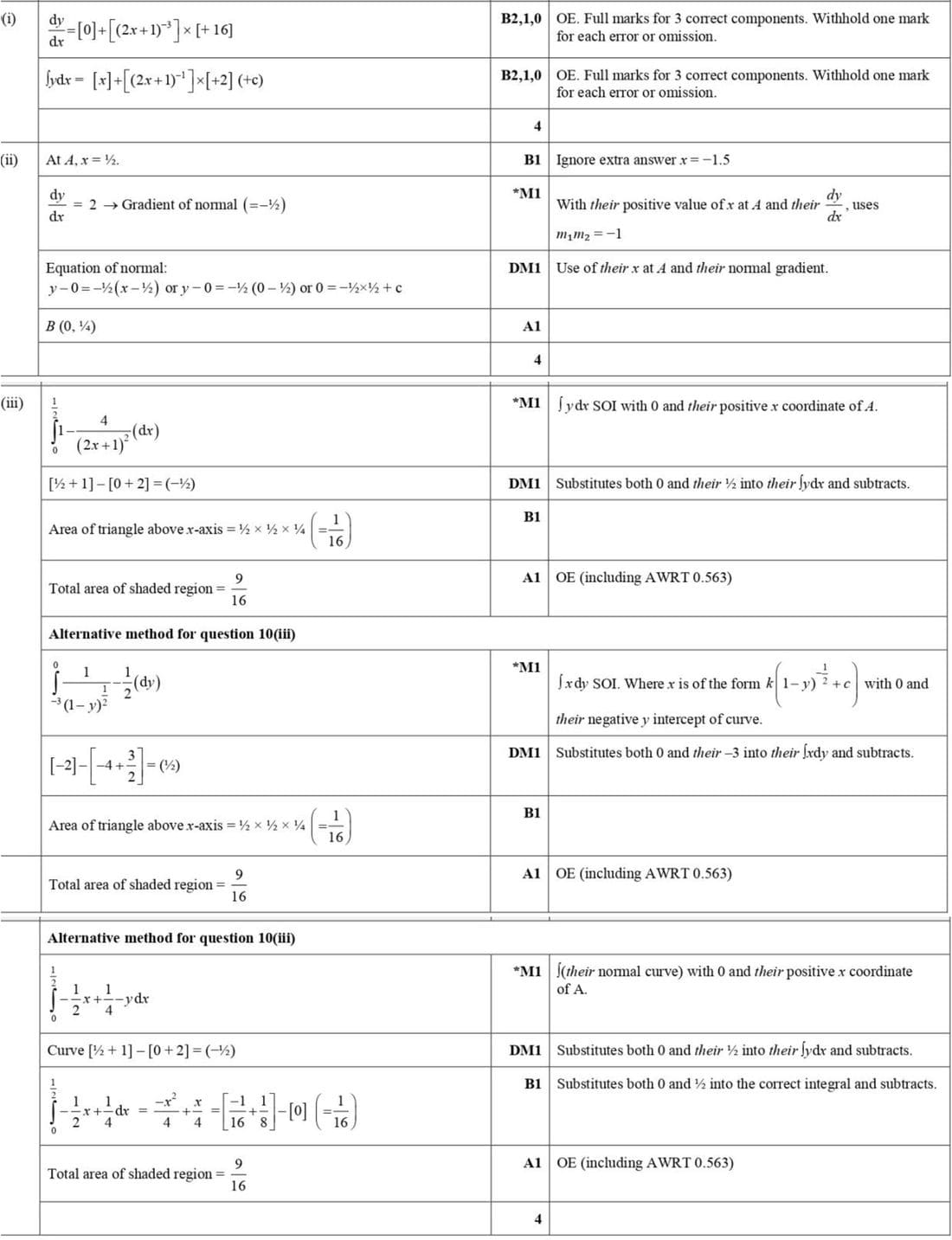
(i) To find \(\frac{dy}{dx}\), differentiate \(y = 1 - \frac{4}{(2x+1)^2}\) using the chain rule:
\(\frac{dy}{dx} = -\frac{d}{dx} \left( \frac{4}{(2x+1)^2} \right) = -\frac{8}{(2x+1)^3}\).
To find \(\int y \, dx\), integrate \(y = 1 - \frac{4}{(2x+1)^2}\):
\(\int y \, dx = \int \left( 1 - \frac{4}{(2x+1)^2} \right) dx = x + \frac{1}{2x+1} + 2 + c\).
(ii) At \(A\), \(x = \frac{1}{2}\). The gradient of the normal is the negative reciprocal of \(\frac{dy}{dx}\) at \(x = \frac{1}{2}\), which is \(-\frac{1}{2}\).
The equation of the normal is \(y - 0 = -\frac{1}{2}(x - \frac{1}{2})\), simplifying to \(y = -\frac{1}{2}x + \frac{1}{4}\).
Thus, \(B(0, \frac{1}{4})\).
(iii) The area of the shaded region is found by integrating \(y\) from 0 to \(\frac{1}{2}\):
\(\int_0^{\frac{1}{2}} \left( 1 - \frac{4}{(2x+1)^2} \right) dx = \left[ x + \frac{1}{2x+1} \right]_0^{\frac{1}{2}} = \frac{1}{2} + \frac{1}{2} - 0 - 1 = -\frac{1}{4}\).
The area of the triangle above the x-axis is \(\frac{1}{2} \times \frac{1}{2} \times \frac{1}{4} = \frac{1}{16}\).
Total area of shaded region = \(\frac{9}{16}\).