Browsing as Guest. Progress, bookmarks and attempts are disabled.
Log in to track your work.
June 2015 p13 q10
1286
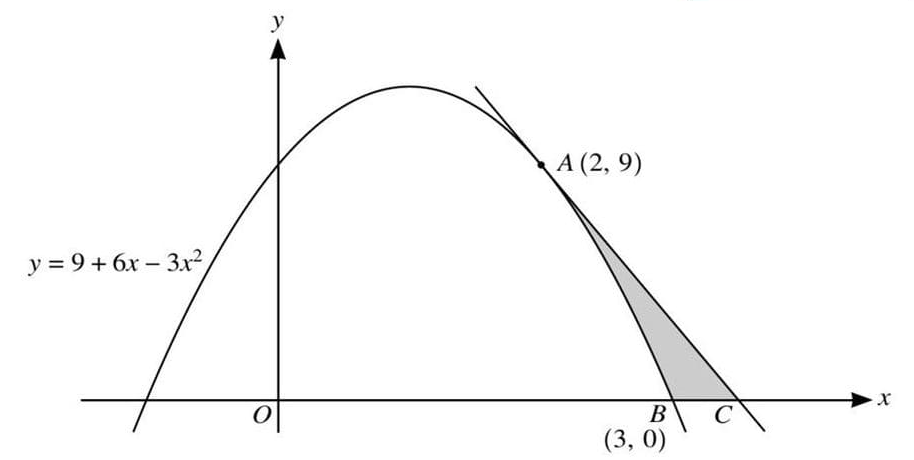
Points A (2, 9) and B (3, 0) lie on the curve \(y = 9 + 6x - 3x^2\), as shown in the diagram. The tangent at A intersects the x-axis at C. Showing all necessary working,
(i) find the equation of the tangent AC and hence find the x-coordinate of C,
(ii) find the area of the shaded region ABC.
Solution
(i) To find the equation of the tangent, we first find the derivative of the curve \(y = 9 + 6x - 3x^2\), which is \(\frac{dy}{dx} = 6 - 6x\). At \(x = 2\), the gradient is \(6 - 6(2) = -6\). The equation of the tangent at A (2, 9) is \(y - 9 = -6(x - 2)\), which simplifies to \(y = -6x + 21\). To find the x-coordinate of C, set \(y = 0\) in the tangent equation: \(0 = -6x + 21\), giving \(x = \frac{21}{6} = \frac{7}{2}\).
(ii) The area under the curve from \(x = 2\) to \(x = 3\) is calculated by integrating \(9 + 6x - 3x^2\), which gives \(9x + 3x^2 - x^3\). Evaluating from 2 to 3, we get \((27 + 27 - 27) - (18 + 12 - 8) = 5\). The area under the tangent from \(x = 2\) to \(x = \frac{7}{2}\) is \(\frac{1}{2} \times \frac{3}{2} \times 9 = \frac{27}{4}\). The area of the shaded region ABC is \(\frac{27}{4} - 5 = \frac{7}{4}\).