Past Exam Questions
← Back9709 P12 - Mar 2026 - Q9 - 4 marks
Solve \(x^{2/3}+(8x)^{1/3}=24\). [4]

9709 P12 - Jun 2026 - Q1 - 3 marks
Solve \(3x^2-8-\dfrac{16}{x^2}=0\). [3]

9709 P13 - Jun 2026 - Q2 - 4 marks
(a) Express \(x\sqrt x\) as \(x^n\), with rational \(n\). [1]
(b) Hence solve \(x^3-9x\sqrt x+8=0\). [3]


9709 P12 - Jun 2023 - Q4 - 3 marks
Solve \(8x^6+215x^3-27=0\). [3]

9709 P13 - Jun 2019 - Q1I
The function \(f\) is defined by \(f(x) = x^2 - 4x + 8\) for \(x \in \mathbb{R}\). Express \(x^2 - 4x + 8\) in the form \((x-a)^2 + b\).

9709 P13 - Jun 2018 - Q1
Express \(3x^2 - 12x + 7\) in the form \(a(x + b)^2 + c\), where \(a\), \(b\), and \(c\) are constants.

9709 P11 - Nov 2016 - Q1I
Express \(x^2 + 6x + 2\) in the form \((x + a)^2 + b\), where \(a\) and \(b\) are constants.

9709 P11 - Jun 2016 - Q6B
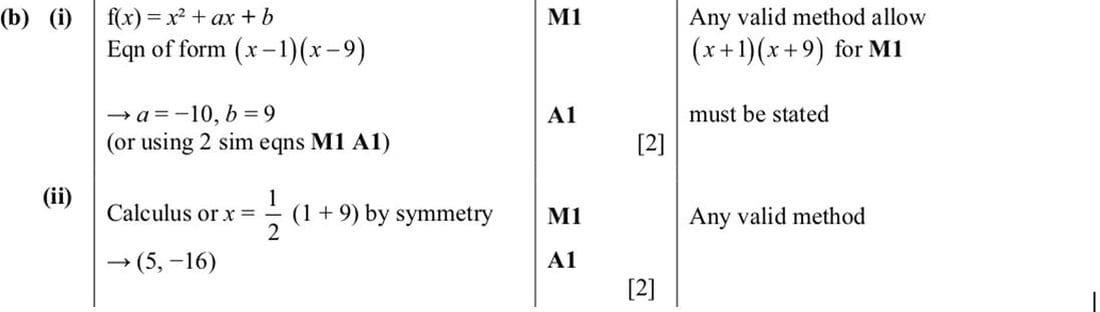
The function \(f\) is defined for \(x \in \mathbb{R}\) by \(f(x) = x^2 + ax + b\), where \(a\) and \(b\) are constants. The solutions of the equation \(f(x) = 0\) are \(x = 1\) and \(x = 9\). Find:
- the values of \(a\) and \(b\),
- the coordinates of the vertex of the curve \(y = f(x)\).
9709 P13 - Jun 2015 - Q1
Express \(2x^2 - 12x + 7\) in the form \(a(x+b)^2 + c\), where \(a, b\) and \(c\) are constants.

9709 P13 - Jun 2014 - Q8I
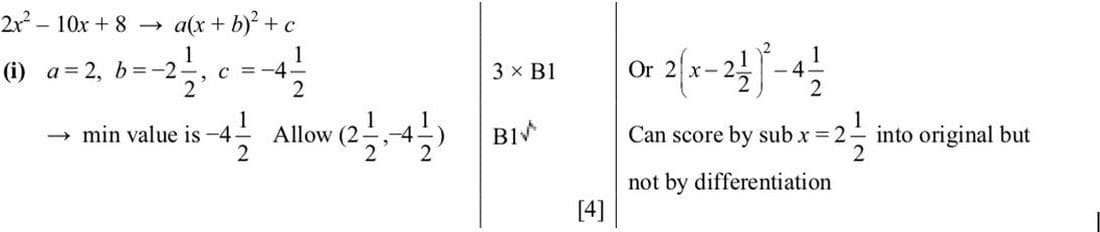
Express \(2x^2 - 10x + 8\) in the form \(a(x + b)^2 + c\), where \(a\), \(b\), and \(c\) are constants, and use your answer to state the minimum value of \(2x^2 - 10x + 8\).
9709 P11 - Jun 2014 - Q2I
Express \(4x^2 - 12x\) in the form \((2x + a)^2 + b\).

9709 P12 - Nov 2013 - Q10II
A curve is described by the equation \(y = 2x^2 - 3x\). Express \(2x^2 - 3x\) in the form \(a(x + b)^2 + c\), where \(a\), \(b\), and \(c\) are constants, and determine the coordinates of the vertex of the curve.

9709 P13 - Jun 2012 - Q11I
The function \(f\) is defined as \(f(x) = 8 - (x - 2)^2\), for \(x \in \mathbb{R}\). Find the coordinates and the nature of the stationary point on the curve \(y = f(x)\).

9709 P13 - Nov 2011 - Q7II
Rewrite the expression \(x^2 - 4x + 5\) in the form \((x + a)^2 + b\). Then, find the coordinates of the minimum point on the curve.

9709 P11 - Jun 2011 - Q10I
Express \(2x^2 - 4x + 1\) in the form \(a(x + b)^2 + c\) and hence state the coordinates of the minimum point, \(A\), on the curve \(y = 2x^2 - 4x + 1\).

9709 P12 - Nov 2022 - Q6 - 9 marks
The equation of a curve is \(y=4x^2+20x+6\).
(a) Express \(y\) in the form \(a(x+b)^2+c\), where \(a\), \(b\) and \(c\) are constants to be found. [3]
(b) Hence solve the equation \(4x^2+20x+6=45\). [3]
(c) Sketch the graph of \(y=4x^2+20x+6\) showing the coordinates of the stationary point. You are not required to indicate where the curve crosses the x- and y-axes. [3]


9709 P11 - Jun 2022 - Q1 - 4 marks
(a) Express \(x^2-8x+11\) in the form \((x+p)^2+q\) where \(p\) and \(q\) are constants. [2]
(b) Hence find the exact solutions of the equation \(x^2-8x+11=1\). [2]

9709 P12 - Jun 2021 - Q1 - 4 marks
(a) Express \(16x^2-24x+10\) in the form \((4x+a)^2+b\). [2]
(b) It is given that the equation \(16x^2-24x+10=k\), where k is a constant, has exactly one root. Find the value of this root. [2]

9709 P13 - Jun 2023 - Q2 - 4 marks
\(f(x)=x^2-6x+c\), \(x\in\mathbb R\). Given \(f(x)>2\) for every real \(x\), find the possible \(c\)-values. [4]

9709 P12 - Jun 2023 - Q3 - 3 marks
(a) Write \(4x^2-24x+p\) as \(a(x+b)^2+c\), where \(a,b\) are integers and \(c\) is in terms of \(p\). [2]
(b) Find the \(p\)-values for which \(4x^2-24x+p=0\) has no real roots. [1]
