Past Exam Questions
← BackQuestion #363
Determine the real roots of the equation \(\frac{18}{x^4} + \frac{1}{x^2} = 4\).
9709 P13 - Jun 2023 - Q2 - 4 marks
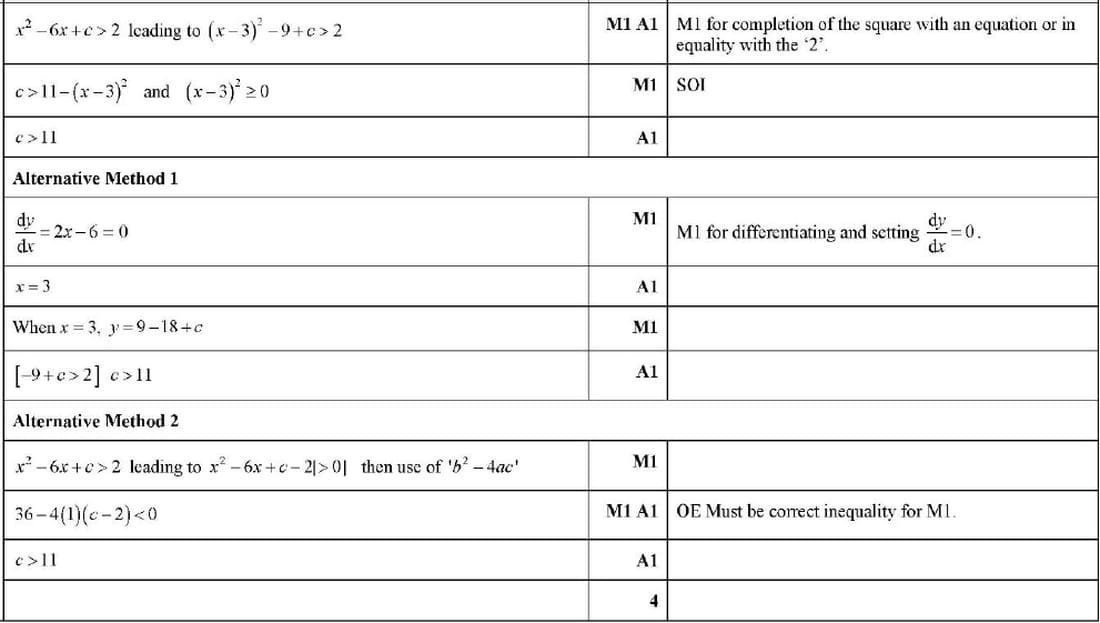
The function \(f\) is defined for \(x \in \mathbb{R}\) by \(f(x) = x^2 - 6x + c\), where \(c\) is a constant. It is given that \(f(x) > 2\) for all values of \(x\). Find the set of possible values of \(c\).
9709 P11 - Nov 2022 - Q1 - 3 marks
Solve the equation \(3x + 2 = \frac{2}{x - 1}\).

9709 P13 - Jun 2019 - Q11II - 3 marks
The function \(f\) is defined by \(f(x) = x^2 - 4x + 8\) for \(x \in \mathbb{R}\). Find the set of values of \(x\) for which \(f(x) < 9\), giving your answer in exact form.

9709 P12 - Nov 2016 - Q3I - 3 marks
A curve is described by the equation \(y = 2x^2 - 6x + 5\). Determine the range of \(x\) values for which \(y > 13\).

9709 P11 - Nov 2016 - Q11II - 2 marks
Find the set of values of \(x\) for which \(x^2 + 6x + 2 > 9\).

9709 P12 - Jun 2016 - Q11I - 3 marks
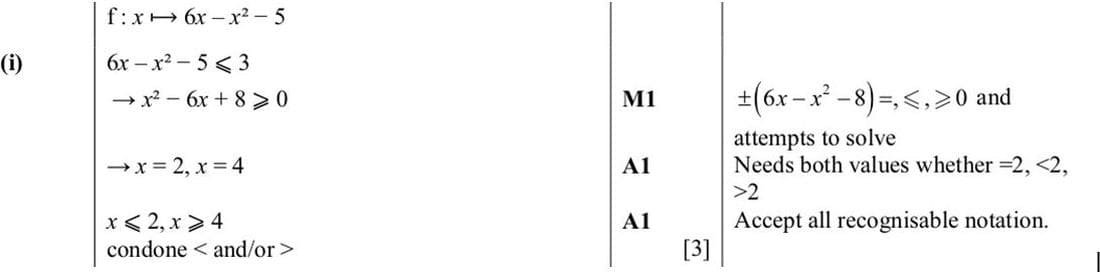
The function \(f\) is defined by \(f : x \mapsto 6x - x^2 - 5\) for \(x \in \mathbb{R}\). Find the set of values of \(x\) for which \(f(x) \leq 3\).
9709 P11 - Jun 2014 - Q2II - 2 marks
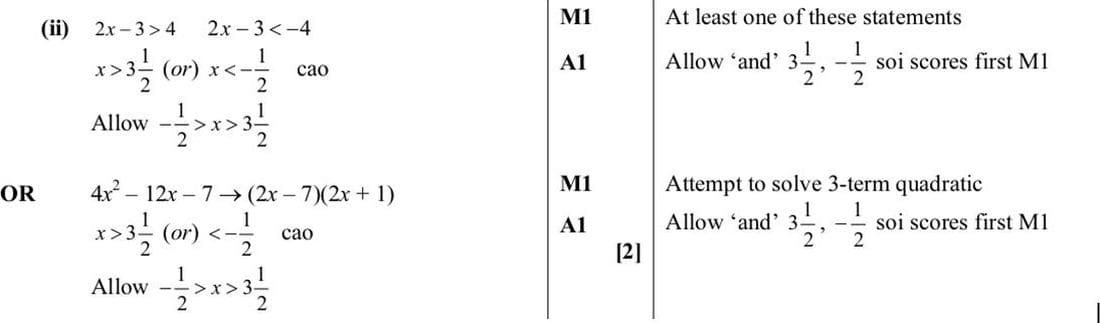
Find the set of values of \(x\) satisfying \(4x^2 - 12x > 7\).
9709 P12 - Nov 2013 - Q10I - 3 marks
A curve is defined by the equation \(y = 2x^2 - 3x\). Determine the set of \(x\) values for which \(y > 9\).

9709 P1 - Nov 2006 - Q10I - 3 marks
The function \(f\) is defined by \(f: x \mapsto x^2 - 3x\) for \(x \in \mathbb{R}\). Find the set of values of \(x\) for which \(f(x) > 4\).

9709 P11 - Nov 2023 - Q2 - 4 marks
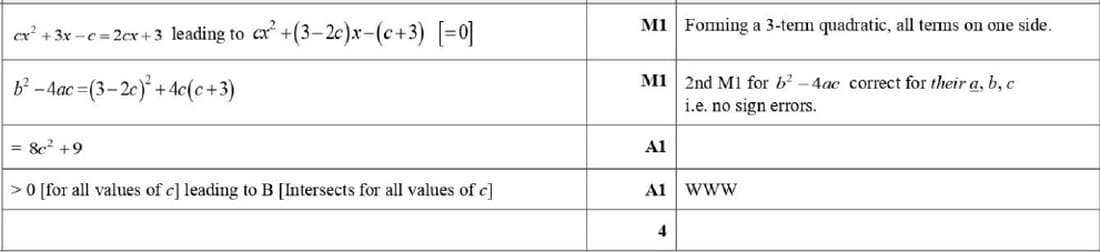
A line has equation \(y = 2x + 3\) and a curve has equation \(y = cx^2 + 3x - c\), where \(c\) is a constant.
Showing all necessary working, determine which of the following statements is correct.
A. The line and curve intersect only for a particular set of values of \(c\).
B. The line and curve intersect for all values of \(c\).
C. The line and curve do not intersect for any values of \(c\).
9709 P11 - Jun 2021 - Q6 - 5 marks
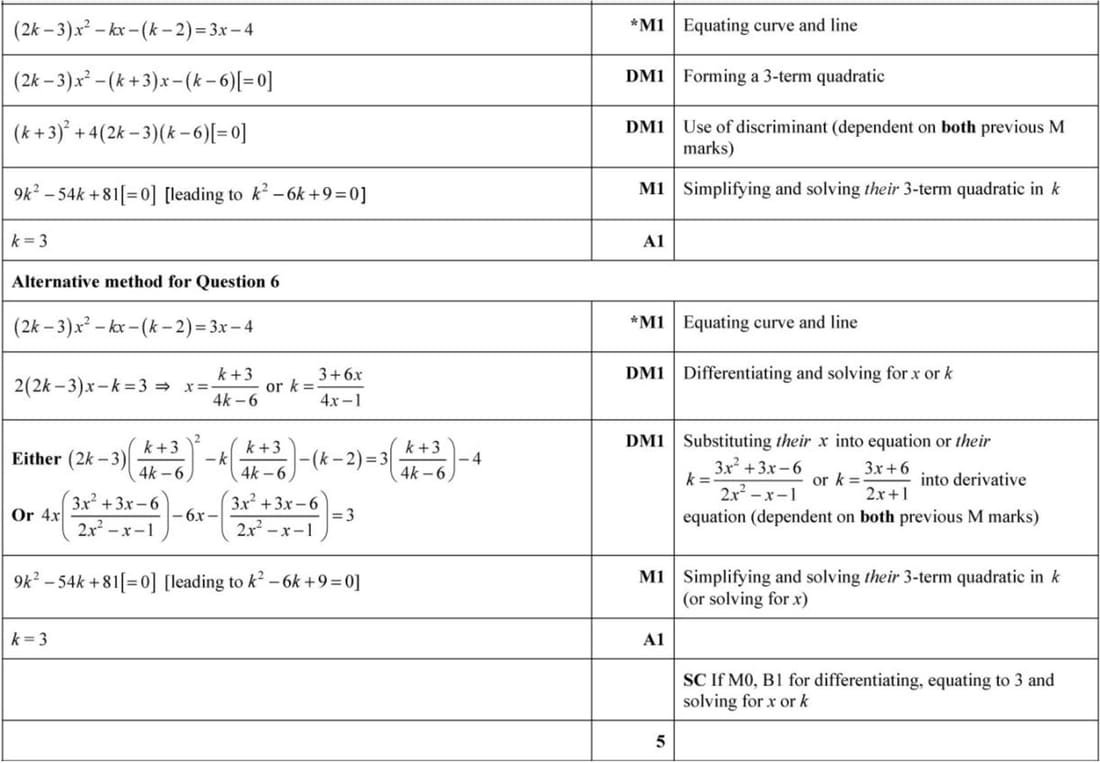
The equation of a curve is \(y = (2k - 3)x^2 - kx - (k - 2)\), where \(k\) is a constant. The line \(y = 3x - 4\) is tangent to the curve.
Find the value of \(k\).
9709 P12 - Mar 2021 - Q4 - 5 marks
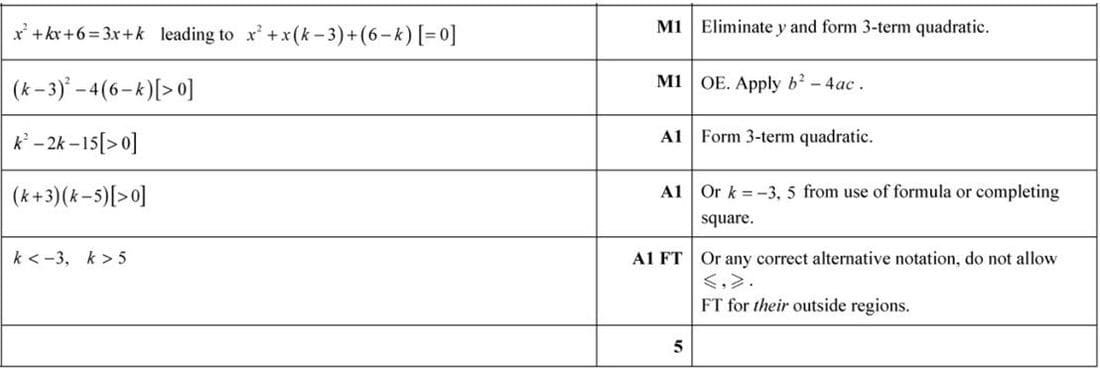
A line has equation \(y = 3x + k\) and a curve has equation \(y = x^2 + kx + 6\), where \(k\) is a constant.
Find the set of values of \(k\) for which the line and curve have two distinct points of intersection.
9709 P13 - Nov 2020 - Q4 - 5 marks
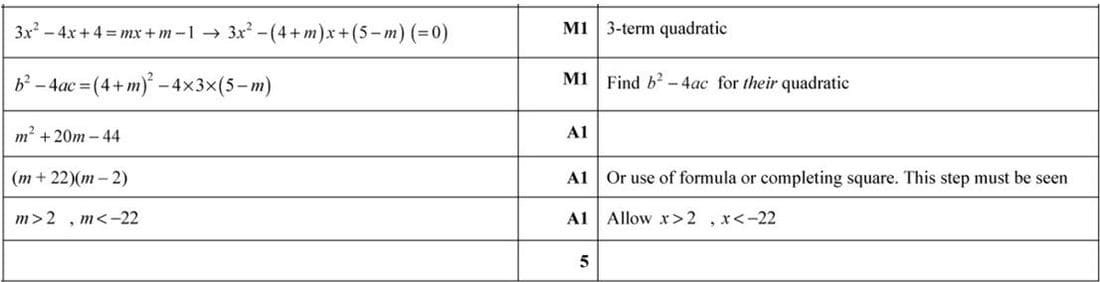
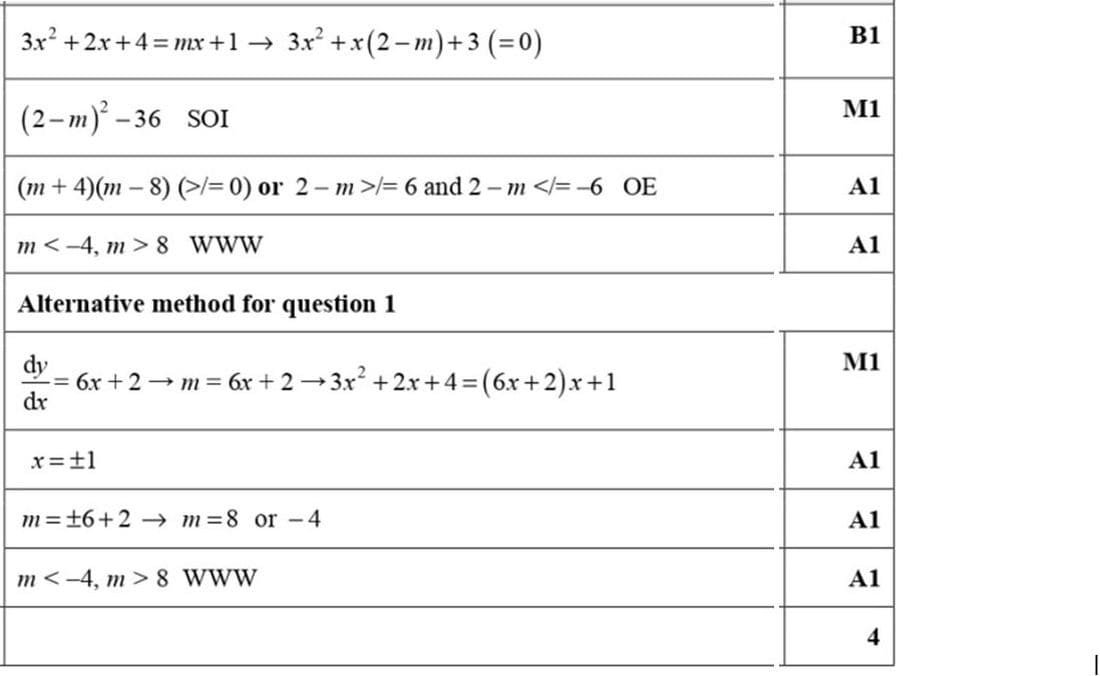
A curve has equation \(y = 3x^2 - 4x + 4\) and a straight line has equation \(y = mx + m - 1\), where \(m\) is a constant.
Find the set of values of \(m\) for which the curve and the line have two distinct points of intersection.
9709 P12 - Nov 2020 - Q3 - 5 marks
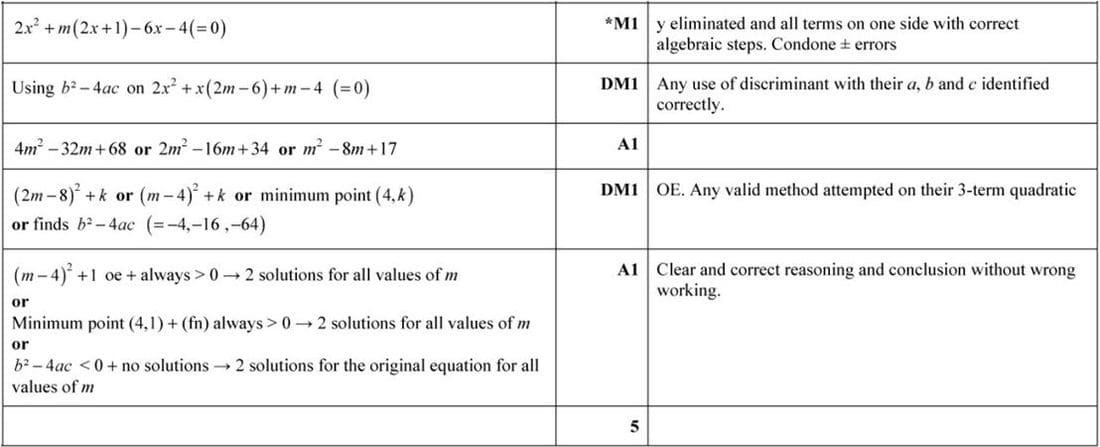
The equation of a curve is \(y = 2x^2 + m(2x + 1)\), where \(m\) is a constant, and the equation of a line is \(y = 6x + 4\).
Show that, for all values of \(m\), the line intersects the curve at two distinct points.
9709 P11 - Nov 2020 - Q1 - 3 marks
Find the set of values of m for which the line with equation \(y = mx - 3\) and the curve with equation \(y = 2x^2 + 5\) do not meet.

9709 P13 - Jun 2020 - Q1 - 4 marks
Find the set of values of m for which the line with equation \(y = mx + 1\) and the curve with equation \(y = 3x^2 + 2x + 4\) intersect at two distinct points.
9709 P12 - Jun 2020 - Q6A - 3 marks
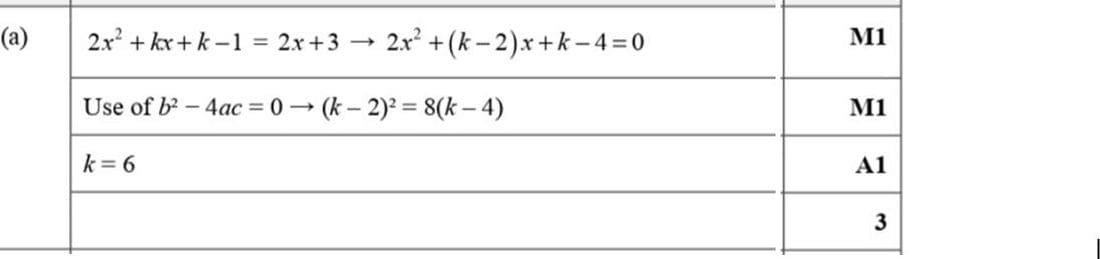
The equation of a curve is \(y = 2x^2 + kx + k - 1\), where \(k\) is a constant. Given that the line \(y = 2x + 3\) is a tangent to the curve, find the value of \(k\).
9709 P11 - Jun 2020 - Q5 - 6 marks
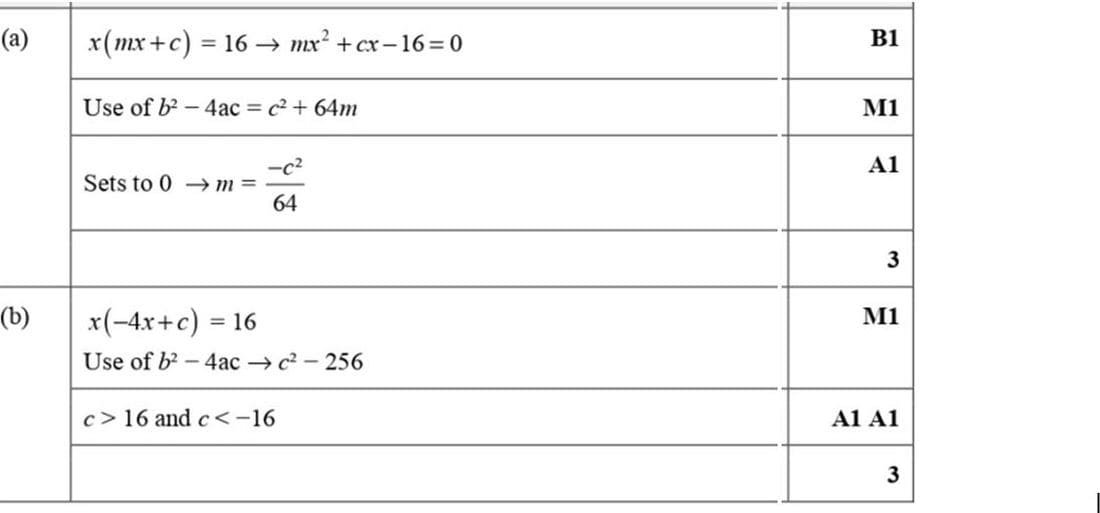
The equation of a line is \(y = mx + c\), where \(m\) and \(c\) are constants, and the equation of a curve is \(xy = 16\).
(a) Given that the line is a tangent to the curve, express \(m\) in terms of \(c\).
(b) Given instead that \(m = -4\), find the set of values of \(c\) for which the line intersects the curve at two distinct points.
9709 P13 - Nov 2019 - Q6 - 7 marks
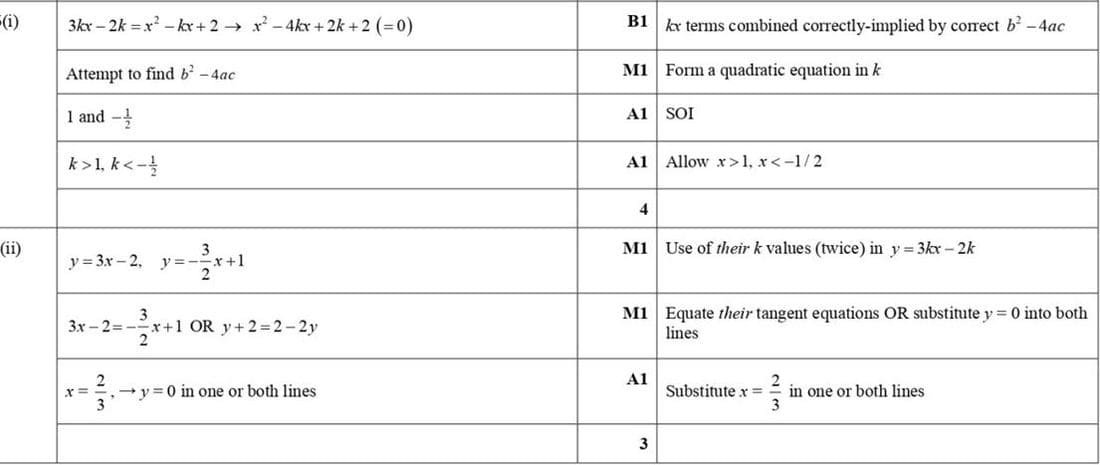
A line has equation \(y = 3kx - 2k\) and a curve has equation \(y = x^2 - kx + 2\), where \(k\) is a constant.
(i) Find the set of values of \(k\) for which the line and curve meet at two distinct points.
(ii) For each of two particular values of \(k\), the line is a tangent to the curve. Show that these two tangents meet on the x-axis.