Past Exam Questions
← Back9709 P11 - Nov 2019 - Q6 - 7 marks
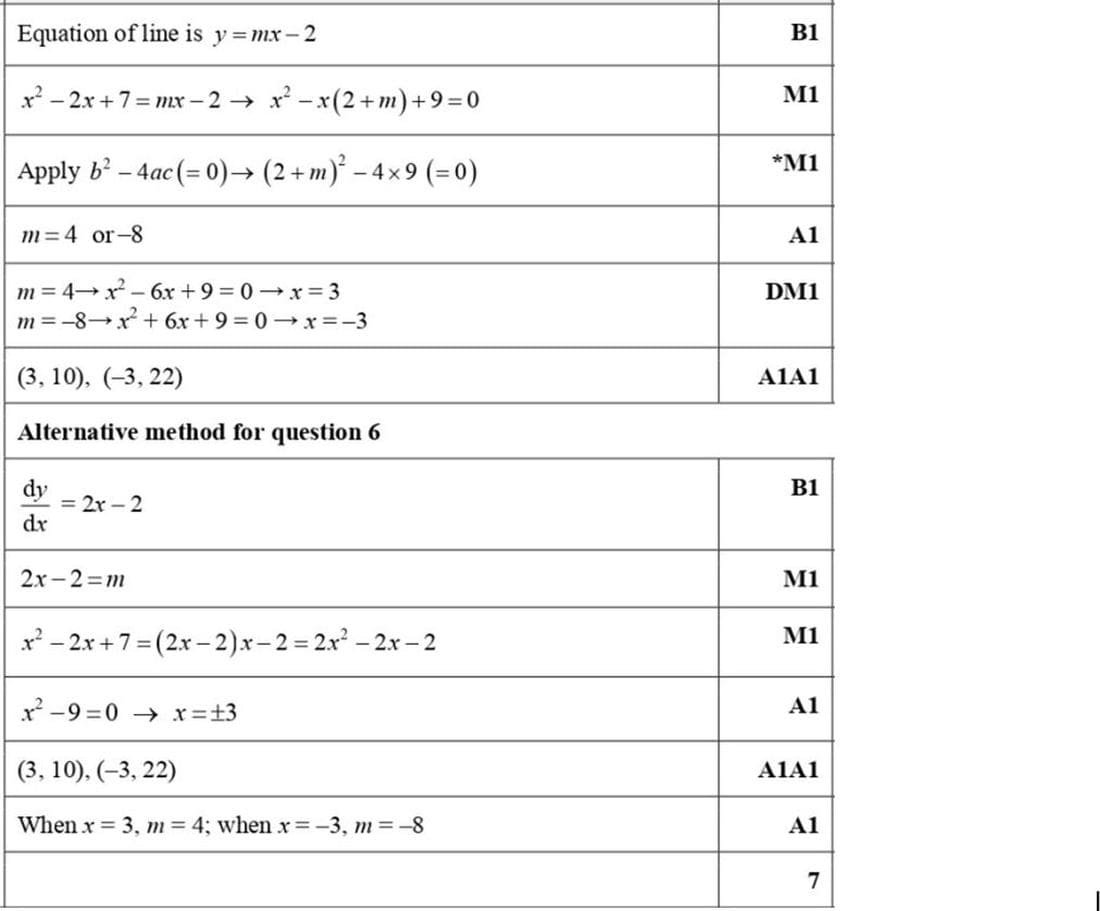
A straight line has gradient m and passes through the point (0, -2). Find the two values of m for which the line is a tangent to the curve y = x^2 - 2x + 7 and, for each value of m, find the coordinates of the point where the line touches the curve.
9709 P12 - Jun 2023 - Q3B - 1 mark
Find the set of values of p for which the equation \(4x^2 - 24x + p = 0\) has no real roots.

9709 P11 - Jun 2019 - Q2 - 5 marks
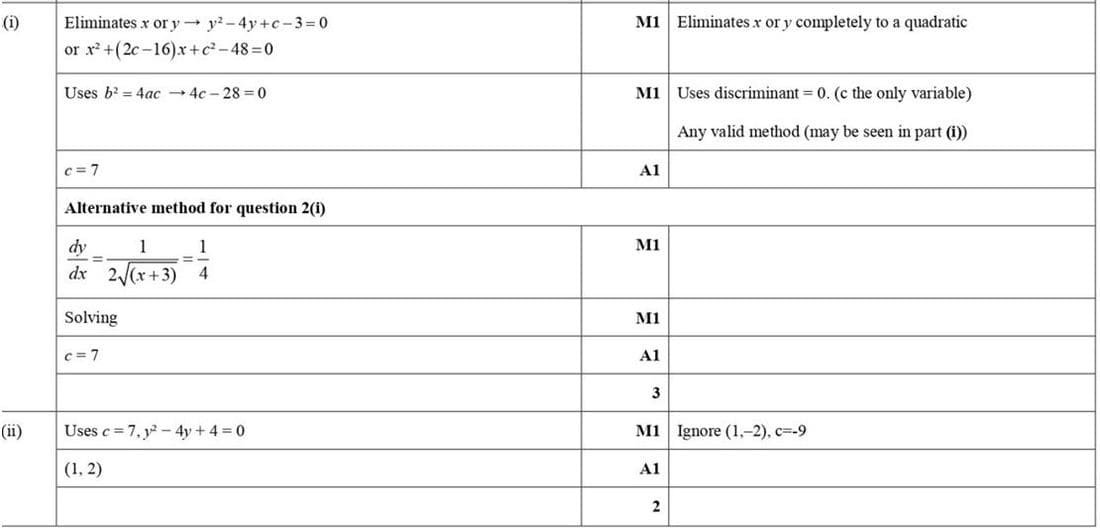
The line \(4y = x + c\), where \(c\) is a constant, is a tangent to the curve \(y^2 = x + 3\) at the point \(P\) on the curve.
(i) Find the value of \(c\).
(ii) Find the coordinates of \(P\).
9709 P13 - Nov 2018 - Q9 - 8 marks
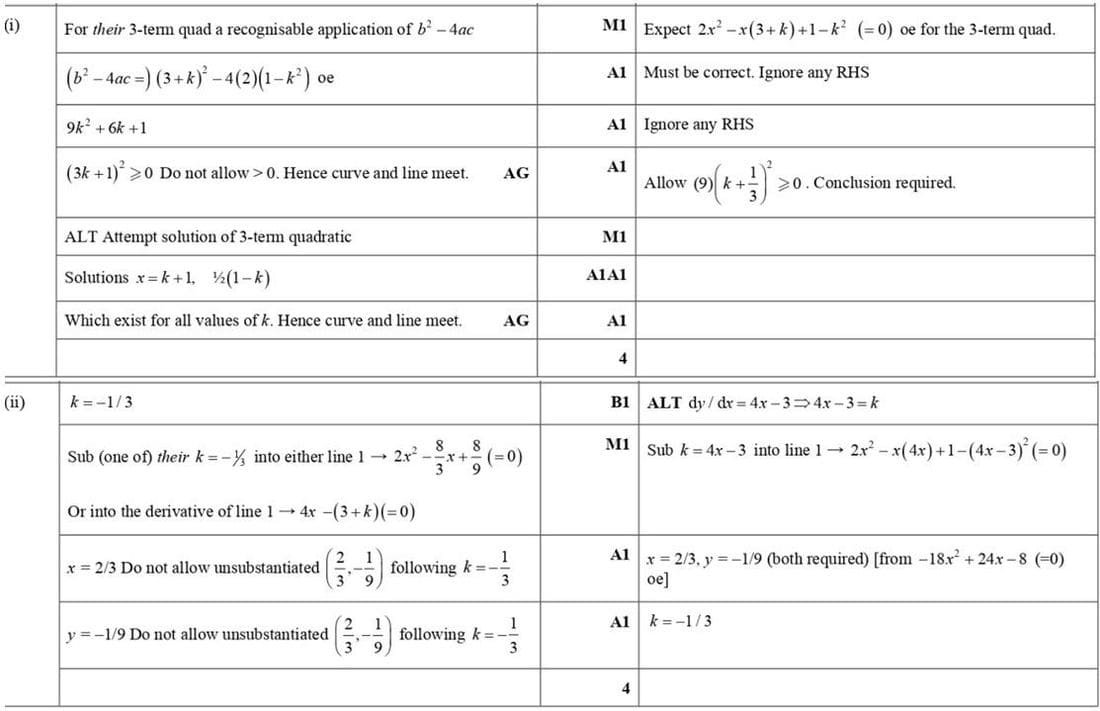
A curve has equation \(y = 2x^2 - 3x + 1\) and a line has equation \(y = kx + k^2\), where \(k\) is a constant.
(i) Show that, for all values of \(k\), the curve and the line meet. [4]
(ii) State the value of \(k\) for which the line is a tangent to the curve and find the coordinates of the point where the line touches the curve. [4]
9709 P12 - Nov 2018 - Q10I - 3 marks
The equation of a curve is \(y = 2x + \frac{12}{x}\) and the equation of a line is \(y + x = k\), where \(k\) is a constant.
Find the set of values of \(k\) for which the line does not meet the curve.

9709 P11 - Nov 2018 - Q2 - 4 marks
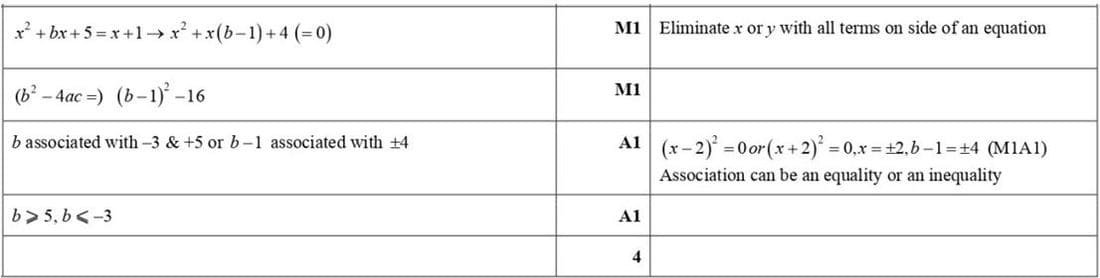
A line has equation \(y = x + 1\) and a curve has equation \(y = x^2 + bx + 5\). Find the set of values of the constant \(b\) for which the line meets the curve.
9709 P12 - Jun 2018 - Q2 - 5 marks
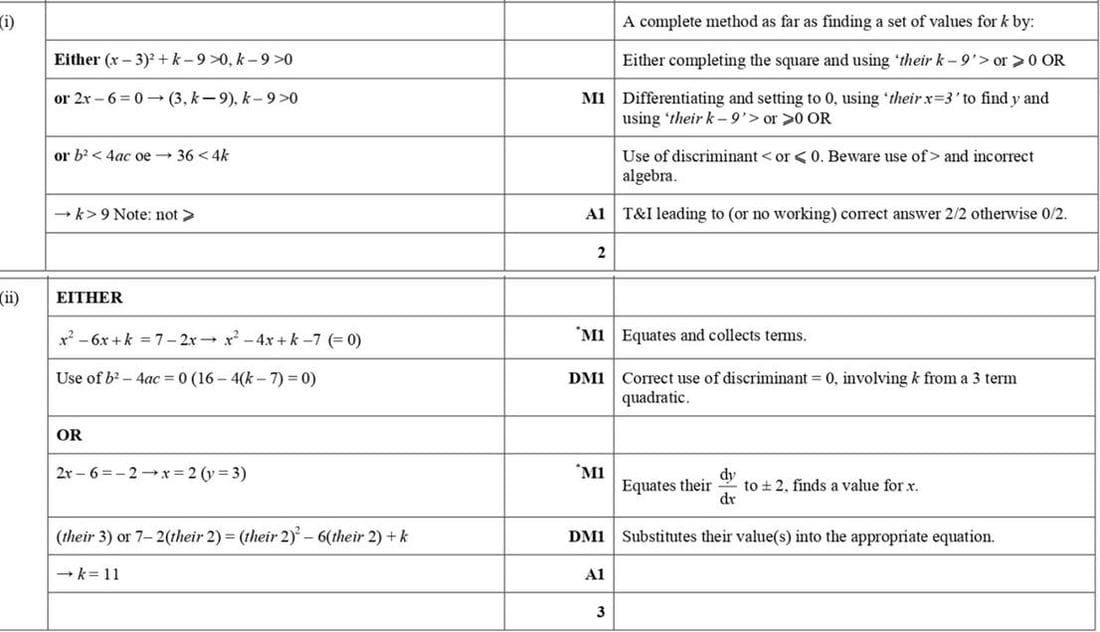
The equation of a curve is \(y = x^2 - 6x + k\), where \(k\) is a constant.
(i) Find the set of values of \(k\) for which the whole of the curve lies above the \(x\)-axis.
(ii) Find the value of \(k\) for which the line \(y + 2x = 7\) is a tangent to the curve.
9709 P13 - Nov 2017 - Q2 - 4 marks
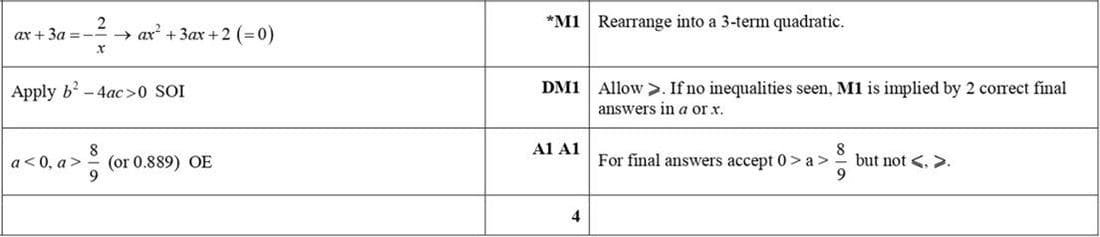
Find the set of values of a for which the curve \(y = -\frac{2}{x}\) and the straight line \(y = ax + 3a\) meet at two distinct points.
9709 P12 - Mar 2017 - Q1 - 4 marks
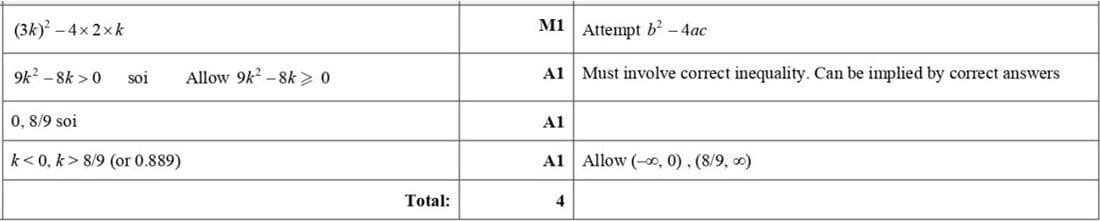
Find the set of values of k for which the equation \(2x^2 + 3kx + k = 0\) has distinct real roots.
9709 P13 - Nov 2016 - Q1 - 3 marks
Find the set of values of k for which the curve y = kx^2 - 3x and the line y = x - k do not meet.

9709 P12 - Nov 2016 - Q3II - 3 marks
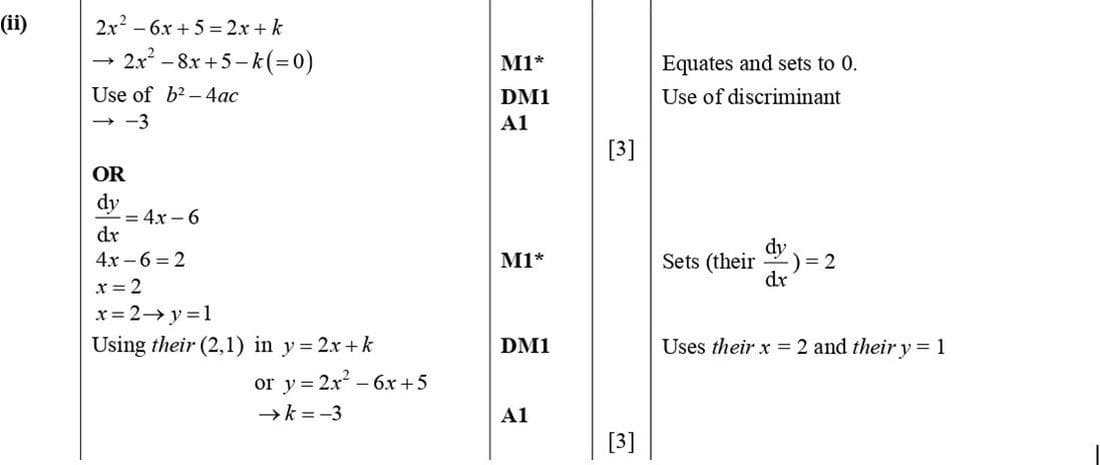
A curve has equation \(y = 2x^2 - 6x + 5\). Find the value of the constant \(k\) for which the line \(y = 2x + k\) is a tangent to the curve.
9709 P12 - Jun 2016 - Q11II - 3 marks
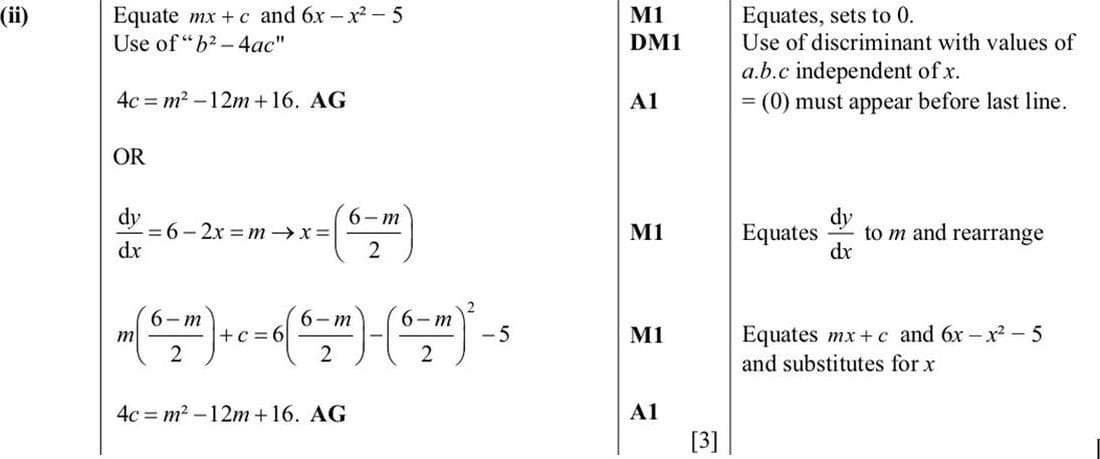
The function \(f\) is defined by \(f : x \mapsto 6x - x^2 - 5\) for \(x \in \mathbb{R}\).
Given that the line \(y = mx + c\) is a tangent to the curve \(y = f(x)\), show that \(4c = m^2 - 12m + 16\).
9709 P11 - Jun 2023 - Q5 - 5 marks
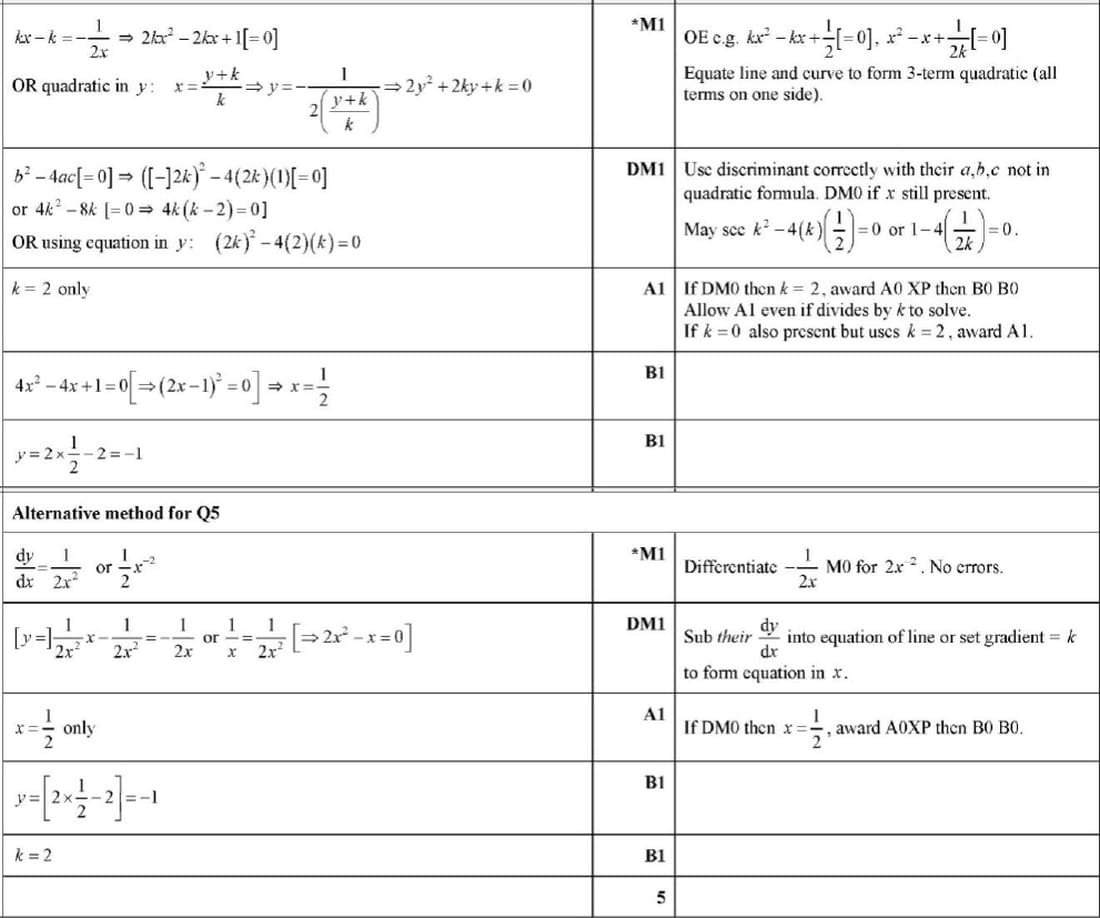
The line with equation \(y = kx - k\), where \(k\) is a positive constant, is a tangent to the curve with equation \(y = -\frac{1}{2x}\).
Find, in either order, the value of \(k\) and the coordinates of the point where the tangent meets the curve.
9709 P11 - Jun 2016 - Q6A - 3 marks
Find the values of the constant m for which the line \(y = mx\) is a tangent to the curve \(y = 2x^2 - 4x + 8\).

9709 P13 - Nov 2015 - Q1 - 3 marks
A line has equation \(y = 2x - 7\) and a curve has equation \(y = x^2 - 4x + c\), where \(c\) is a constant. Find the set of possible values of \(c\) for which the line does not intersect the curve.

9709 P12 - Jun 2015 - Q11I - 3 marks
The function \(f\) is defined by \(f : x \mapsto 2x^2 - 6x + 5\) for \(x \in \mathbb{R}\).
Find the set of values of \(p\) for which the equation \(f(x) = p\) has no real roots.

9709 P11 - Nov 2014 - Q5 - 5 marks
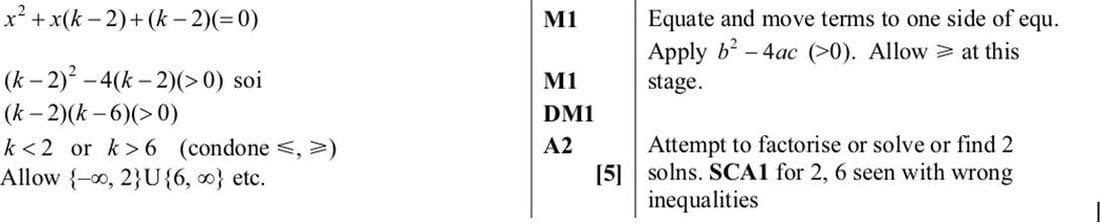
Find the set of values of k for which the line \(y = 2x - k\) meets the curve \(y = x^2 + kx - 2\) at two distinct points.
9709 P13 - Jun 2014 - Q8II - 4 marks
Find the set of values of k for which the equation \(2x^2 - 10x + 8 = kx\) has no real roots.

9709 P11 - Jun 2014 - Q11I - 3 marks
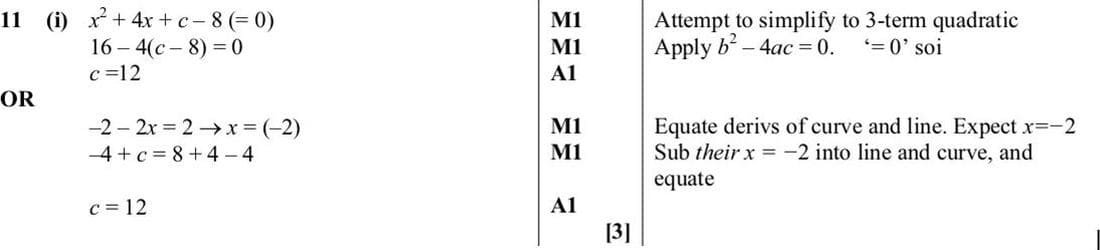
A line has equation \(y = 2x + c\) and a curve has equation \(y = 8 - 2x - x^2\). For the case where the line is a tangent to the curve, find the value of the constant \(c\).
9709 P12 - Jun 2013 - Q3 - 5 marks
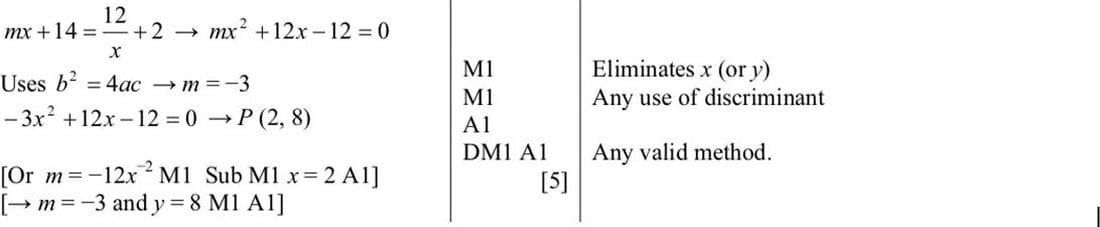
The straight line \(y = mx + 14\) is a tangent to the curve \(y = \frac{12}{x} + 2\) at the point \(P\). Find the value of the constant \(m\) and the coordinates of \(P\).