Past Exam Questions
← Back9709 P11 - Jun 2013 - Q7II - 5 marks
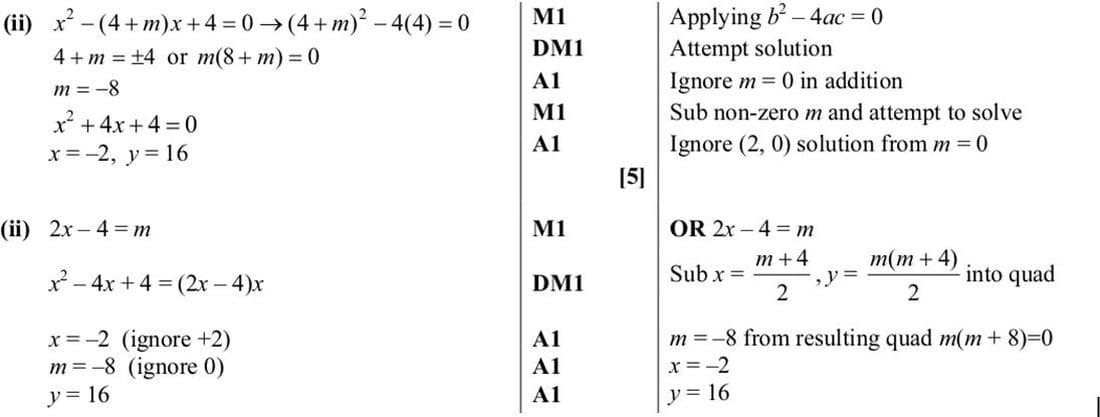
A curve has equation \(y = x^2 - 4x + 4\) and a line has equation \(y = mx\), where \(m\) is a constant.
Find the non-zero value of \(m\) for which the line is a tangent to the curve, and find the coordinates of the point where the tangent touches the curve.
9709 P12 - Nov 2012 - Q4 - 6 marks
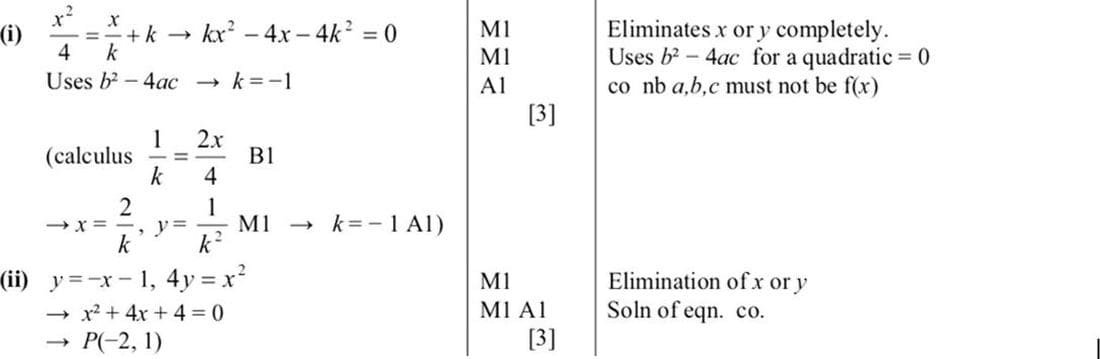
The line \(y = \frac{x}{k} + k\), where \(k\) is a constant, is a tangent to the curve \(4y = x^2\) at the point \(P\). Find
- the value of \(k\),
- the coordinates of \(P\).
9709 P13 - Jun 2012 - Q10II - 3 marks
Find the set of values of k for which the line 2y + x = k intersects the curve xy = 6 at two distinct points.

9709 P12 - Mar 2023 - Q1 - 4 marks
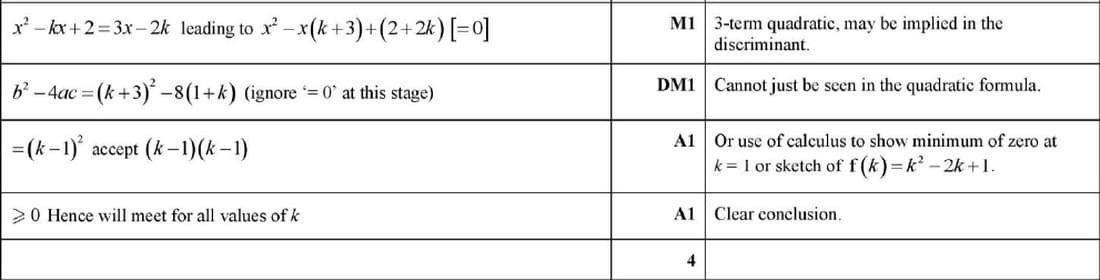
A line has equation \(y = 3x - 2k\) and a curve has equation \(y = x^2 - kx + 2\), where \(k\) is a constant.
Show that the line and the curve meet for all values of \(k\).
9709 P11 - Jun 2012 - Q5II - 2 marks
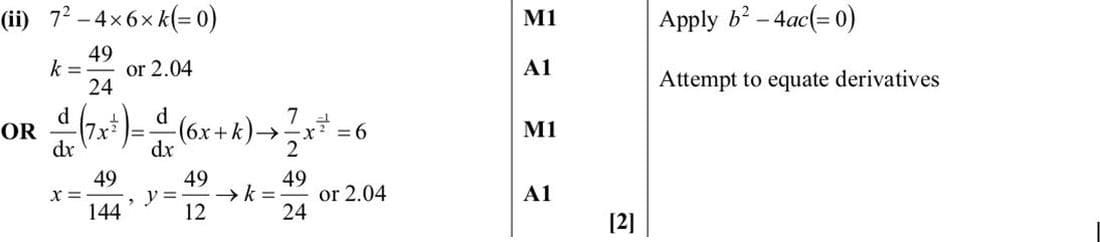
Find the value of k for which y = 6x + k is a tangent to the curve y = 7/√x.
9709 P13 - Nov 2011 - Q7 - 7 marks
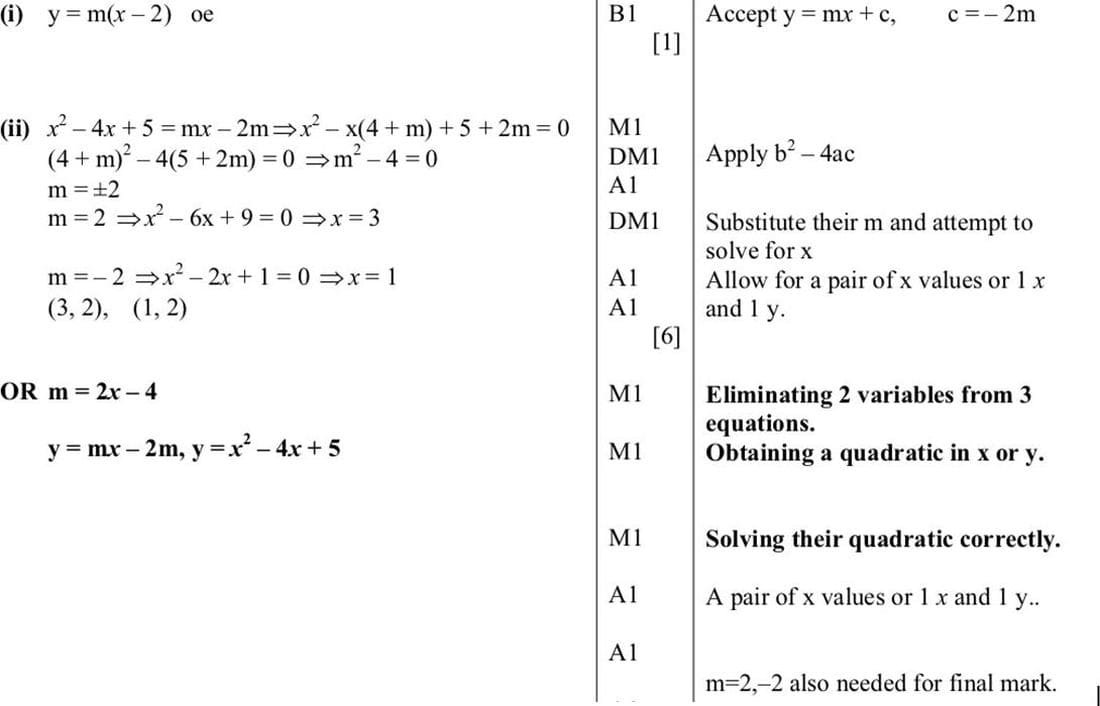
(i) A straight line passes through the point (2, 0) and has gradient m. Write down the equation of the line.
(ii) Find the two values of m for which the line is a tangent to the curve \(y = x^2 - 4x + 5\). For each value of m, find the coordinates of the point where the line touches the curve.
9709 P12 - Nov 2011 - Q4II - 3 marks
The equation of a curve is \(y^2 + 2x = 13\) and the equation of a line is \(2y + x = k\), where \(k\) is a constant. Find the value of \(k\) for which the line is a tangent to the curve.

9709 P11 - Nov 2011 - Q9II - 4 marks
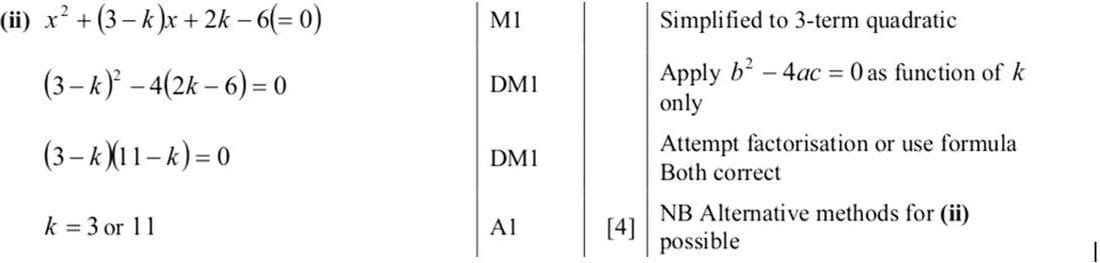
A line has equation \(y = kx + 6\) and a curve has equation \(y = x^2 + 3x + 2k\), where \(k\) is a constant. Find the two values of \(k\) for which the line is a tangent to the curve.
9709 P13 - Jun 2011 - Q2 - 5 marks
Find the set of values of m for which the line \(y = mx + 4\) intersects the curve \(y = 3x^2 - 4x + 7\) at two distinct points.

9709 P12 - Jun 2011 - Q3 - 5 marks
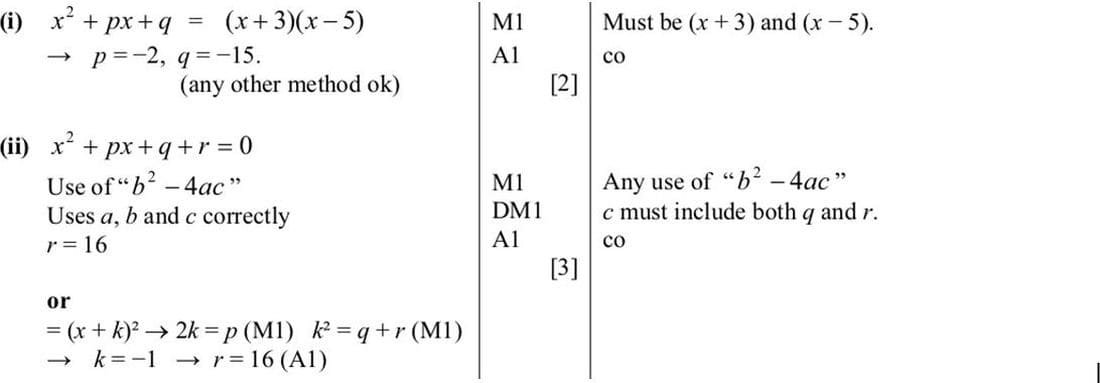
The equation \(x^2 + px + q = 0\), where \(p\) and \(q\) are constants, has roots \(-3\) and \(5\).
(i) Find the values of \(p\) and \(q\).
(ii) Using these values of \(p\) and \(q\), find the value of the constant \(r\) for which the equation \(x^2 + px + q + r = 0\) has equal roots.
9709 P12 - Nov 2010 - Q6 - 7 marks
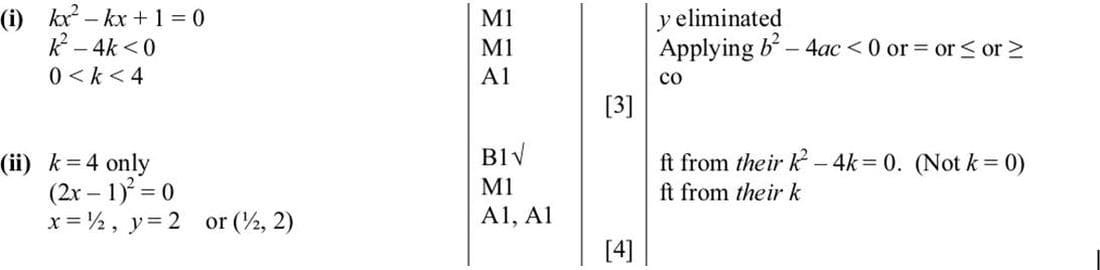
A curve has equation \(y = kx^2 + 1\) and a line has equation \(y = kx\), where \(k\) is a non-zero constant.
(i) Find the set of values of \(k\) for which the curve and the line have no common points. [3]
(ii) State the value of \(k\) for which the line is a tangent to the curve and, for this case, find the coordinates of the point where the line touches the curve. [4]
9709 P11 - Nov 2010 - Q11III - 4 marks
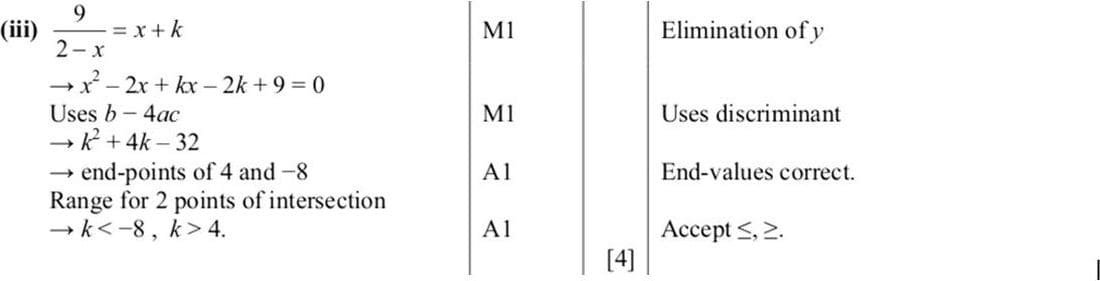
The equation of a curve is \(y = \frac{9}{2-x}\).
Find the set of values of \(k\) for which the line \(y = x + k\) intersects the curve at two distinct points.
9709 P13 - Jun 2010 - Q10I - 4 marks
The function \(f : x \mapsto 2x^2 - 8x + 14\) is defined for \(x \in \mathbb{R}\). Find the values of the constant \(k\) for which the line \(y + kx = 12\) is a tangent to the curve \(y = f(x)\).

9709 P12 - Nov 2009 - Q10II - 4 marks
Determine the set of values of k for which the line 2y = x + k does not intersect the curve \(y = x^2 - 4x + 7\).

9709 P12 - Nov 2022 - Q3A - 2 marks
Find the set of values of k for which the equation \(8x^2 + kx + 2 = 0\) has no real roots.

9709 P1 - Jun 2009 - Q2 - 4 marks
Find the set of values of k for which the line \(y = kx - 4\) intersects the curve \(y = x^2 - 2x\) at two distinct points.

9709 P1 - Nov 2007 - Q1
Determine the set of values of the constant k for which the line y = 4x + k does not intersect the curve y = x2.
9709 P1 - Jun 2021 - Q1
Find the value of the constant c for which the line y = 2x + c is a tangent to the curve y2 = 4x.
9709 P1 - Nov 2005 - Q9
The equation of a curve is \(xy = 12\) and the equation of a line \(l\) is \(2x + y = k\), where \(k\) is a constant.
Find the set of values of \(k\) for which \(l\) does not intersect the curve.
9709 P12 - Jun 2022 - Q5
The equation of a curve is \(y = 4x^2 - kx + \frac{1}{2}k^2\) and the equation of a line is \(y = x - a\), where \(k\) and \(a\) are constants.
Given instead that \(a = -\frac{7}{2}\), find the values of \(k\) for which the line is a tangent to the curve.