The equation \(x^2 + px + q = 0\), where \(p\) and \(q\) are constants, has roots \(-3\) and \(5\).
(i) Find the values of \(p\) and \(q\).
(ii) Using these values of \(p\) and \(q\), find the value of the constant \(r\) for which the equation \(x^2 + px + q + r = 0\) has equal roots.
Solution
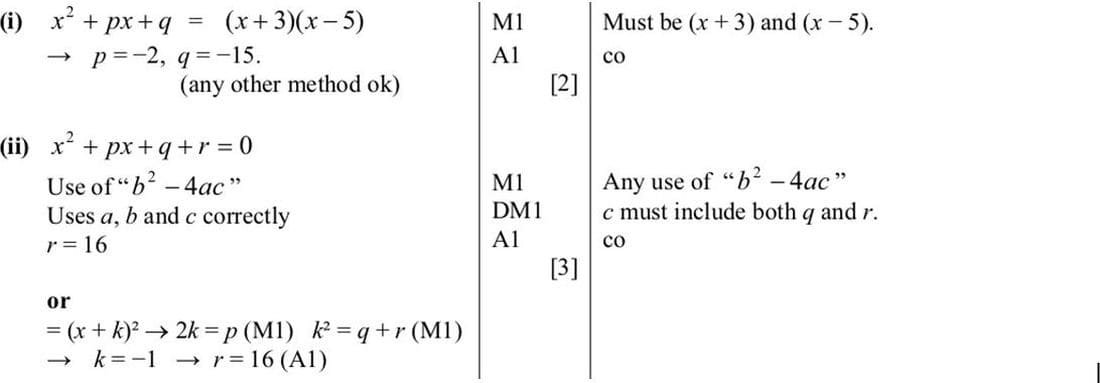
(i) Since the roots of the equation are \(-3\) and \(5\), we can express the quadratic as \((x + 3)(x - 5) = 0\).
Expanding this, we get:
\(x^2 - 5x + 3x - 15 = x^2 - 2x - 15\).
Thus, \(p = -2\) and \(q = -15\).
(ii) For the equation \(x^2 + px + q + r = 0\) to have equal roots, the discriminant must be zero.
The discriminant \(b^2 - 4ac = 0\).
Here, \(a = 1\), \(b = p = -2\), and \(c = q + r = -15 + r\).
So, \((-2)^2 - 4(1)(-15 + r) = 0\).
\(4 - 4(-15 + r) = 0\).
\(4 + 60 - 4r = 0\).
\(64 = 4r\).
\(r = 16\).
Log in to record attempts.