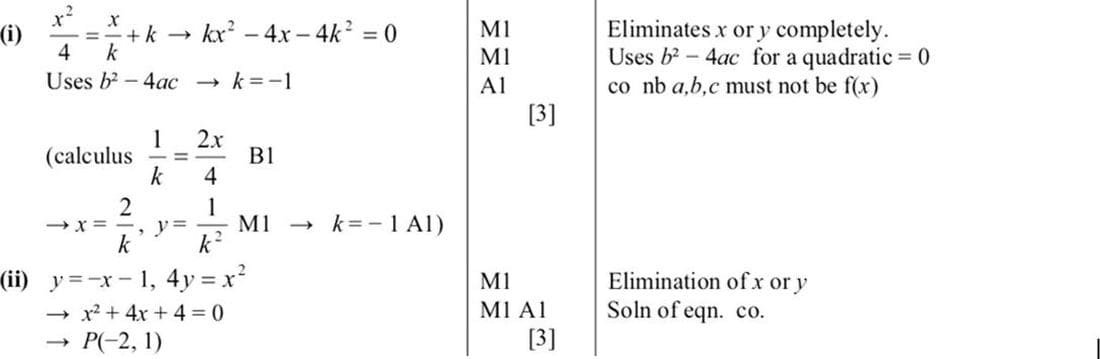
(i) To find the value of \(k\), we equate the line and the curve:
\(\frac{x^2}{4} = \frac{x}{k} + k\)
Rearranging gives:
\(kx^2 - 4x - 4k^2 = 0\)
For the line to be tangent, the discriminant must be zero:
\(b^2 - 4ac = 0\)
Substituting \(a = k\), \(b = -4\), \(c = -4k^2\), we get:
\((-4)^2 - 4(k)(-4k^2) = 0\)
\(16 + 16k^3 = 0\)
\(k^3 = -1\)
\(k = -1\)
(ii) Substitute \(k = -1\) into the line equation:
\(y = -x - 1\)
Substitute into the curve equation \(4y = x^2\):
\(4(-x - 1) = x^2\)
\(x^2 + 4x + 4 = 0\)
\((x + 2)^2 = 0\)
\(x = -2\)
Substitute \(x = -2\) back into \(y = -x - 1\):
\(y = -(-2) - 1 = 1\)
Thus, the coordinates of \(P\) are \((-2, 1)\).