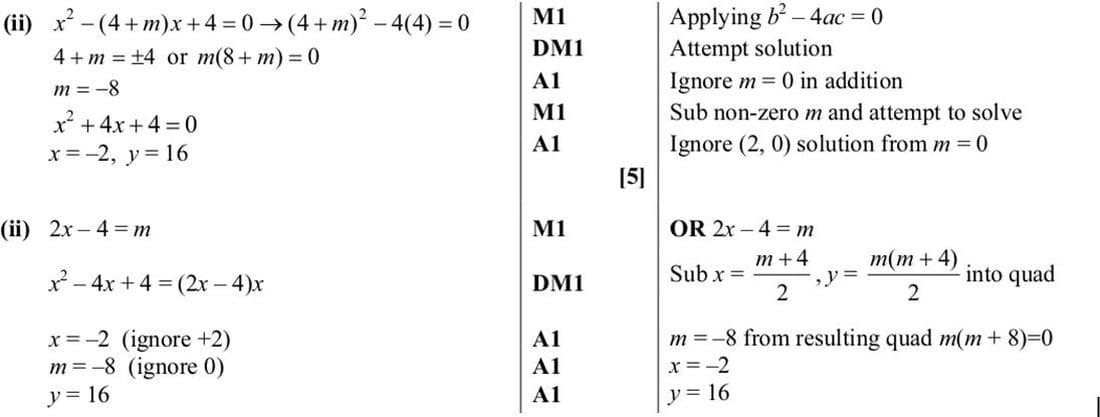
To find the value of \(m\) for which the line is tangent to the curve, we set the equations equal: \(x^2 - 4x + 4 = mx\).
Rearrange to form a quadratic equation: \(x^2 - (4 + m)x + 4 = 0\).
For the line to be tangent, the discriminant must be zero: \(b^2 - 4ac = 0\).
Here, \(a = 1\), \(b = -(4 + m)\), \(c = 4\).
Calculate the discriminant: \((4 + m)^2 - 4(1)(4) = 0\).
Simplify: \((4 + m)^2 - 16 = 0\).
\((4 + m)^2 = 16\).
\(4 + m = \\pm 4\).
Solving gives \(m = 0\) or \(m = -8\).
Since \(m\) must be non-zero, \(m = -8\).
Substitute \(m = -8\) back into the quadratic: \(x^2 + 4x + 4 = 0\).
Factor: \((x + 2)^2 = 0\).
\(x = -2\).
Substitute \(x = -2\) into the curve equation to find \(y\):
\(y = (-2)^2 - 4(-2) + 4 = 4 + 8 + 4 = 16\).
Thus, the coordinates are \((-2, 16)\).