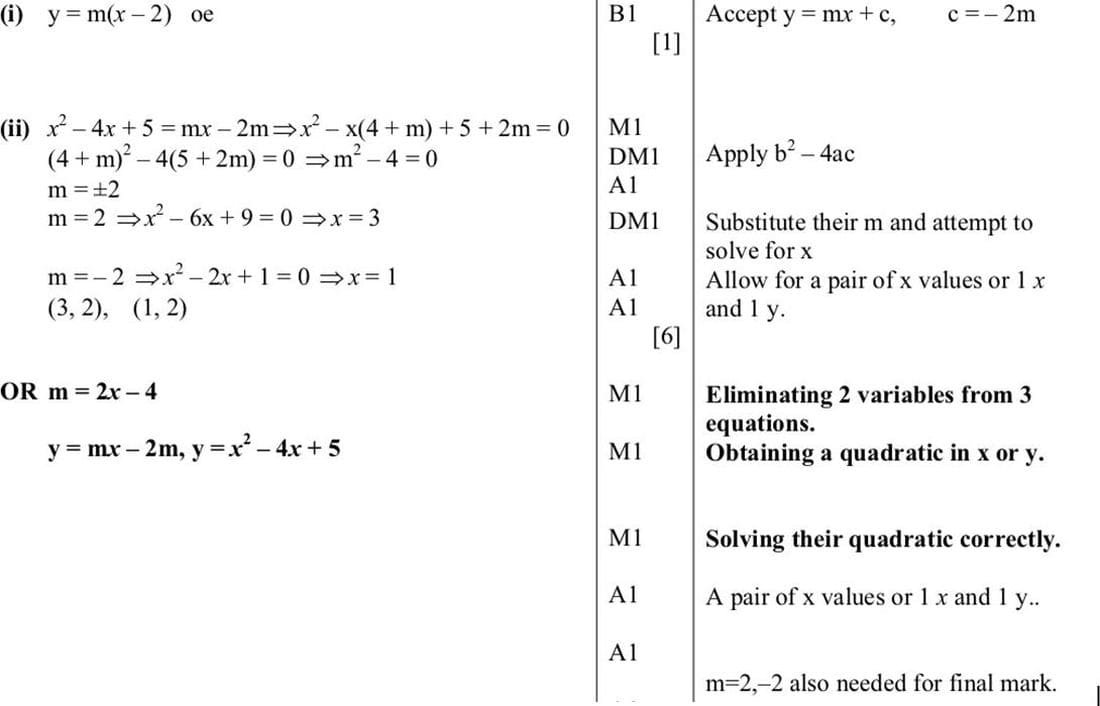
(i) The equation of a line with gradient \(m\) passing through the point \((2, 0)\) is given by the point-slope form:
\(y - 0 = m(x - 2)\)
Thus, the equation is \(y = m(x - 2)\).
(ii) To find the values of \(m\) for which the line is tangent to the curve \(y = x^2 - 4x + 5\), equate the line equation \(y = mx - 2m\) to the curve:
\(x^2 - 4x + 5 = mx - 2m\)
Rearrange to form a quadratic equation:
\(x^2 - (4 + m)x + (5 + 2m) = 0\)
For the line to be tangent, the discriminant must be zero:
\(b^2 - 4ac = 0\)
\((4 + m)^2 - 4(5 + 2m) = 0\)
\(m^2 - 4 = 0\)
Solving gives \(m = \pm 2\).
For \(m = 2\):
\(x^2 - 6x + 9 = 0\)
\((x - 3)^2 = 0\)
\(x = 3\)
Substitute \(x = 3\) into \(y = 2(x - 2)\):
\(y = 2(3 - 2) = 2\)
Point is (3, 2).
For \(m = -2\):
\(x^2 - 2x + 1 = 0\)
\((x - 1)^2 = 0\)
\(x = 1\)
Substitute \(x = 1\) into \(y = -2(x - 2)\):
\(y = -2(1 - 2) = 2\)
Point is (1, 2).