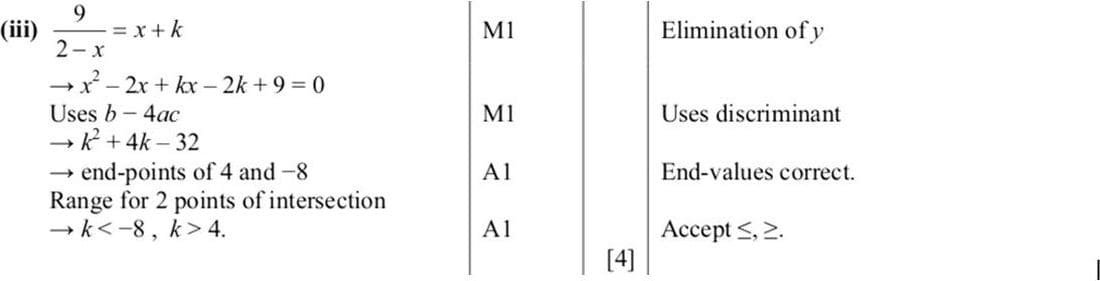
To find the intersection points, set the equations equal: \(\frac{9}{2-x} = x + k\).
Multiply both sides by \(2-x\) to eliminate the fraction: \(9 = (x + k)(2-x)\).
Expand and rearrange: \(x^2 - 2x + kx - 2k + 9 = 0\).
This simplifies to \(x^2 + (k-2)x + (9-2k) = 0\).
For two distinct points, the discriminant \(b^2 - 4ac\) must be greater than zero.
Here, \(a = 1\), \(b = k-2\), \(c = 9-2k\).
Calculate the discriminant: \((k-2)^2 - 4(1)(9-2k) > 0\).
Simplify: \(k^2 - 4k + 4 - 36 + 8k > 0\).
Further simplify: \(k^2 + 4k - 32 > 0\).
Factorize: \((k+8)(k-4) > 0\).
The solution to this inequality is \(k < -8\) or \(k > 4\).