Past Exam Questions
← Back9709 P12 - Mar 2022 - Q2
A curve has equation \(y = x^2 + 2cx + 4\) and a straight line has equation \(y = 4x + c\), where \(c\) is a constant.
Find the set of values of \(c\) for which the curve and line intersect at two distinct points.
9709 P11 - Nov 2021 - Q2
A curve has equation \(y = kx^2 + 2x - k\) and a line has equation \(y = kx - 2\), where \(k\) is a constant.
Find the set of values of \(k\) for which the curve and line do not intersect.
9709 P12 - Jun 2021 - Q1
It is given that the equation \(16x^2 - 24x + 10 = k\), where \(k\) is a constant, has exactly one root.
Find the value of this root.
9709 P52 - Nov 2023 - Q4
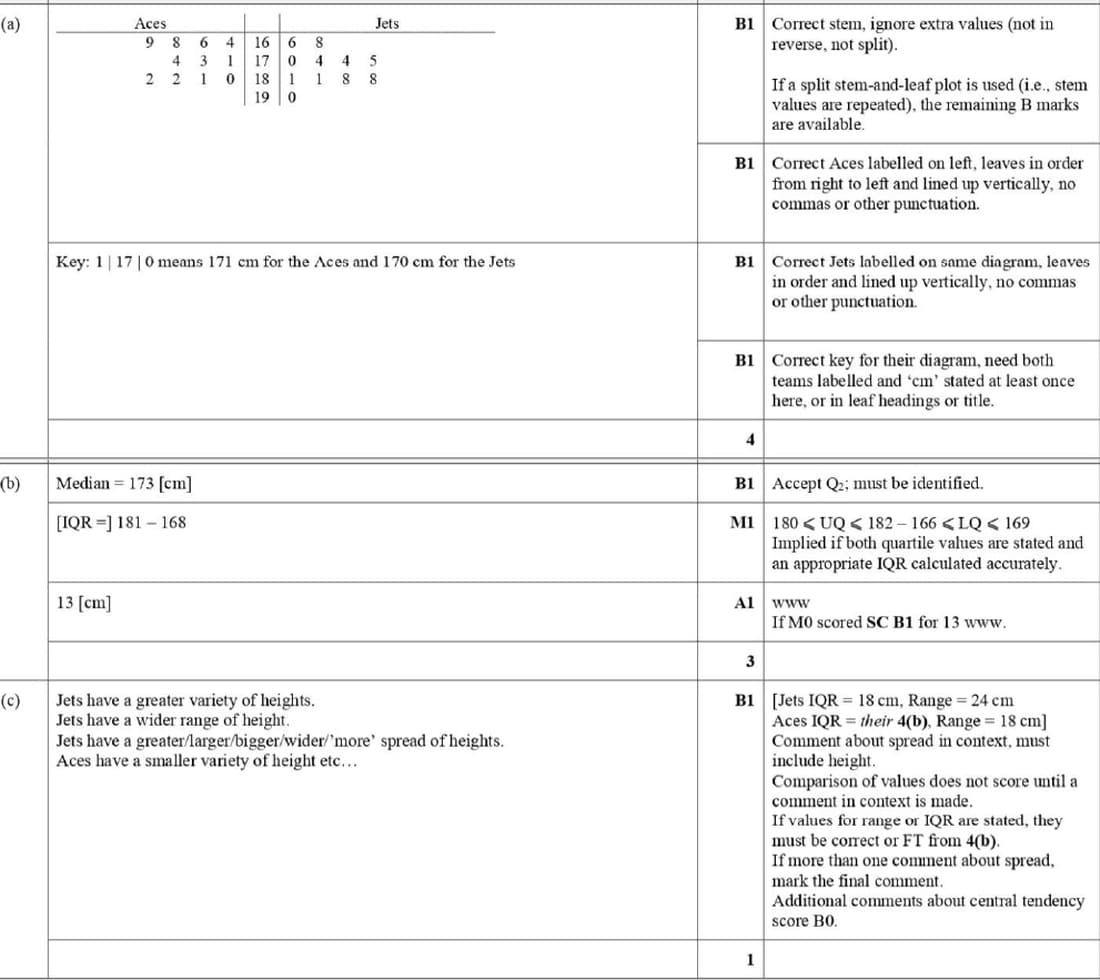
The heights, in cm, of the 11 players in each of two teams, the Aces and the Jets, are shown in the following table.
| Aces | 180 | 174 | 169 | 182 | 181 | 166 | 173 | 182 | 168 | 171 | 164 |
|---|---|---|---|---|---|---|---|---|---|---|---|
| Jets | 175 | 174 | 188 | 168 | 166 | 174 | 181 | 181 | 170 | 188 | 190 |
- Draw a back-to-back stem-and-leaf diagram to represent this information with the Aces on the left-hand side of the diagram.
- Find the median and the interquartile range of the heights of the players in the Aces.
- Give one comment comparing the spread of the heights of the Aces with the spread of the heights of the Jets.
9709 P63 - Nov 2018 - Q7
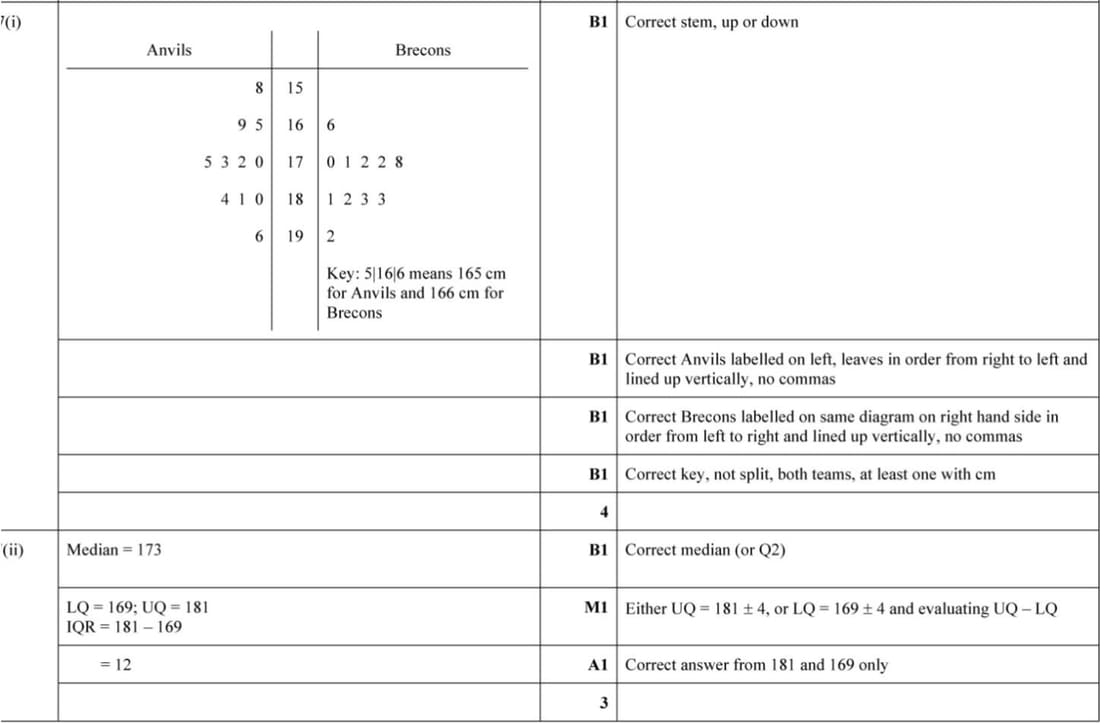
The heights, in cm, of the 11 members of the Anvils athletics team and the 11 members of the Brecons swimming team are shown below.
| Anvils | 173 | 158 | 180 | 196 | 175 | 165 | 170 | 169 | 181 | 184 | 172 |
|---|---|---|---|---|---|---|---|---|---|---|---|
| Brecons | 166 | 170 | 171 | 172 | 178 | 181 | 182 | 183 | 183 | 192 |
- Draw a back-to-back stem-and-leaf diagram to represent this information, with Anvils on the left-hand side of the diagram and Brecons on the right-hand side.
- Find the median and the interquartile range for the heights of the Anvils.
9709 P63 - Nov 2017 - Q5
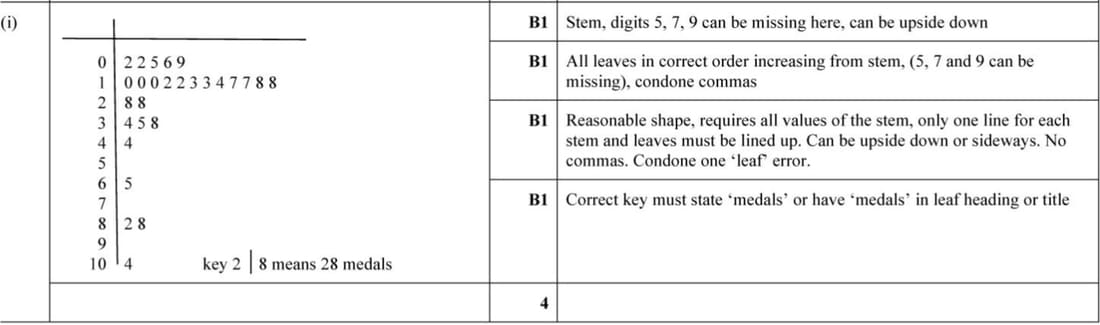
The number of Olympic medals won in the 2012 Olympic Games by the top 27 countries is shown below.
104, 88, 82, 65, 44, 38, 35, 34, 28, 28, 18, 18, 17, 17, 14, 13, 13, 12, 12, 10, 10, 10, 9, 6, 5, 2, 2
Draw a stem-and-leaf diagram to illustrate the data.
9709 P61 - Nov 2016 - Q7
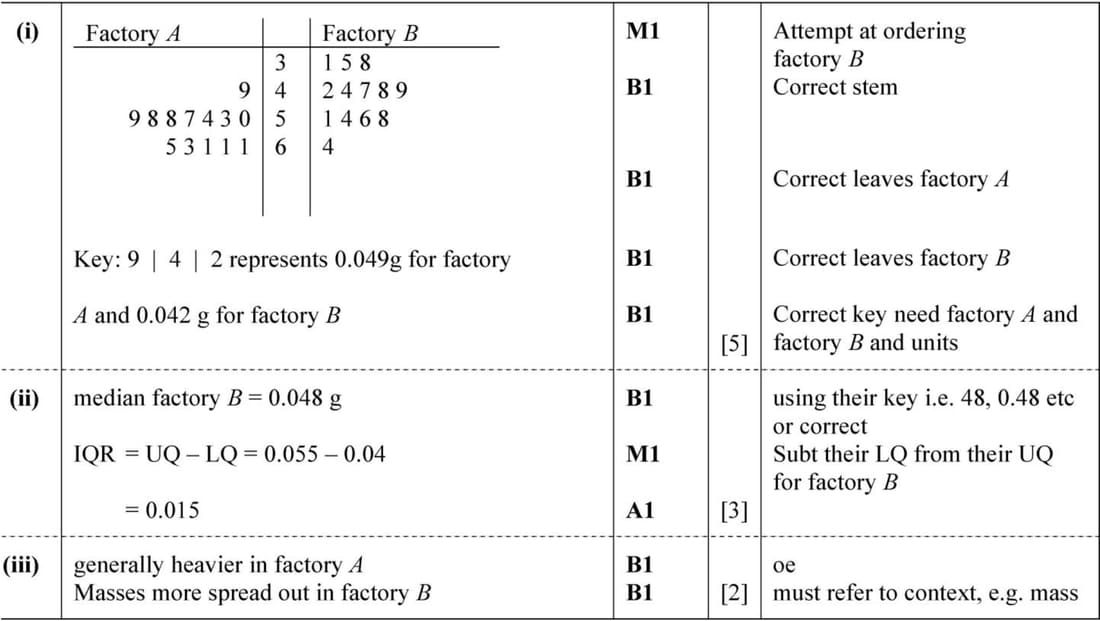
The masses, in grams, of components made in factory A and components made in factory B are shown below.
Factory A
| 0.049 | 0.050 | 0.053 | 0.054 | 0.057 | 0.058 | 0.058 |
| 0.059 | 0.061 | 0.061 | 0.061 | 0.063 | 0.065 |
Factory B
| 0.031 | 0.056 | 0.049 | 0.044 | 0.038 | 0.048 | 0.051 |
| 0.064 | 0.035 | 0.042 | 0.047 | 0.054 | 0.058 |
(i) Draw a back-to-back stem-and-leaf diagram to represent the masses of components made in the two factories.
(ii) Find the median and the interquartile range for the masses of components made in factory B.
(iii) Make two comparisons between the masses of components made in factory A and the masses of those made in factory B.
9709 P62 - Jun 2016 - Q5
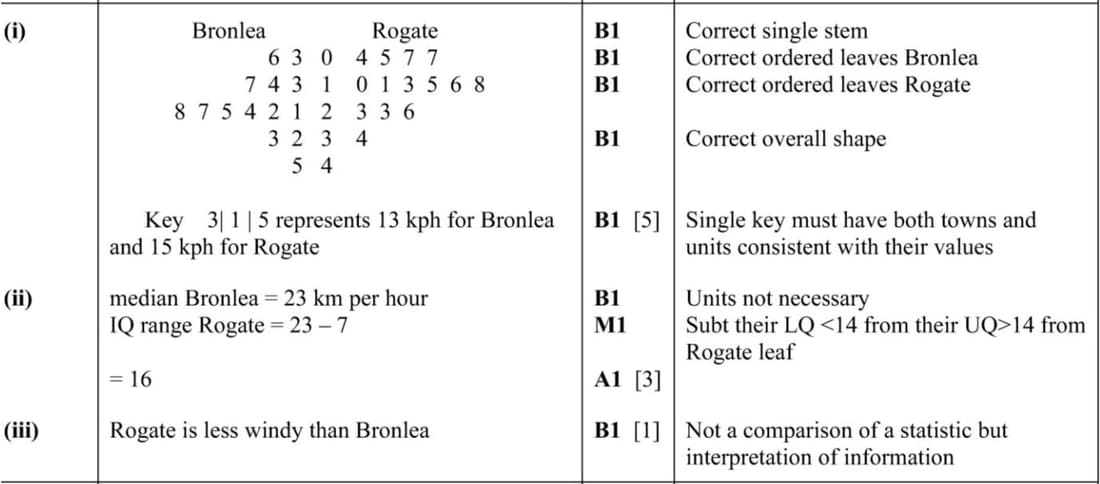
The following are the maximum daily wind speeds in kilometres per hour for the first two weeks in April for two towns, Bronlea and Rogate.
| Bronlea | 21 | 45 | 6 | 33 | 27 | 3 | 32 | 14 | 28 | 24 | 13 | 17 | 25 | 22 |
|---|---|---|---|---|---|---|---|---|---|---|---|---|---|---|
| Rogate | 7 | 5 | 4 | 15 | 23 | 7 | 11 | 13 | 26 | 18 | 23 | 16 | 10 | 34 |
- Draw a back-to-back stem-and-leaf diagram to represent this information.
- Write down the median of the maximum wind speeds for Bronlea and find the interquartile range for Rogate.
- Use your diagram to make one comparison between the maximum wind speeds in the two towns.
9709 P62 - Nov 2015 - Q5
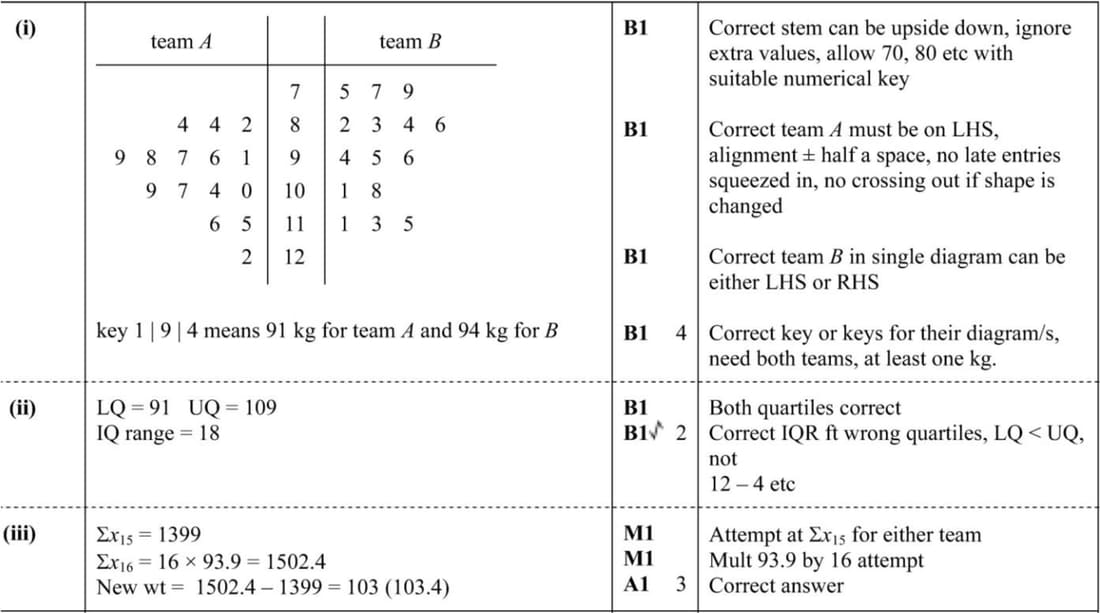
The weights, in kilograms, of the 15 rugby players in each of two teams, A and B, are shown below.
| Team A | 97 | 98 | 104 | 84 | 100 | 109 | 115 | 99 | 122 | 82 | 116 | 96 | 84 | 107 | 91 |
|---|---|---|---|---|---|---|---|---|---|---|---|---|---|---|---|
| Team B | 75 | 79 | 94 | 101 | 96 | 77 | 111 | 108 | 83 | 84 | 86 | 115 | 82 | 113 | 95 |
- Represent the data by drawing a back-to-back stem-and-leaf diagram with team A on the left-hand side of the diagram and team B on the right-hand side.
- Find the interquartile range of the weights of the players in team A.
- A new player joins team B as a substitute. The mean weight of the 16 players in team B is now \(93.9\ \text{kg}\). Find the weight of the new player.
9709 P63 - Nov 2014 - Q4I
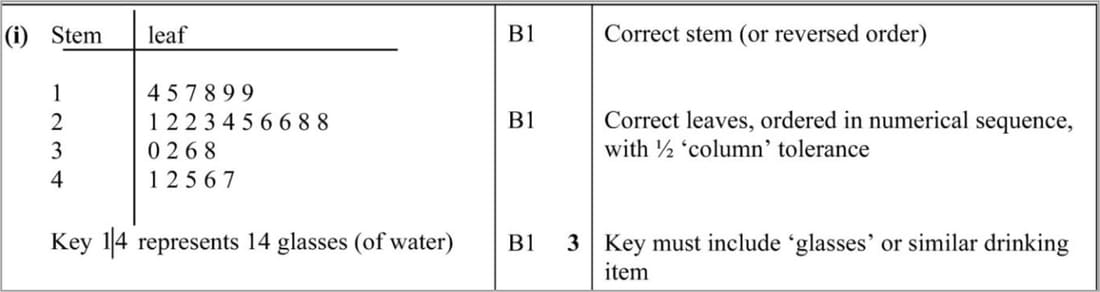
A random sample of 25 people recorded the number of glasses of water they drank in a particular week. The results are shown below.
23, 19, 32, 14, 25, 22, 26, 36, 45, 42, 47, 28, 17, 38, 15, 46, 18, 26, 22, 41, 19, 21, 28, 24, 30
Draw a stem-and-leaf diagram to represent the data.
9709 P63 - Jun 2014 - Q1
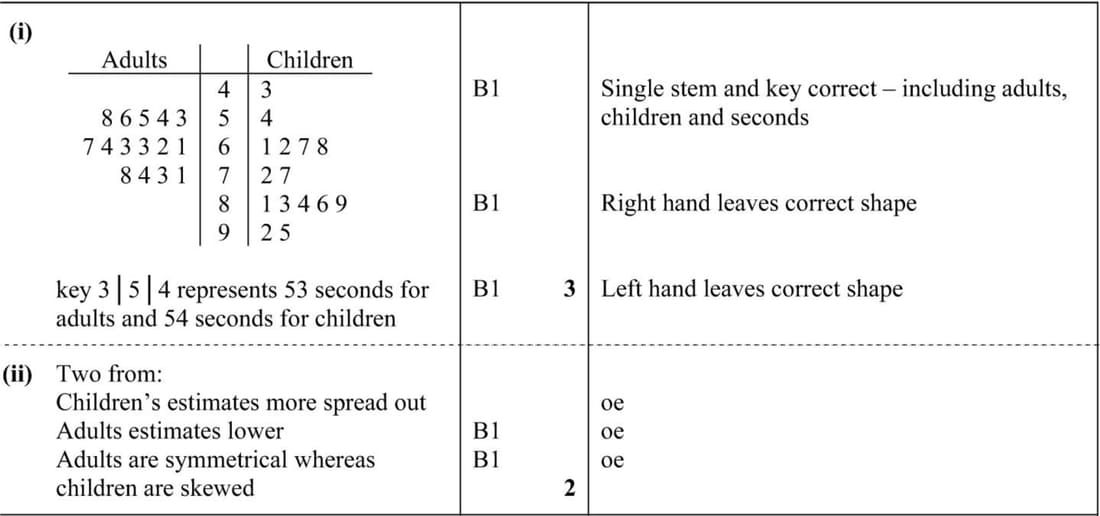
Some adults and some children each tried to estimate, without using a watch, the number of seconds that had elapsed in a fixed time-interval. Their estimates are shown below.
| Adults | 55 | 58 | 67 | 74 | 63 | 61 | 63 | 71 | 56 | 53 | 54 | 78 | 73 | 64 | 62 |
|---|---|---|---|---|---|---|---|---|---|---|---|---|---|---|---|
| Children | 86 | 95 | 89 | 72 | 61 | 84 | 77 | 92 | 81 | 54 | 43 | 68 | 62 | 67 | 83 |
- Draw a back-to-back stem-and-leaf diagram to represent the data.
- Make two comparisons between the estimates of the adults and the children.
9709 P62 - Jun 2013 - Q5
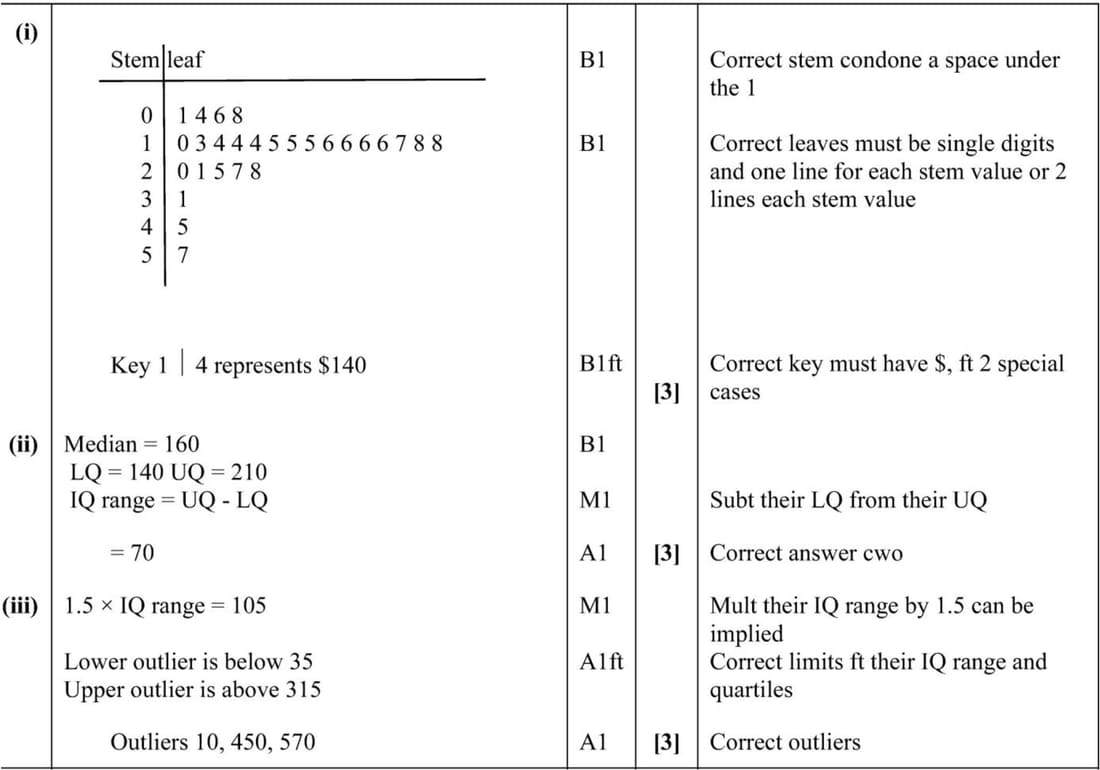
The following are the annual amounts of money spent on clothes, to the nearest $10, by 27 people.
| 10 | 40 | 60 | 80 | 100 | 130 | 140 | 140 | 140 |
| 150 | 150 | 150 | 160 | 160 | 160 | 160 | 170 | 180 |
| 180 | 200 | 210 | 250 | 270 | 280 | 310 | 450 | 570 |
- Construct a stem-and-leaf diagram for the data.
- Find the median and the interquartile range of the data.
- An ‘outlier’ is defined as any data value which is more than 1.5 times the interquartile range above the upper quartile, or more than 1.5 times the interquartile range below the lower quartile. List the outliers.
9709 P61 - Nov 2012 - Q4
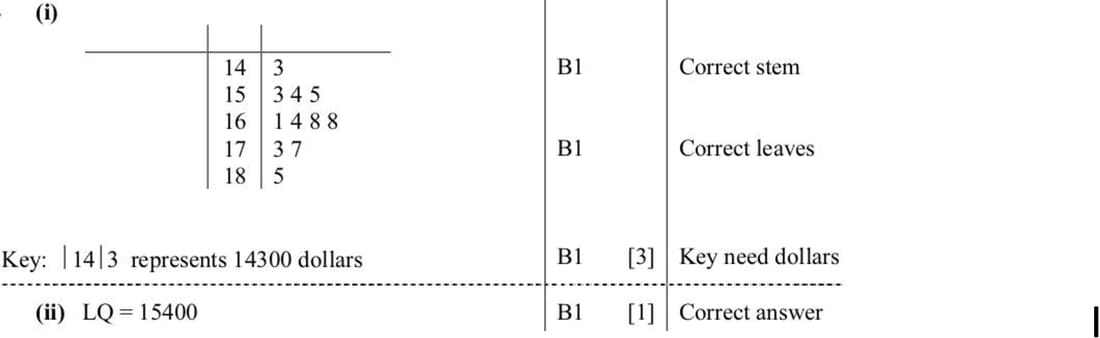
Prices in dollars of 11 caravans in a showroom are as follows.
16 800, 18 500, 17 700, 14 300, 15 500, 15 300, 16 100, 16 800, 17 300, 15 400, 16 400
(i) Represent these prices by a stem-and-leaf diagram.
(ii) Write down the lower quartile of the prices of the caravans in the showroom.
9709 P61 - Jun 2012 - Q5
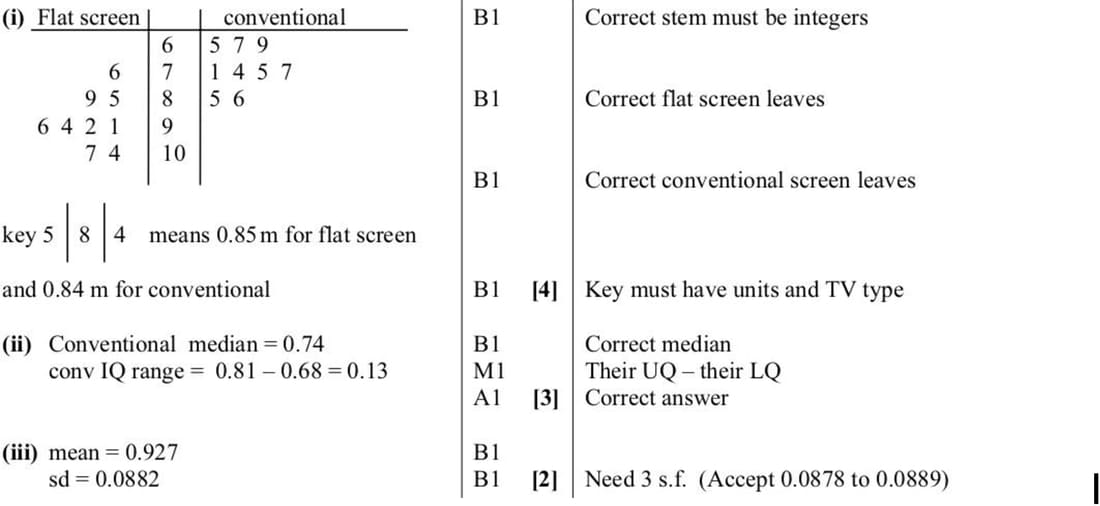
The lengths of the diagonals in metres of the 9 most popular flat screen TVs and the 9 most popular conventional TVs are shown below.
Flat screen: 0.85, 0.94, 0.91, 0.96, 1.04, 0.89, 1.07, 0.92, 0.76
Conventional: 0.69, 0.65, 0.85, 0.77, 0.74, 0.67, 0.71, 0.86, 0.75
- Represent this information on a back-to-back stem-and-leaf diagram.
- Find the median and the interquartile range of the lengths of the diagonals of the 9 conventional TVs.
- Find the mean and standard deviation of the lengths of the diagonals of the 9 flat screen TVs.
9709 P53 - Jun 2023 - Q4
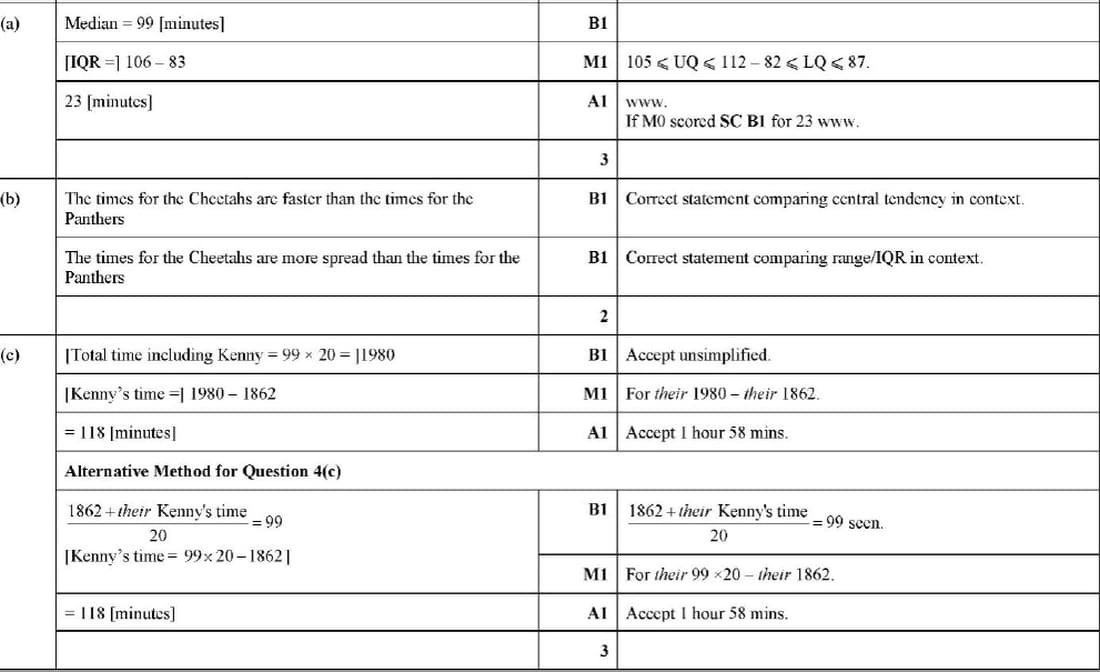
The times taken, in minutes, to complete a cycle race by 19 cyclists from each of two clubs, the Cheetahs and the Panthers, are represented in the following back-to-back stem-and-leaf diagram.
| Cheetahs | Panthers | |
|---|---|---|
| 9 8 | 7 | 4 |
| 8 7 3 2 0 | 8 | 6 8 |
| 9 8 7 | 9 | 1 7 8 8 9 9 |
| 6 5 3 3 | 10 | 2 3 4 4 5 6 |
| 9 8 2 | 11 | 1 2 8 |
| 4 | 12 | 0 6 |
Key: \( 7 \mid 9 \mid 1 \) means 97 minutes for Cheetahs and 91 minutes for Panthers.
(a) Find the median and the interquartile range of the times of the Cheetahs.
The median and interquartile range for the Panthers are 103 minutes and 14 minutes respectively.
(b) Make two comparisons between the times taken by the Cheetahs and the times taken by the Panthers.
Another cyclist, Kenny, from the Cheetahs also took part in the race. The mean time taken by the 20 cyclists from the Cheetahs was 99 minutes.
(c) Find the time taken by Kenny to complete the race.
9709 P62 - Nov 2010 - Q4
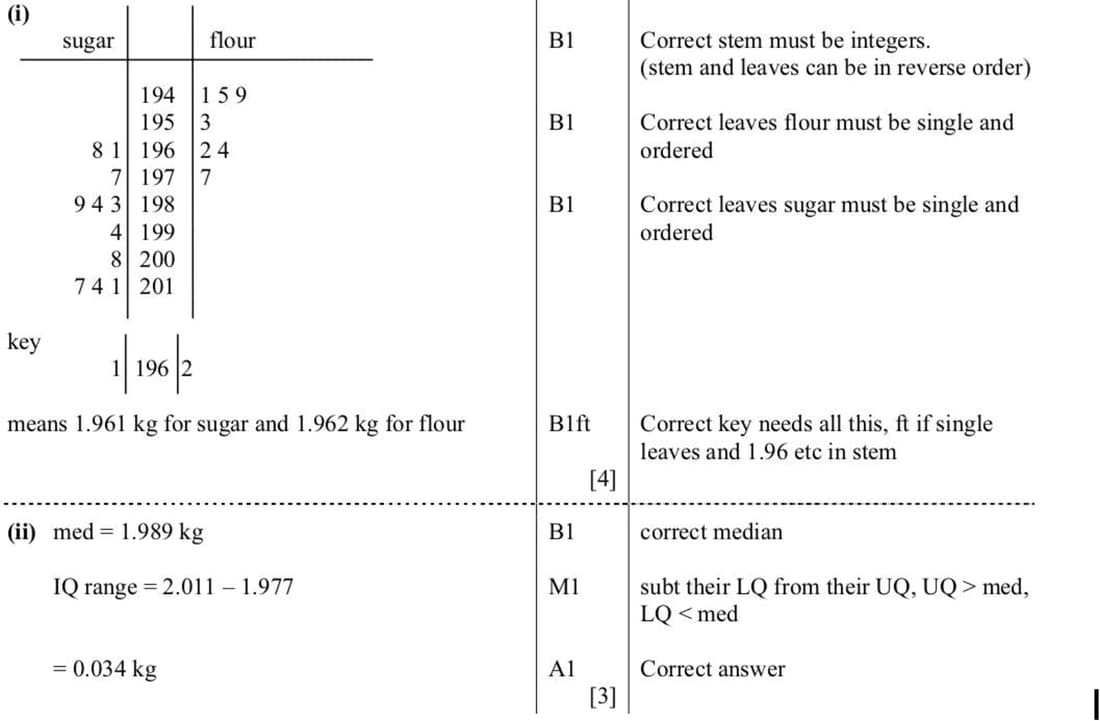
The weights in kilograms of 11 bags of sugar and 7 bags of flour are as follows:
Sugar: 1.961, 1.983, 2.008, 2.014, 1.968, 1.994, 2.011, 2.017, 1.977, 1.984, 1.989
Flour: 1.945, 1.962, 1.949, 1.977, 1.964, 1.941, 1.953
(i) Represent this information on a back-to-back stem-and-leaf diagram with sugar on the left-hand side.
(ii) Find the median and interquartile range of the weights of the bags of sugar.
9709 P61 - Jun 2010 - Q2
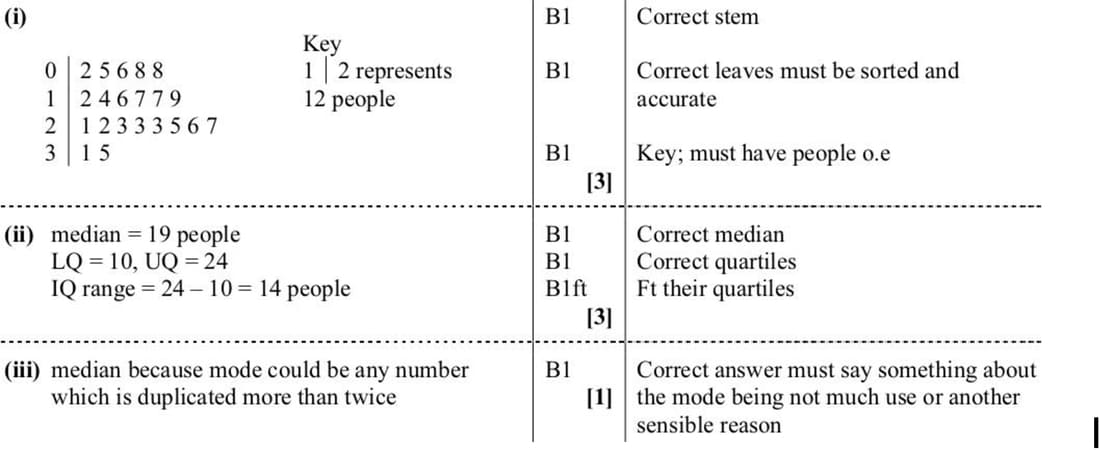
The numbers of people travelling on a certain bus at different times of the day are as follows.
17, 5, 2, 23, 16, 31, 8, 22, 14, 25, 35, 17, 27, 12, 6, 23, 19, 21, 23, 8, 26
(i) Draw a stem-and-leaf diagram to illustrate the information given above. [3]
(ii) Find the median, the lower quartile, the upper quartile and the interquartile range. [3]
(iii) State, in this case, which of the median and mode is preferable as a measure of central tendency, and why. [1]
9709 P6 - Nov 2008 - Q5
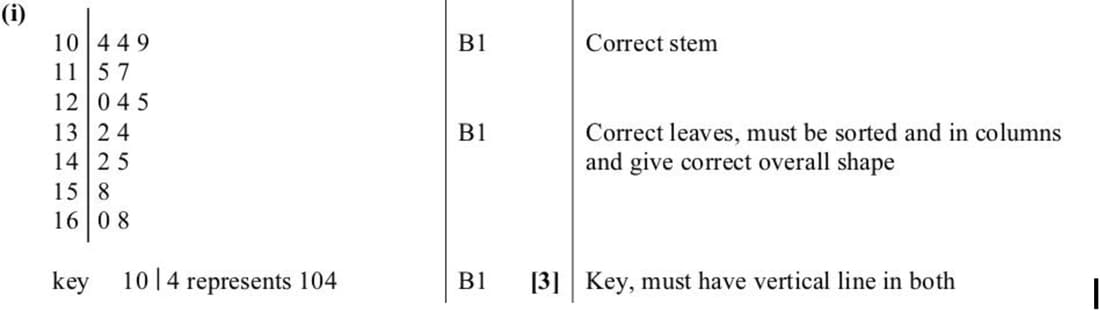
The pulse rates, in beats per minute, of a random sample of 15 small animals are shown in the following table.
115, 120, 158, 132, 125, 104, 142, 160, 145, 104, 162, 117, 109, 124, 134
Draw a stem-and-leaf diagram to represent the data.
9709 P6 - Jun 2008 - Q1
The stem-and-leaf diagram below represents data collected for the number of hits on an internet site on each day in March 2007. There is one missing value, denoted by \(x\).
Stem-and-leaf diagram:
| Stem | leaf | |
|---|---|---|
| 0 | 0 1 5 6 | (4) |
| 1 | 1 3 5 6 6 8 | (6) |
| 2 | 1 1 2 3 4 4 4 8 9 | (9) |
| 3 | 1 2 2 2 x 8 9 | (7) |
| 4 | 2 5 6 7 9 | (5) |
Key: \( 1 \mid 5 \) represents 15 hits.
(i) Find the median and lower quartile for the number of hits each day.
(ii) The interquartile range is 19. Find the value of \(x\).

9709 P6 - Jun 2007 - Q4
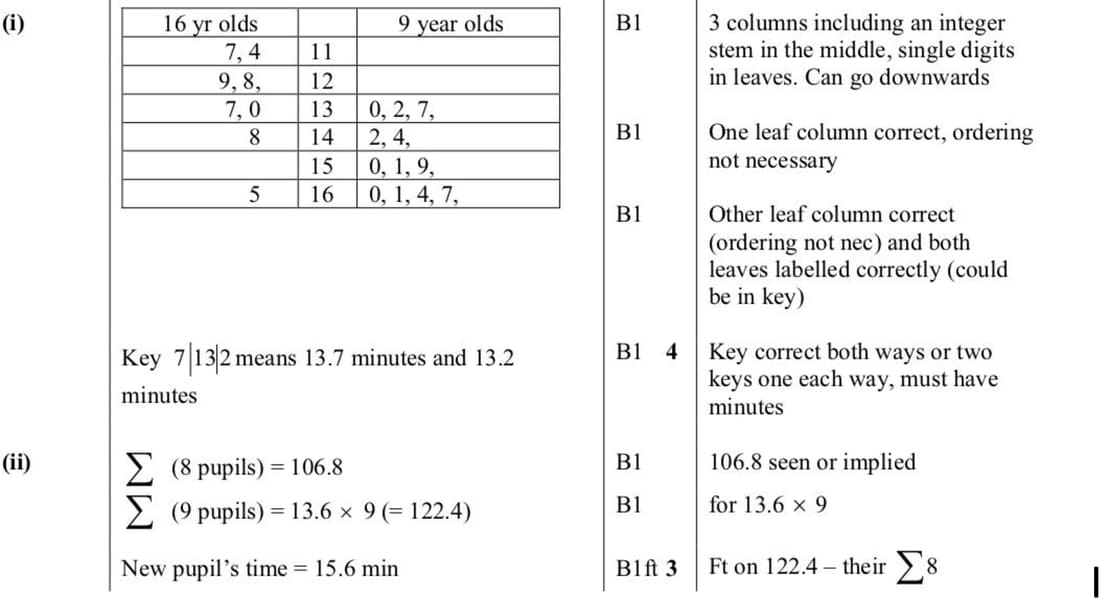
The lengths of time in minutes to swim a certain distance by the members of a class of twelve 9-year-olds and by the members of a class of eight 16-year-olds are shown below.
9-year-olds: 13.0, 16.1, 16.0, 14.4, 15.9, 15.1, 14.2, 13.7, 16.7, 16.4, 15.0, 13.2
16-year-olds: 14.8, 13.0, 11.4, 11.7, 16.5, 13.7, 12.8, 12.9
(i) Draw a back-to-back stem-and-leaf diagram to represent the information above.
(ii) A new pupil joined the 16-year-old class and swam the distance. The mean time for the class of nine pupils was now 13.6 minutes. Find the new pupil’s time to swim the distance.