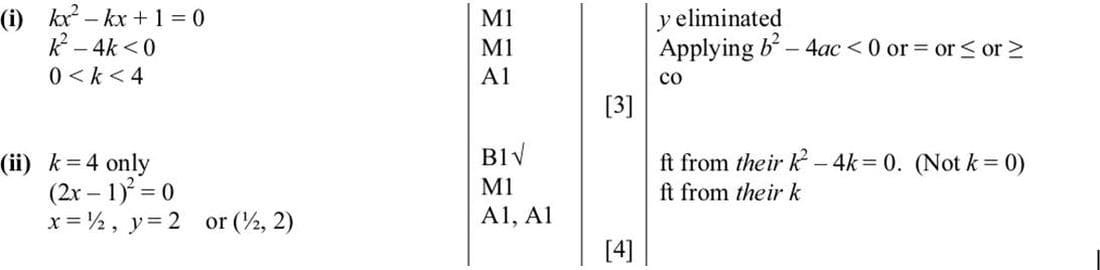
(i) To find when the curve \(y = kx^2 + 1\) and the line \(y = kx\) have no common points, set the equations equal: \(kx^2 + 1 = kx\).
Rearrange to form a quadratic equation: \(kx^2 - kx + 1 = 0\).
For no common points, the discriminant must be less than zero: \(b^2 - 4ac < 0\).
Here, \(a = k\), \(b = -k\), \(c = 1\). So, \((-k)^2 - 4(k)(1) < 0\).
Simplify: \(k^2 - 4k < 0\).
Factor: \(k(k - 4) < 0\).
The solution to this inequality is \(0 < k < 4\).
(ii) For the line to be tangent to the curve, the discriminant must be zero: \(k^2 - 4k = 0\).
Factor: \(k(k - 4) = 0\).
Since \(k \neq 0\), \(k = 4\).
Substitute \(k = 4\) into the quadratic equation: \(4x^2 - 4x + 1 = 0\).
Factor: \((2x - 1)^2 = 0\).
Solve for \(x\): \(x = \frac{1}{2}\).
Substitute \(x = \frac{1}{2}\) into \(y = 4x\): \(y = 4 \times \frac{1}{2} = 2\).
The point of tangency is \(\left( \frac{1}{2}, 2 \right)\).