Browsing as Guest. Progress, bookmarks and attempts are disabled.
Log in to track your work.
Nov 2018 p11 q2
321
A line has equation \(y = x + 1\) and a curve has equation \(y = x^2 + bx + 5\). Find the set of values of the constant \(b\) for which the line meets the curve.
Solution
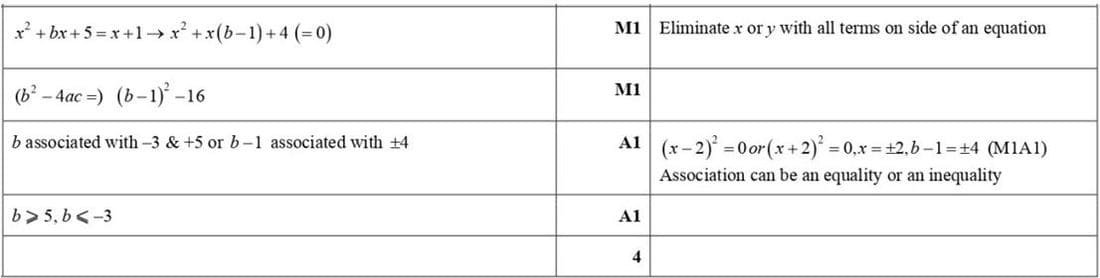
To find the values of \(b\) for which the line meets the curve, set the equations equal to each other:
\(x + 1 = x^2 + bx + 5\)
Rearrange to form a quadratic equation:
\(x^2 + (b-1)x + 4 = 0\)
For the line to meet the curve, the quadratic must have real roots. This requires the discriminant to be non-negative:
\((b-1)^2 - 4 \times 1 \times 4 \geq 0\)
\((b-1)^2 - 16 \geq 0\)
\((b-1)^2 \geq 16\)
Taking square roots gives:
\(b-1 \geq 4\) or \(b-1 \leq -4\)
Solving these inequalities:
\(b \geq 5\) or \(b \leq -3\)
Thus, the set of values for \(b\) is \(b \geq 5\) or \(b \leq -3\).