Feb/Mar 2021 p12 q4
308
A line has equation \(y = 3x + k\) and a curve has equation \(y = x^2 + kx + 6\), where \(k\) is a constant.
Find the set of values of \(k\) for which the line and curve have two distinct points of intersection.
Solution
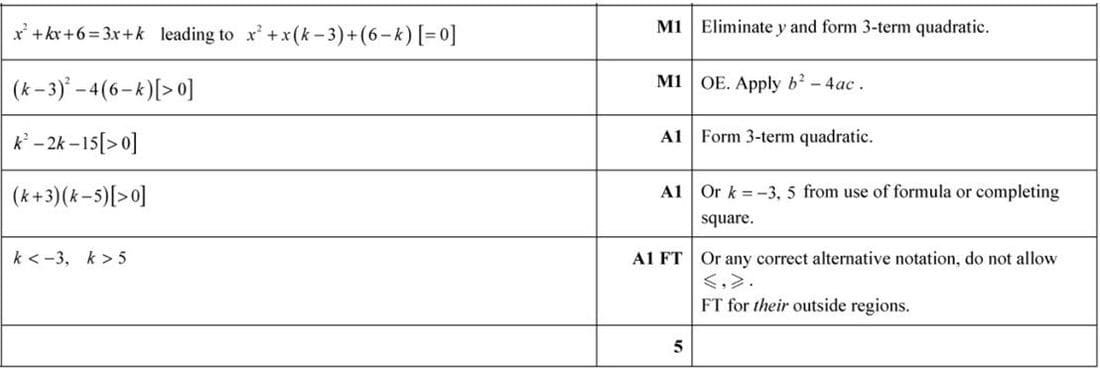
To find the points of intersection, set the equations equal: \(3x + k = x^2 + kx + 6\).
Rearrange to form a quadratic equation: \(x^2 + (k - 3)x + (6 - k) = 0\).
For two distinct points of intersection, the discriminant must be greater than zero: \(b^2 - 4ac > 0\).
Here, \(a = 1\), \(b = k - 3\), and \(c = 6 - k\).
Calculate the discriminant: \((k - 3)^2 - 4(6 - k) > 0\).
Simplify: \(k^2 - 2k - 15 > 0\).
Factorize: \((k + 3)(k - 5) > 0\).
The solution to this inequality is \(k < -3\) or \(k > 5\).
Log in to record attempts.