9709 P12 - Nov 2022 - Q6
299
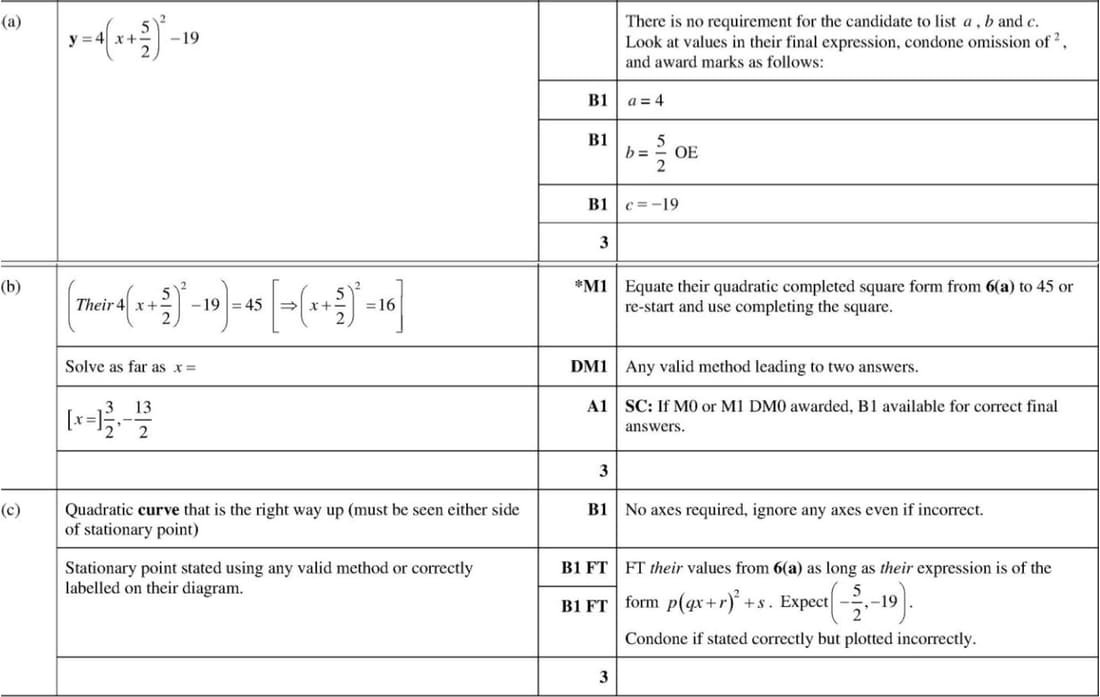
The equation of a curve is \(y = 4x^2 + 20x + 6\).
- Express the equation in the form \(y = a(x + b)^2 + c\), where \(a, b,\) and \(c\) are constants.
- Hence solve the equation \(4x^2 + 20x + 6 = 45\).
- Sketch the graph of \(y = 4x^2 + 20x + 6\) showing the coordinates of the stationary point. You are not required to indicate where the curve crosses the \(x\)- and \(y\)-axes.