Past Exam Questions
← Back9709 P13 - Nov 2020 - Q2
The function \(f\) is defined by \(f(x) = \frac{2}{(x+2)^2}\) for \(x > -2\).
(a) Find \(\int_{1}^{\infty} f(x) \, dx\).
(b) The equation of a curve is such that \(\frac{dy}{dx} = f(x)\). It is given that the point \((-1, -1)\) lies on the curve.
Find the equation of the curve.

9709 P12 - Nov 2023 - Q3
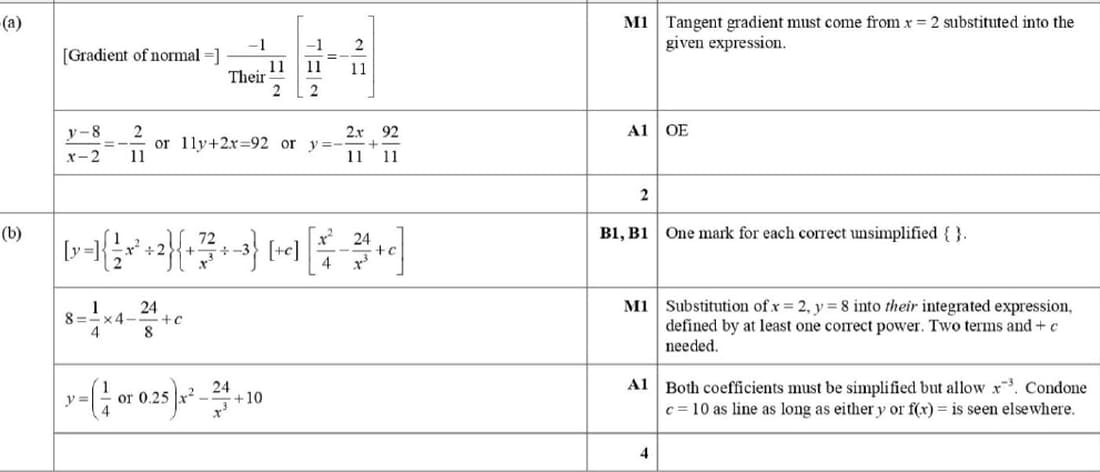
The equation of a curve is such that \(\frac{dy}{dx} = \frac{1}{2}x + \frac{72}{x^4}\). The curve passes through the point \(P(2, 8)\).
(a) Find the equation of the normal to the curve at \(P\).
(b) Find the equation of the curve.
9709 P12 - Nov 2020 - Q7
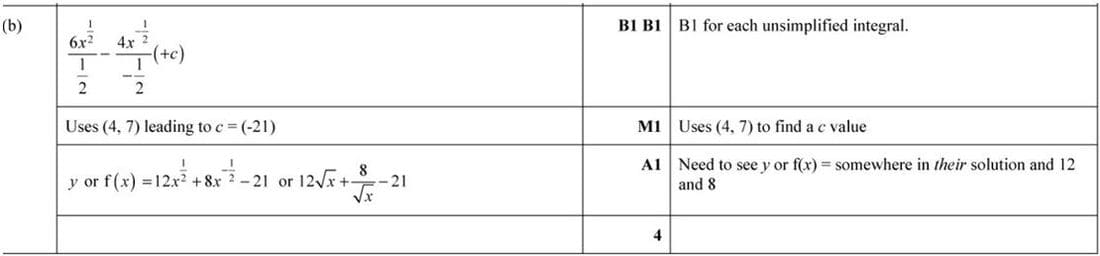
The point (4, 7) lies on the curve \(y = f(x)\) and it is given that \(f'(x) = 6x^{-\frac{1}{2}} - 4x^{-\frac{3}{2}}\).
Find the equation of the curve.
9709 P11 - Nov 2020 - Q2
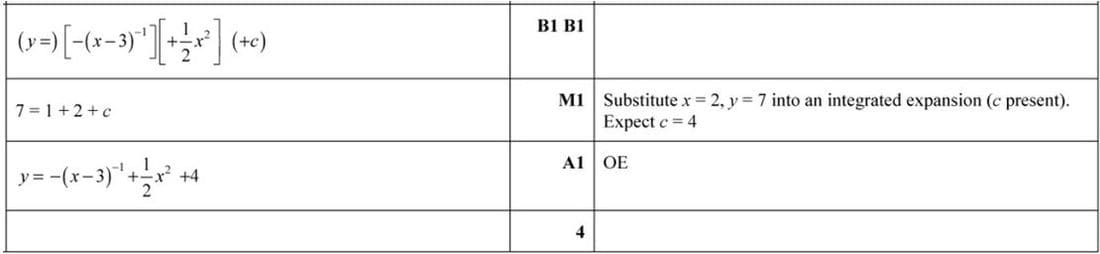
The equation of a curve is such that \(\frac{dy}{dx} = \frac{1}{(x-3)^2} + x\). It is given that the curve passes through the point (2, 7).
Find the equation of the curve.
9709 P13 - Jun 2020 - Q2
The equation of a curve is such that \(\frac{dy}{dx} = 3x^{\frac{1}{2}} - 3x^{-\frac{1}{2}}\). It is given that the point (4, 7) lies on the curve.
Find the equation of the curve.

9709 P12 - Jun 2019 - Q3
A curve is such that \(\frac{dy}{dx} = x^3 - \frac{4}{x^2}\). The point \(P(2, 9)\) lies on the curve.
Find the equation of the curve.

9709 P11 - Jun 2018 - Q3
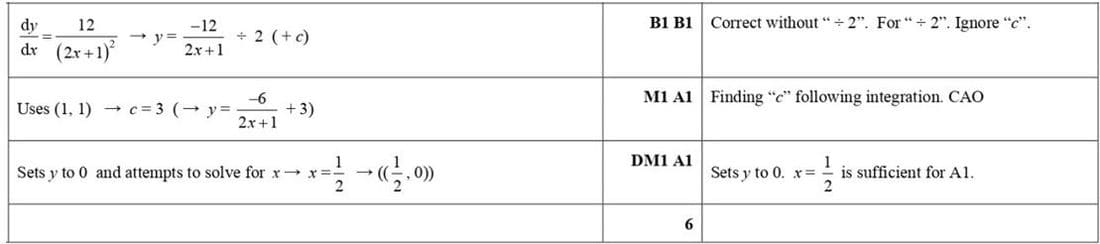
A curve is such that \(\frac{dy}{dx} = \frac{12}{(2x+1)^2}\). The point (1, 1) lies on the curve. Find the coordinates of the point at which the curve intersects the x-axis.
9709 P12 - Mar 2018 - Q1
A curve passes through the point (4, -6) and has an equation for which \(\frac{dy}{dx} = x^{-\frac{1}{2}} - 3\). Find the equation of the curve.

9709 P12 - Nov 2017 - Q8
A curve is such that \(\frac{dy}{dx} = -x^2 + 5x - 4\).
Given that the curve passes through the point (6, 2), find the equation of the curve.

9709 P12 - Nov 2016 - Q1
A curve is such that \(\frac{dy}{dx} = \frac{8}{\sqrt{4x + 1}}\). The point \((2, 5)\) lies on the curve. Find the equation of the curve.

9709 P12 - Jun 2016 - Q2
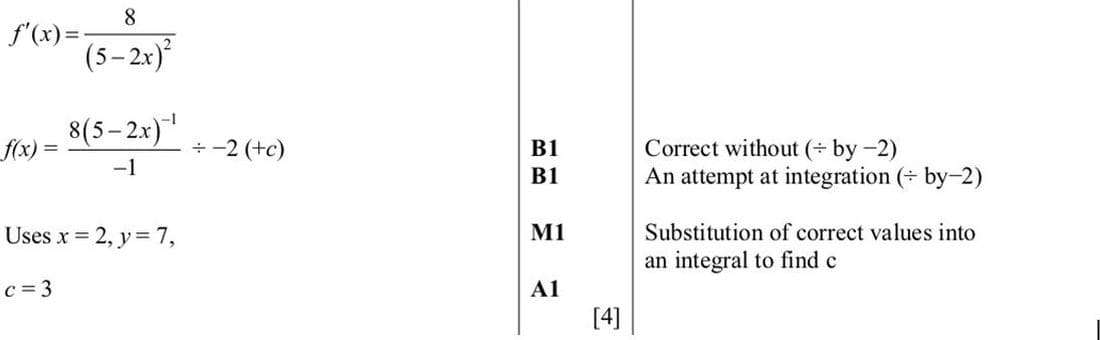
A curve is such that \(\frac{dy}{dx} = \frac{8}{(5 - 2x)^2}\). Given that the curve passes through (2, 7), find the equation of the curve.
9709 P12 - Mar 2016 - Q2
A curve for which \(\frac{dy}{dx} = 3x^2 - \frac{2}{x^3}\) passes through \((-1, 3)\). Find the equation of the curve.

9709 P11 - Nov 2023 - Q10
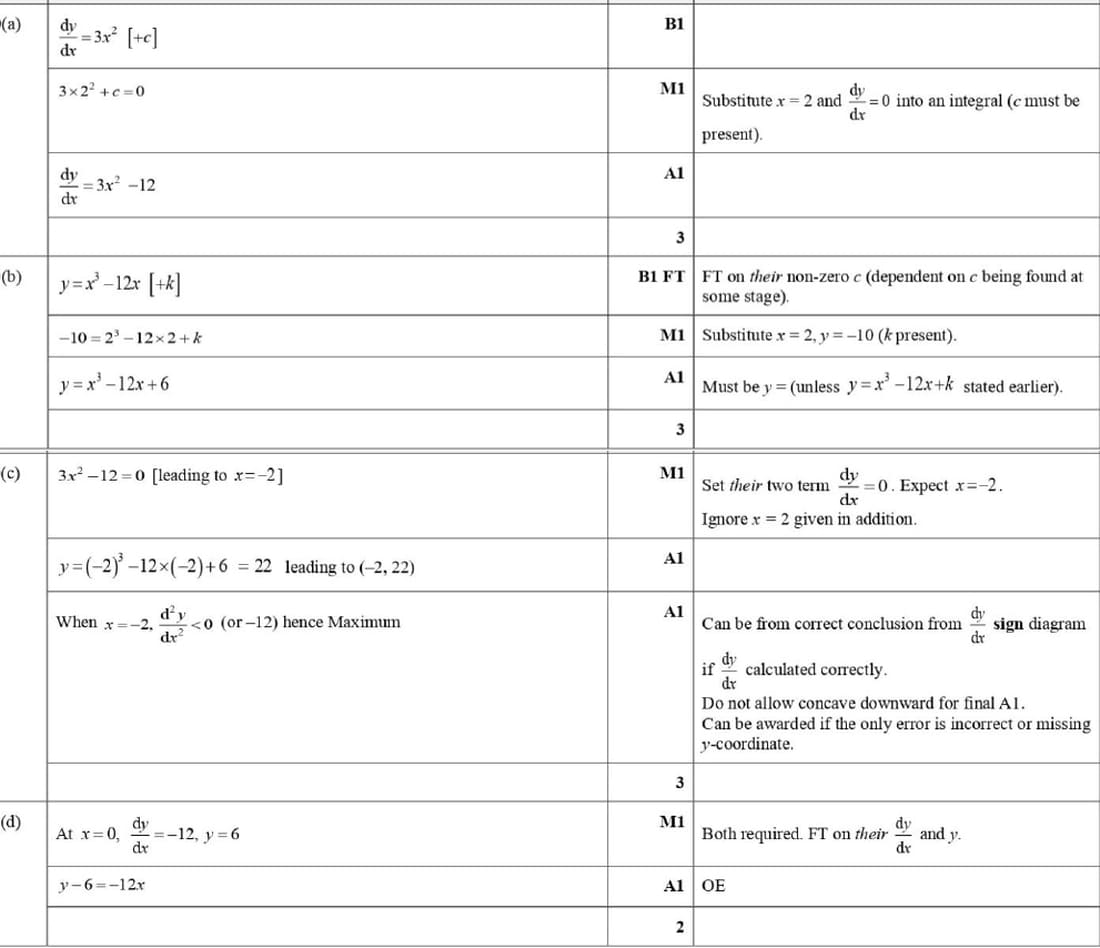
A curve has a stationary point at \(2, -10\) and is such that \(\frac{d^2y}{dx^2} = 6x\).
(a) Find \(\frac{dy}{dx}\).
(b) Find the equation of the curve.
(c) Find the coordinates of the other stationary point and determine its nature.
(d) Find the equation of the tangent to the curve at the point where the curve crosses the y-axis.
9709 P11 - Nov 2015 - Q2
The function \(f\) is such that \(f'(x) = 3x^2 - 7\) and \(f(3) = 5\). Find \(f(x)\).

9709 P13 - Jun 2015 - Q2
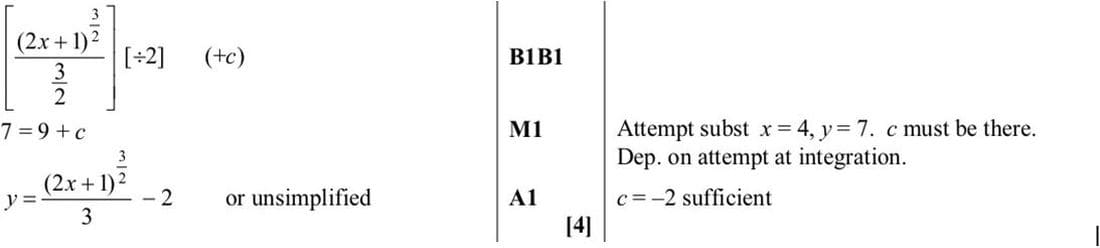
A curve is such that \(\frac{dy}{dx} = (2x + 1)^{\frac{1}{2}}\) and the point \((4, 7)\) lies on the curve. Find the equation of the curve.
9709 P12 - Jun 2015 - Q1
The function \(f\) is such that \(f'(x) = 5 - 2x^2\) and \((3, 5)\) is a point on the curve \(y = f(x)\). Find \(f(x)\).

9709 P13 - Nov 2013 - Q2
A curve has equation \(y = f(x)\). It is given that \(f'(x) = x^{-\frac{3}{2}} + 1\) and that \(f(4) = 5\). Find \(f(x)\).

9709 P11 - Nov 2013 - Q2
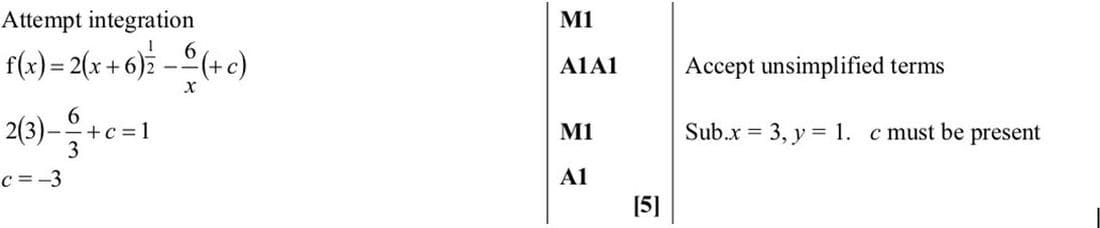
A curve has equation \(y = f(x)\). It is given that \(f'(x) = \frac{1}{\sqrt{x+6}} + \frac{6}{x^2}\) and that \(f(3) = 1\). Find \(f(x)\). [5]
9709 P13 - Jun 2013 - Q1
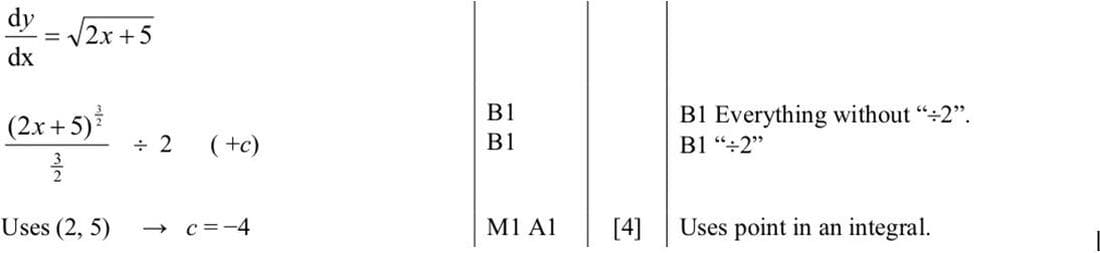
A curve is such that \(\frac{dy}{dx} = \sqrt{2x + 5}\) and \((2, 5)\) is a point on the curve. Find the equation of the curve.
9709 P12 - Jun 2013 - Q1
A curve is such that \(\frac{dy}{dx} = \frac{6}{x^2}\) and \((2, 9)\) is a point on the curve. Find the equation of the curve.
