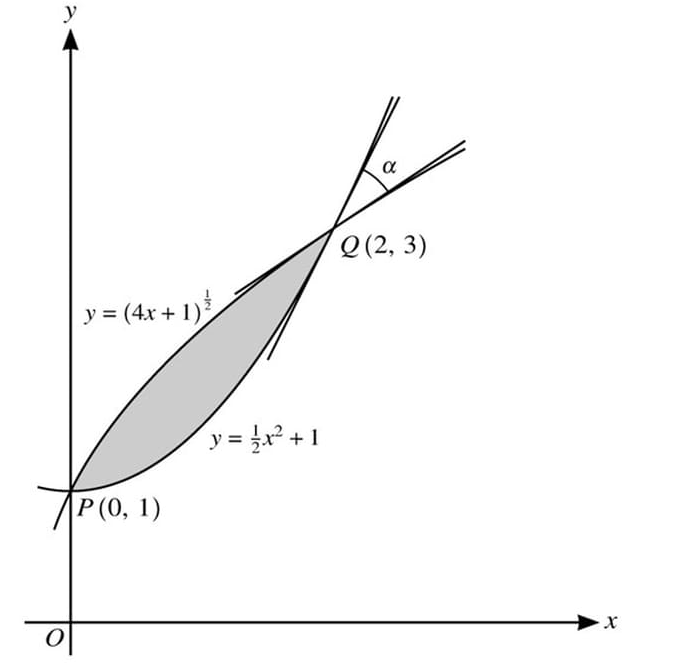
(i) For \(y = (4x + 1)^{\frac{1}{2}}\), the derivative is \(\frac{dy}{dx} = \frac{1}{2}(4x + 1)^{-\frac{1}{2}} \times 4 = \frac{2}{\sqrt{4x + 1}}\).
When \(x = 2\), \(\frac{dy}{dx} = \frac{2}{3}\).
For \(y = \frac{1}{2}x^2 + 1\), the derivative is \(\frac{dy}{dx} = x\).
When \(x = 2\), \(\frac{dy}{dx} = 2\).
The angle \(\alpha\) is given by \(\alpha = \arctan(m_2) - \arctan(m_1)\), where \(m_1 = \frac{2}{3}\) and \(m_2 = 2\).
\(\alpha = \arctan(2) - \arctan\left(\frac{2}{3}\right) \approx 63.43 - 33.69 = 29.7\) degrees.
(ii) The area of the shaded region is found by integrating the difference between the two curves from \(x = 0\) to \(x = 2\).
\(\int (4x + 1)^{\frac{1}{2}} \, dx = \left[ \frac{(4x+1)^{\frac{3}{2}}}{\frac{3}{2} \times 4} \right] = \left[ \frac{(4x+1)^{\frac{3}{2}}}{6} \right]\).
\(\int \left(\frac{1}{2}x^2 + 1\right) \, dx = \frac{1}{6}x^3 + x\).
Evaluate from 0 to 2:
\(\left[ \frac{(4 \times 2 + 1)^{\frac{3}{2}}}{6} \right] - \left[ \frac{(4 \times 0 + 1)^{\frac{3}{2}}}{6} \right] = \frac{27}{6} - \frac{1}{6} = \frac{26}{6} = \frac{13}{3}\).
\(\left[ \frac{1}{6}(2)^3 + 2 \right] - \left[ \frac{1}{6}(0)^3 + 0 \right] = \frac{8}{6} + 2 = \frac{10}{3}\).
The area is \(\frac{13}{3} - \frac{10}{3} = 1\).