Browsing as Guest. Progress, bookmarks and attempts are disabled.
Log in to track your work.
June 2013 p12 q11
1296
The diagram shows the curve \(y = \sqrt{1 + 4x}\), which intersects the x-axis at \(A\) and the y-axis at \(B\). The normal to the curve at \(B\) meets the x-axis at \(C\). Find
(i) the equation of \(BC\),
(ii) the area of the shaded region.
Solution
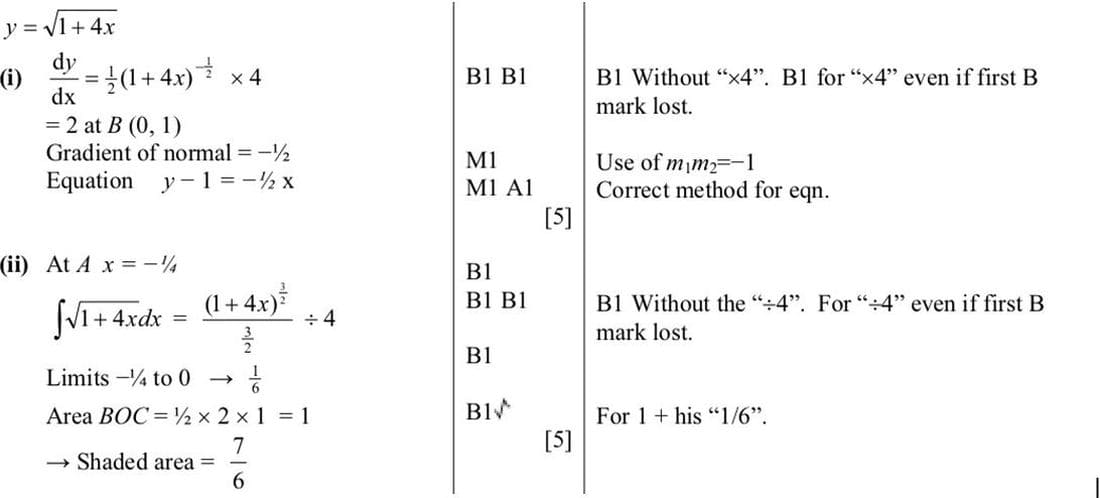
(i) To find the equation of \(BC\), we first find the derivative of \(y = \sqrt{1 + 4x}\). The derivative is \(\frac{dy}{dx} = \frac{1}{2}(1 + 4x)^{-\frac{1}{2}} \times 4\).
At \(B(0, 1)\), the gradient of the tangent is \(2\). Therefore, the gradient of the normal is \(-\frac{1}{2}\) (since \(m_1 m_2 = -1\)).
The equation of the normal is \(y - 1 = -\frac{1}{2}x\).
(ii) To find the area of the shaded region, we first find the x-coordinate of \(A\) by setting \(y = 0\) in \(y = \sqrt{1 + 4x}\), giving \(x = -\frac{1}{4}\).
The integral of \(\sqrt{1 + 4x}\) is \(\int \sqrt{1 + 4x} \, dx = \frac{(1 + 4x)^{\frac{3}{2}}}{\frac{3}{2}} \times \frac{1}{4}\).
Evaluating from \(-\frac{1}{4}\) to \(0\), the area under the curve is \(\frac{1}{6}\).
The area of \(\triangle BOC\) is \(\frac{1}{2} \times 2 \times 1 = 1\).
Thus, the shaded area is \(1 + \frac{1}{6} = \frac{7}{6}\).