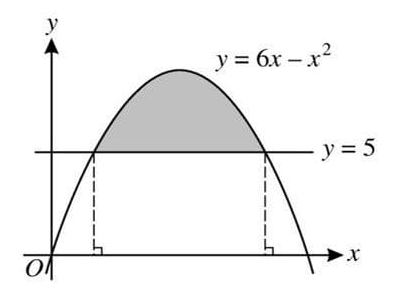
The curve \(y = 6x - x^2\) intersects the line \(y = 5\) when:
\(6x - x^2 = 5\)
\(x^2 - 6x + 5 = 0\)
Factoring gives:
\((x - 1)(x - 5) = 0\)
Thus, \(x = 1\) and \(x = 5\).
The area under the curve from \(x = 1\) to \(x = 5\) is found by integrating:
\(\int_{1}^{5} (6x - x^2) \, dx = \left[ 3x^2 - \frac{1}{3}x^3 \right]_{1}^{5}\)
Calculating the definite integral:
\(\left( 3(5)^2 - \frac{1}{3}(5)^3 \right) - \left( 3(1)^2 - \frac{1}{3}(1)^3 \right)\)
\(= (75 - \frac{125}{3}) - (3 - \frac{1}{3})\)
\(= \frac{225}{3} - \frac{125}{3} - \left( \frac{9}{3} - \frac{1}{3} \right)\)
\(= \frac{100}{3} - \frac{8}{3}\)
\(= \frac{92}{3}\)
The area of the rectangle formed by the line \(y = 5\) from \(x = 1\) to \(x = 5\) is:
\(5 \times (5 - 1) = 20\)
The shaded area is the area under the curve minus the area of the rectangle:
\(\frac{92}{3} - 20 = \frac{92}{3} - \frac{60}{3} = \frac{32}{3}\)
Thus, the shaded area is \(\frac{10}{3}\).