Browsing as Guest. Progress, bookmarks and attempts are disabled.
Log in to track your work.
June 2009 p1 q11
1306
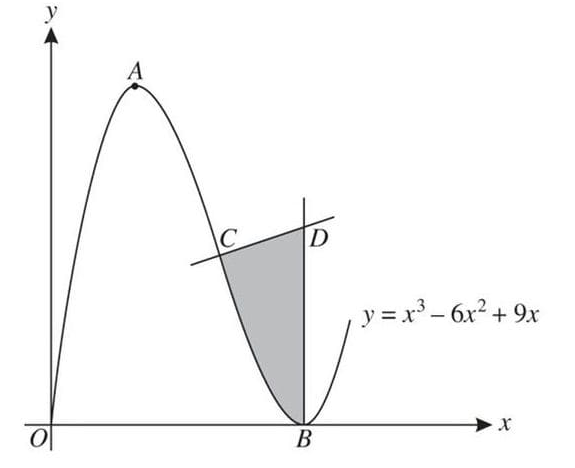
The diagram shows the curve \(y = x^3 - 6x^2 + 9x\) for \(x \geq 0\). The curve has a maximum point at \(A\) and a minimum point on the \(x\)-axis at \(B\). The normal to the curve at \(C (2, 2)\) meets the normal to the curve at \(B\) at the point \(D\).
(i) Find the coordinates of \(A\) and \(B\).
(ii) Find the equation of the normal to the curve at \(C\).
(iii) Find the area of the shaded region.
Solution
(i) To find the coordinates of \(A\) and \(B\), we first find the derivative \(\frac{dy}{dx} = 3x^2 - 12x + 9\). Setting \(\frac{dy}{dx} = 0\) gives the critical points. Solving \(3x^2 - 12x + 9 = 0\) gives \(x = 1\) and \(x = 3\). Substituting back into the original equation, \(y = x^3 - 6x^2 + 9x\), we find \(A(1, 4)\) and \(B(3, 0)\).
(ii) At \(C(2, 2)\), the slope of the tangent is \(m = -3\). The slope of the normal is \(\frac{1}{3}\). The equation of the normal is \(y - 2 = \frac{1}{3}(x - 2)\), which simplifies to \(3y = x + 4\).
(iii) To find the area of the shaded region, integrate \(y = x^3 - 6x^2 + 9x\) from \(x = 0\) to \(x = 3\). The integral is \(\frac{1}{4}x^4 - 2x^3 + \frac{9}{2}x^2\). Evaluating from 0 to 3 gives \(\frac{3}{4}\). The area of the trapezium is \(\frac{1}{2} \times 1 \times (2 + \frac{2}{3}) = \frac{13}{6}\). Subtracting gives the shaded area \(\frac{17}{12}\).