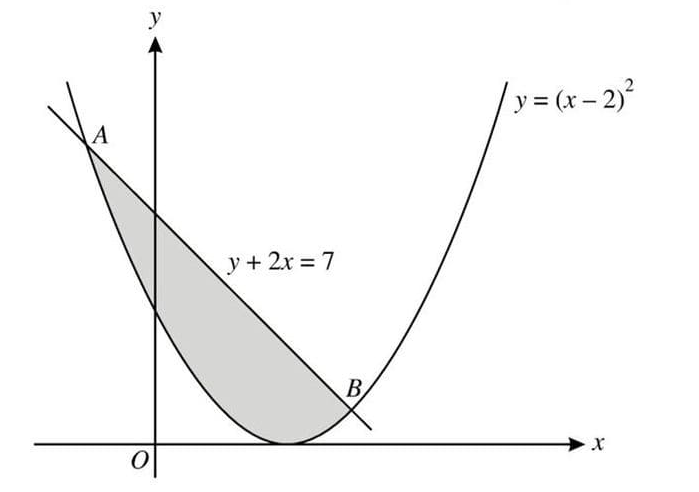
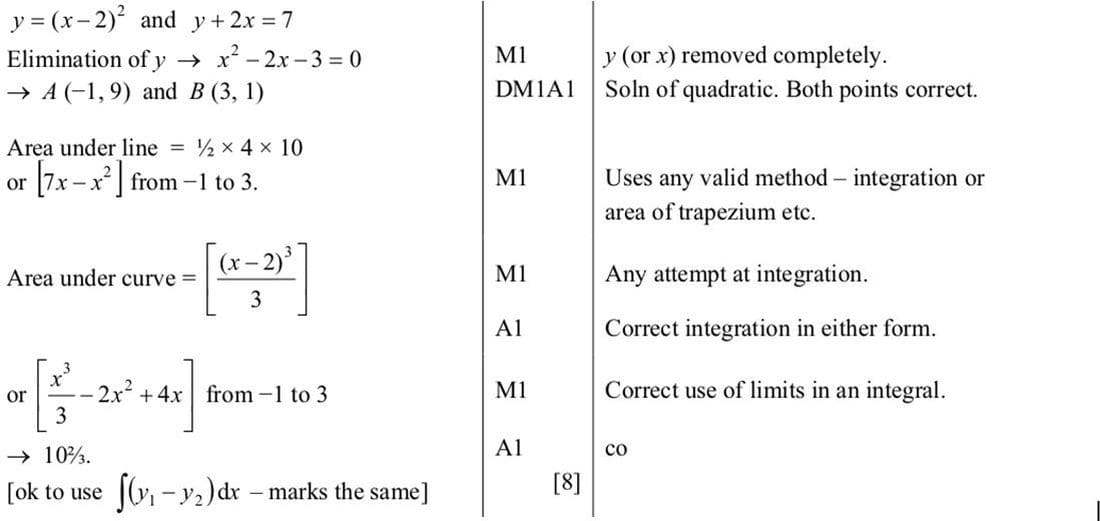
First, find the points of intersection by solving the equations simultaneously:
Set \(y = (x-2)^2\) equal to \(y = 7 - 2x\):
\((x-2)^2 = 7 - 2x\)
Expand and rearrange:
\(x^2 - 4x + 4 = 7 - 2x\)
\(x^2 - 2x - 3 = 0\)
Factorize:
\((x-3)(x+1) = 0\)
Thus, \(x = 3\) or \(x = -1\).
Find corresponding \(y\) values:
For \(x = 3\), \(y = (3-2)^2 = 1\), so \(B(3, 1)\).
For \(x = -1\), \(y = (-1-2)^2 = 9\), so \(A(-1, 9)\).
Calculate the area under the line from \(x = -1\) to \(x = 3\):
\(\int_{-1}^{3} (7 - 2x) \, dx = [7x - x^2]_{-1}^{3}\)
\(= (21 - 9) - (-7 - 1) = 12 + 8 = 20\)
Calculate the area under the curve from \(x = -1\) to \(x = 3\):
\(\int_{-1}^{3} (x-2)^2 \, dx = \int_{-1}^{3} (x^2 - 4x + 4) \, dx\)
\(= \left[ \frac{x^3}{3} - 2x^2 + 4x \right]_{-1}^{3}\)
\(= \left( \frac{27}{3} - 18 + 12 \right) - \left( \frac{-1}{3} - 2 - 4 \right)\)
\(= (9 - 18 + 12) - (-\frac{1}{3} + 2 + 4)\)
\(= 3 - \frac{5}{3} = \frac{4}{3}\)
Find the area of the shaded region:
\(20 - \frac{4}{3} = \frac{60}{3} - \frac{4}{3} = \frac{56}{3} = 10\frac{2}{3}\)