Browsing as Guest. Progress, bookmarks and attempts are disabled.
Log in to track your work.
9709 P11 - Jun 2015 - Q10
1287
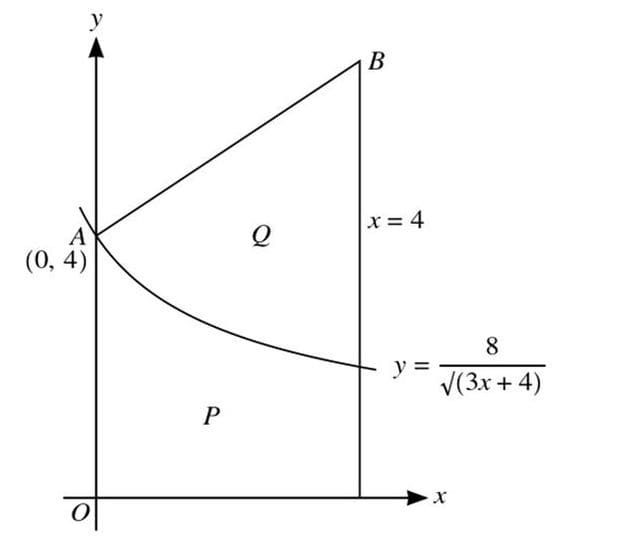
The diagram shows part of the curve \(y = \frac{8}{\sqrt{3x+4}}\). The curve intersects the y-axis at \(A (0, 4)\). The normal to the curve at \(A\) intersects the line \(x = 4\) at the point \(B\).
(i) Find the coordinates of \(B\).
(ii) Show, with all necessary working, that the areas of the regions marked \(P\) and \(Q\) are equal.
Solution
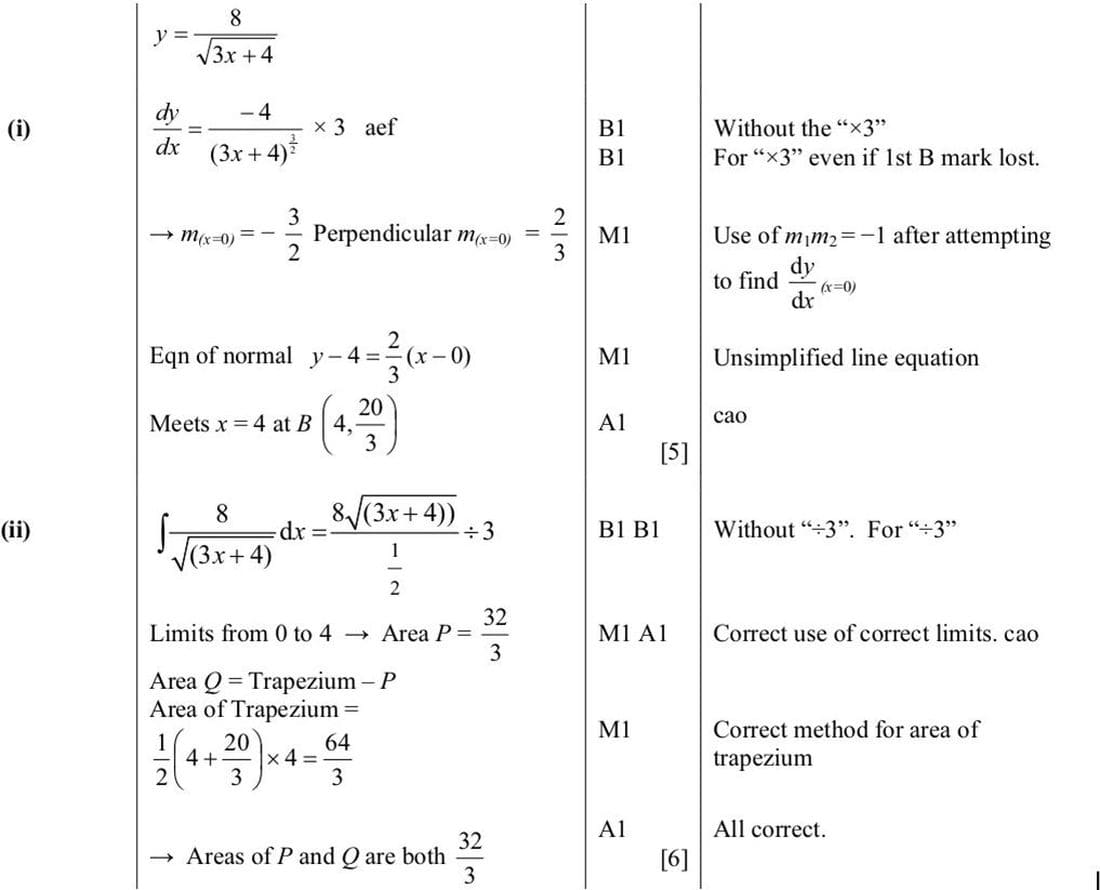
(i) The equation of the curve is \(y = \frac{8}{\sqrt{3x+4}}\). The derivative is \(\frac{dy}{dx} = \frac{-4}{(3x+4)^{\frac{3}{2}}} \times 3\). At \(x = 0\), \(\frac{dy}{dx} = -\frac{3}{2}\). The slope of the normal is the negative reciprocal, \(\frac{2}{3}\).
The equation of the normal at \(A\) is \(y - 4 = \frac{2}{3}(x - 0)\). Solving for \(x = 4\), we find \(B \left( 4, \frac{20}{3} \right)\).
(ii) The area \(P\) is given by \(\int_{0}^{4} \frac{8}{\sqrt{3x+4}} \, dx = 8 \int_{0}^{4} (3x+4)^{-\frac{1}{2}} \, dx\). This evaluates to \(\frac{32}{3}\).
The area \(Q\) is the area of the trapezium minus \(P\). The area of the trapezium is \(\frac{1}{2} \times (4 + \frac{20}{3}) \times 4 = \frac{64}{3}\). Thus, \(Q = \frac{64}{3} - \frac{32}{3} = \frac{32}{3}\).
Therefore, the areas of \(P\) and \(Q\) are both \(\frac{32}{3}\).