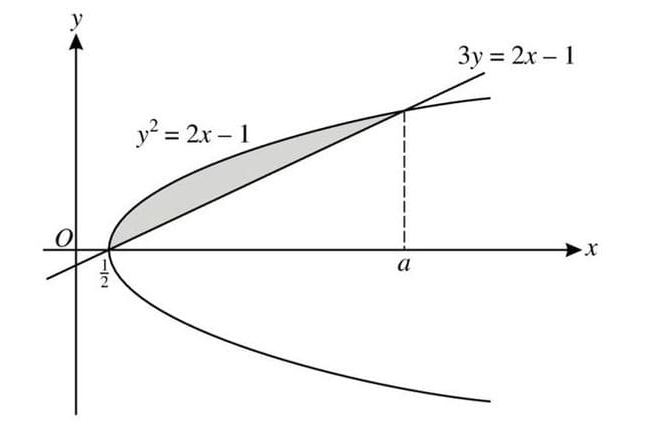
(i) To find the intersection points, equate \(y^2 = 2x - 1\) and \(3y = 2x - 1\).
Substitute \(y = \frac{2x - 1}{3}\) into \(y^2 = 2x - 1\):
\(\left( \frac{2x - 1}{3} \right)^2 = 2x - 1\)
\(\frac{(2x - 1)^2}{9} = 2x - 1\)
\((2x - 1)^2 = 9(2x - 1)\)
\(4x^2 - 4x + 1 = 18x - 9\)
\(4x^2 - 22x + 10 = 0\)
\(2x^2 - 11x + 5 = 0\)
Solving this quadratic equation using the quadratic formula:
\(x = \frac{-b \pm \sqrt{b^2 - 4ac}}{2a}\)
\(x = \frac{11 \pm \sqrt{121 - 40}}{4}\)
\(x = \frac{11 \pm \sqrt{81}}{4}\)
\(x = \frac{11 \pm 9}{4}\)
\(x = 5\) or \(x = \frac{1}{2}\)
Thus, \(a = 5\).
(ii) To find the area of the shaded region, integrate the difference between the curve and the line from \(x = \frac{1}{2}\) to \(x = 5\).
The area under the curve \(y^2 = 2x - 1\) is:
\(\int_{1/2}^{5} \sqrt{2x - 1} \, dx\)
Let \(u = 2x - 1\), then \(du = 2 \, dx\), \(dx = \frac{du}{2}\).
\(\int \sqrt{u} \cdot \frac{du}{2} = \frac{1}{2} \int u^{1/2} \, du\)
\(= \frac{1}{2} \cdot \frac{2}{3} u^{3/2} = \frac{1}{3} u^{3/2}\)
\(= \frac{1}{3} (2x - 1)^{3/2}\)
Evaluate from \(x = \frac{1}{2}\) to \(x = 5\):
\(\left[ \frac{1}{3} (2x - 1)^{3/2} \right]_{1/2}^{5}\)
\(= \frac{1}{3} [(9)^{3/2} - (0)^{3/2}]\)
\(= \frac{1}{3} [27 - 0] = 9\)
The area under the line \(3y = 2x - 1\) is:
\(\int_{1/2}^{5} \frac{2x - 1}{3} \, dx\)
\(= \frac{1}{3} \int (2x - 1) \, dx\)
\(= \frac{1}{3} \left[ x^2 - x \right]_{1/2}^{5}\)
\(= \frac{1}{3} \left[ 25 - 5 - \left( \frac{1}{4} - \frac{1}{2} \right) \right]\)
\(= \frac{1}{3} \left[ 20 - \left( -\frac{1}{4} \right) \right]\)
\(= \frac{1}{3} \times 20.25 = \frac{27}{4}\)
The area of the shaded region is:
\(9 - \frac{27}{4} = \frac{9}{4}\)