Past Exam Questions
← Back0606 P21 - Nov 2020 - Q12 - 10 marks
The diagram shows a shape consisting of two circles of radii \(3\) cm and \(4\) cm with centres \(A\) and \(B\), which are \(5\) cm apart. The circles intersect at \(C\) and \(D\) as shown. The lines \(AC\) and \(BC\) are tangents to the circles with centres \(B\) and \(A\), respectively.
Find
(a) the angle \(CAB\), in radians,
(b) the perimeter of the whole shape,
(c) the area of the whole shape.


0606 P12 - Jun 2019 - Q5 - 6 marks
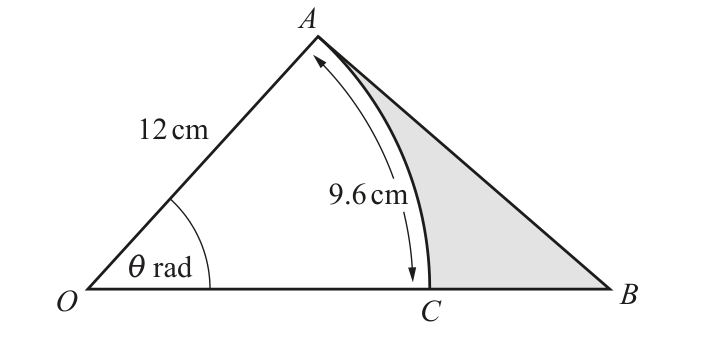
The diagram shows the right-angled triangle \(OAB\). The point \(C\) lies on \(OB\). Angle \(OAB=\frac{\pi}{2}\) radians and angle \(AOB=\theta\) radians. \(AC\) is an arc of the circle, centre \(O\), radius \(12\) cm and \(AC\) has length \(9.6\) cm.
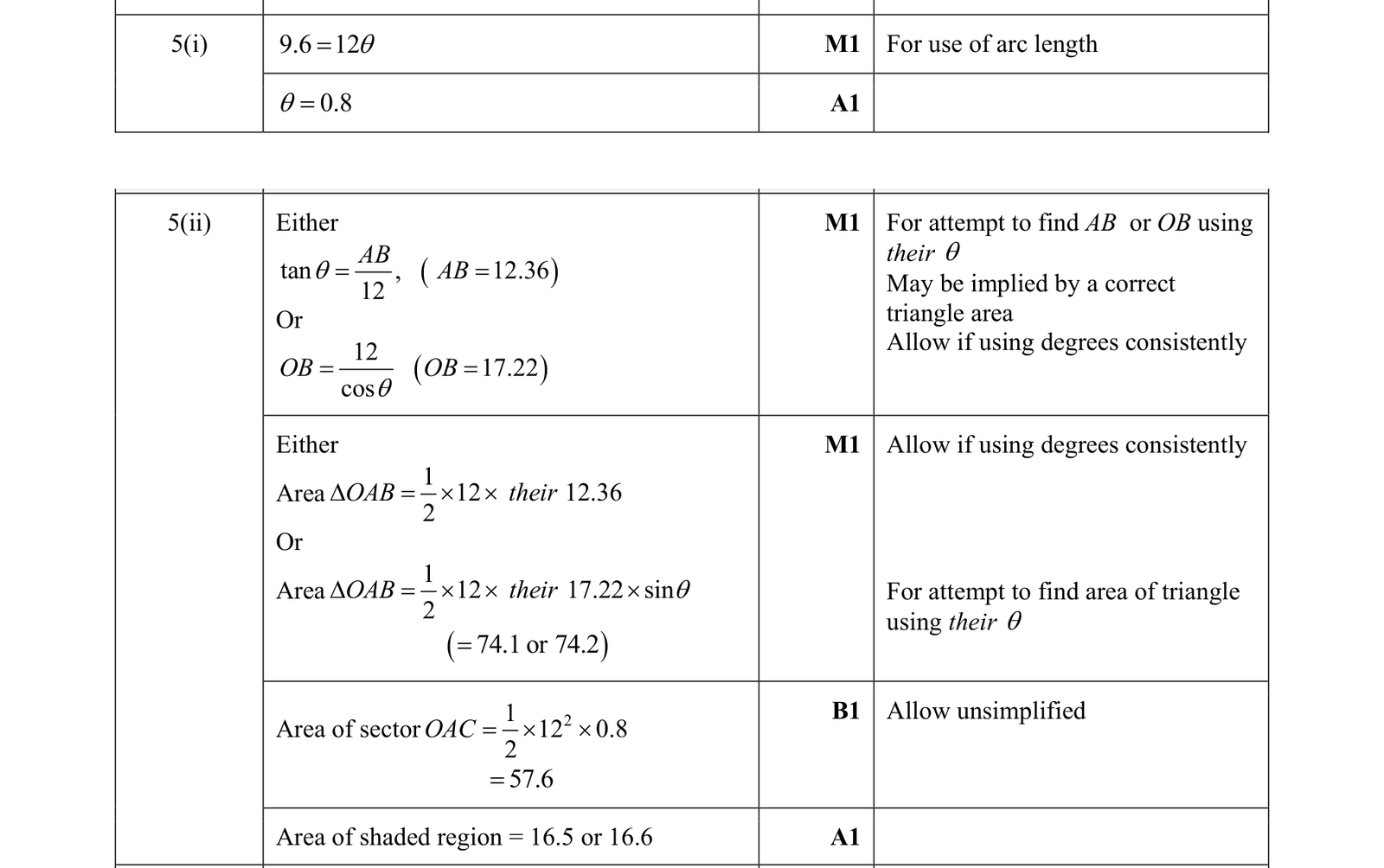
(i) Find the value of \(\theta\).
(ii) Find the area of the shaded region.
0606 P21 - Jun 2019 - Q8 - 9 marks
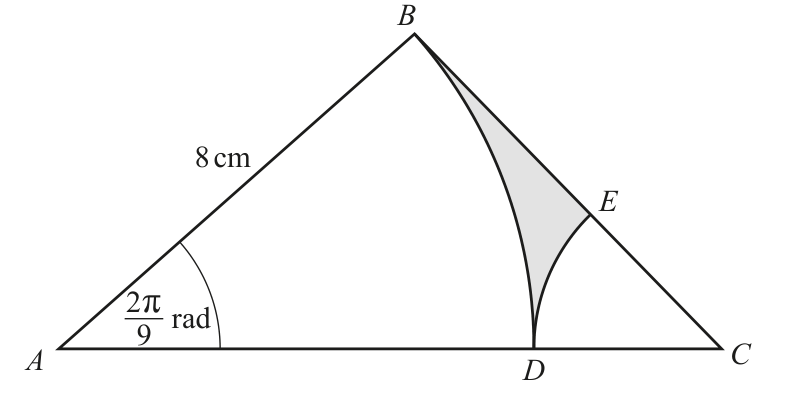
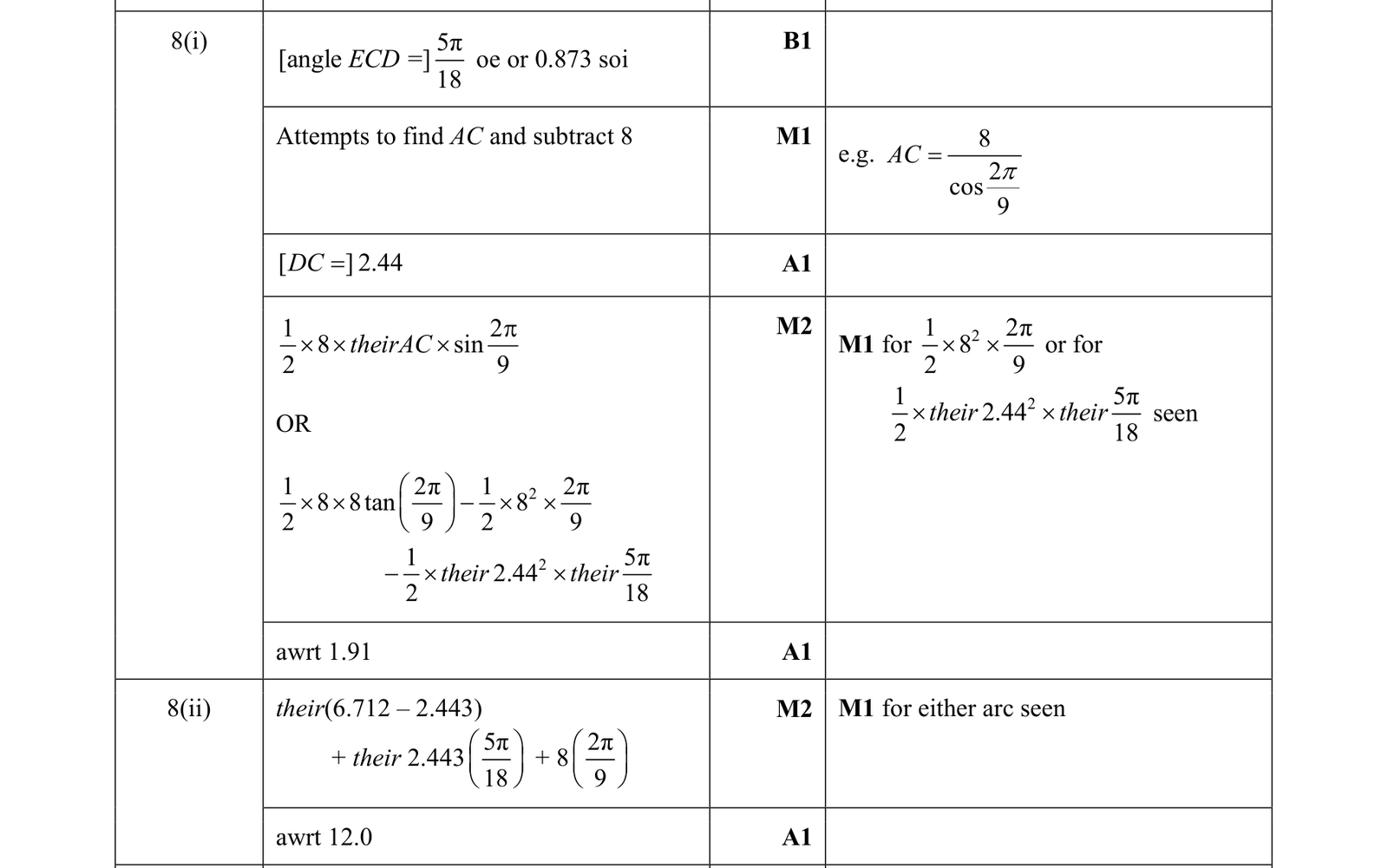
The diagram shows a right-angled triangle \(ABC\) with \(AB=8\text{ cm}\) and angle \(ABC=\frac{\pi}{2}\) radians. The points \(D\) and \(E\) lie on \(AC\) and \(BC\) respectively. \(BAD\) and \(ECD\) are sectors of circles with centres \(A\) and \(C\) respectively. Angle \(BAD=\frac{2\pi}{9}\) radians.
(i) Find the area of the shaded region.
(ii) Find the perimeter of the shaded region.
0606 P23 - Jun 2019 - Q7 - 8 marks
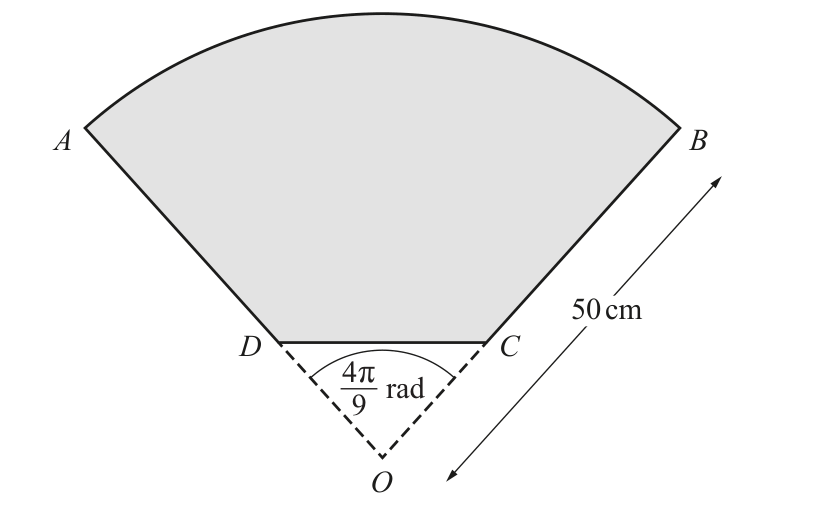
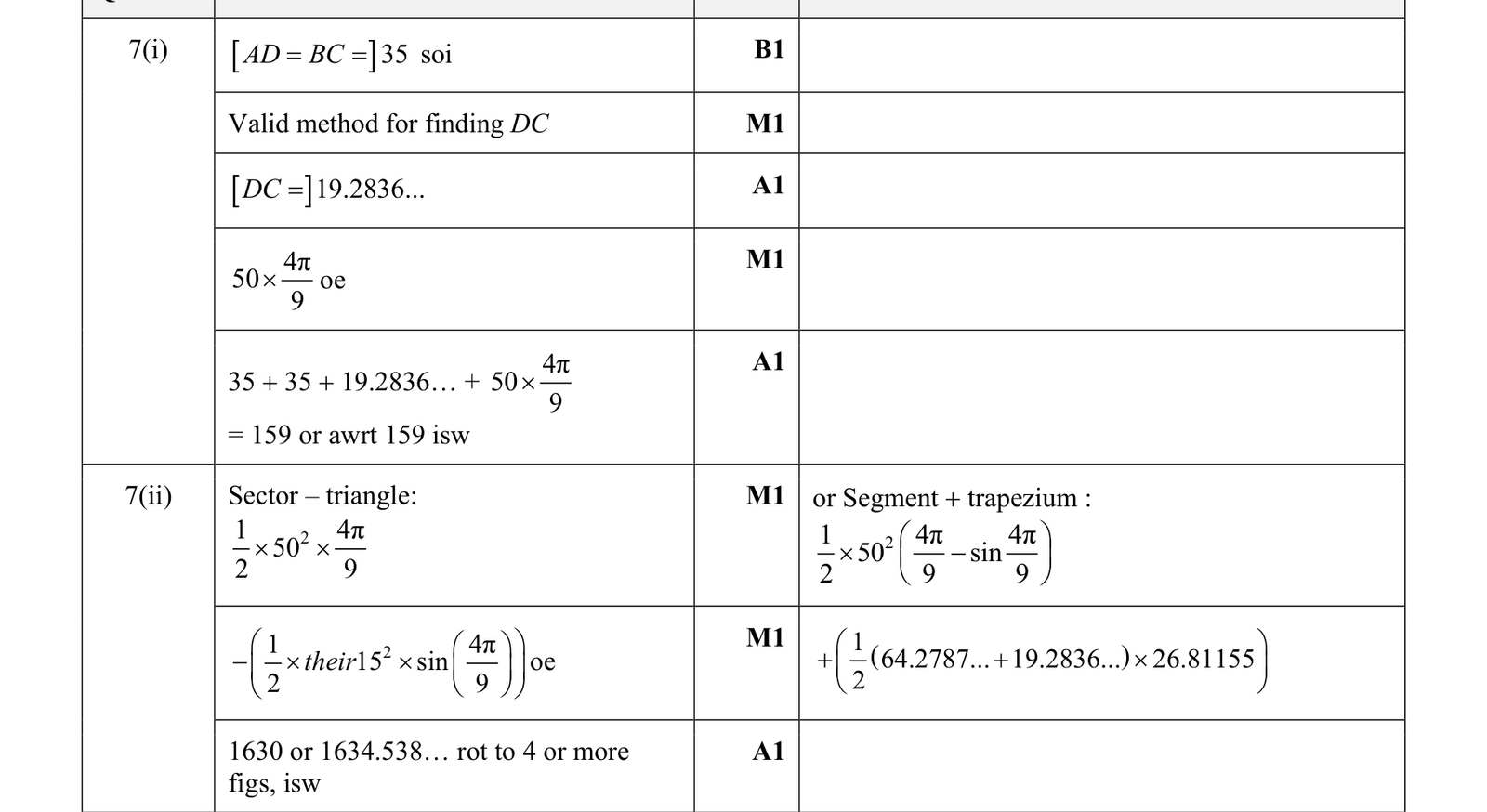
The diagram shows a company logo, \(ABCD\). The logo is part of a sector, \(AOB\), of a circle, centre \(O\) and radius \(50\) cm. The points \(C\) and \(D\) lie on \(OB\) and \(OA\) respectively. The lengths \(AD\) and \(BC\) are equal and \(AD:AO=7:10\). The angle \(AOB\) is \(\dfrac{4\pi}{9}\) radians.
(i) Find the perimeter of \(ABCD\).
(ii) Find the area of \(ABCD\).
0606 P11 - Nov 2019 - Q9 - 10 marks
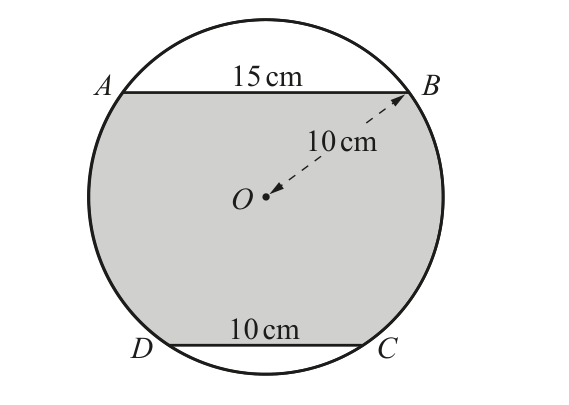
The diagram shows a circle with centre \(O\) and radius \(10\) cm. The points \(A\), \(B\), \(C\) and \(D\) lie on the circle such that the chord \(AB=15\) cm and the chord \(CD=10\) cm. The chord \(AB\) is parallel to the chord \(DC\).
(i) Show that the angle \(AOB\) is \(1.70\) radians correct to 2 decimal places.
(ii) Find the perimeter of the shaded region.
(iii) Find the area of the shaded region.

0606 P12 - Nov 2019 - Q10 - 11 marks
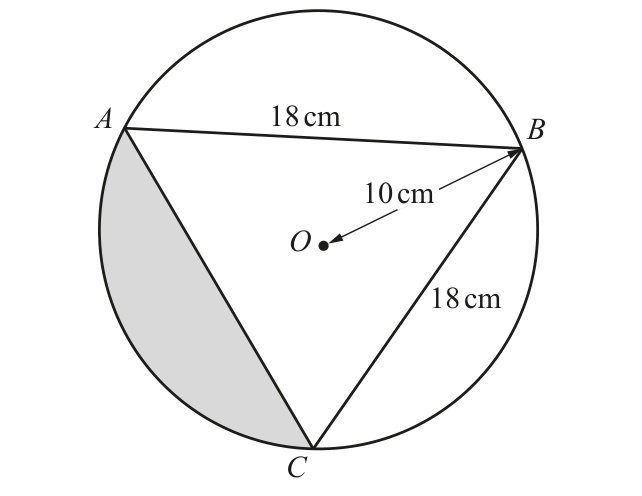
The diagram shows a circle centre \(O\), radius \(10\) cm. The points \(A\), \(B\) and \(C\) lie on the circumference of the circle such that \(AB=BC=18\) cm.
(i) Show that angle \(AOB=2.24\) radians correct to 2 decimal places.
(ii) Find the perimeter of the shaded region.
(iii) Find the area of the shaded region.

0606 P13 - Nov 2019 - Q9 - 12 marks
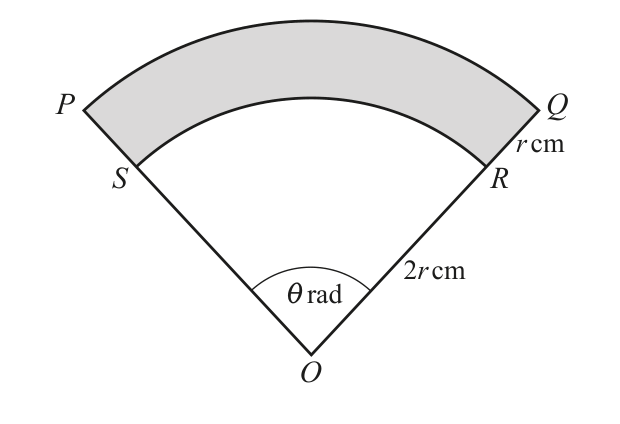
The diagram shows a sector \(OPQ\) of the circle centre \(O\), radius \(3r\) cm. The points \(S\) and \(R\) lie on \(OP\) and \(OQ\) respectively such that \(ORS\) is a sector of the circle centre \(O\), radius \(2r\) cm. The angle \(POQ=\theta\) radians. The perimeter of the shaded region \(PQRS\) is \(100\) cm.
(i) Find \(\theta\) in terms of \(r\).
(ii) Hence show that the area, \(A\text{ cm}^2\), of the shaded region \(PQRS\) is given by \(A=50r-r^2\).
(iii) Given that \(r\) can vary and that \(A\) has a maximum value, find this value of \(A\).
(iv) Given that \(A\) is increasing at the rate of \(3\text{ cm}^2\text{s}^{-1}\) when \(r=10\), find the corresponding rate of change of \(r\).
(v) Find the corresponding rate of change of \(\theta\) when \(r=10\).

0606 P22 - Mar 2018 - Q7 - 7 marks
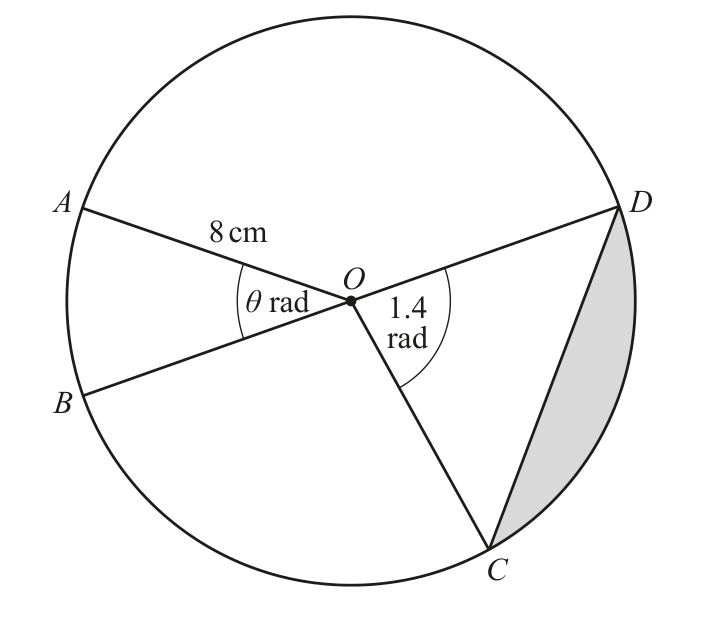
The diagram shows a circle with centre \(O\) and radius \(8\) cm. The points \(A\), \(B\), \(C\), and \(D\) lie on the circumference of the circle. Angle \(AOB=\theta\) radians and angle \(COD=1.4\) radians. The area of sector \(AOB\) is \(20\text{ cm}^2\).
(i) Find angle \(\theta\).
(ii) Find the length of the arc \(AB\).
(iii) Find the area of the shaded segment.

0606 P21 - Jun 2018 - Q6 - 7 marks
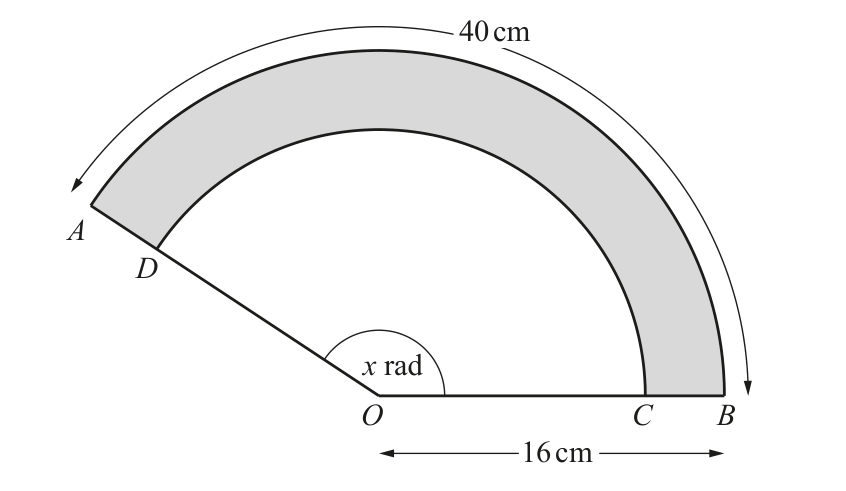
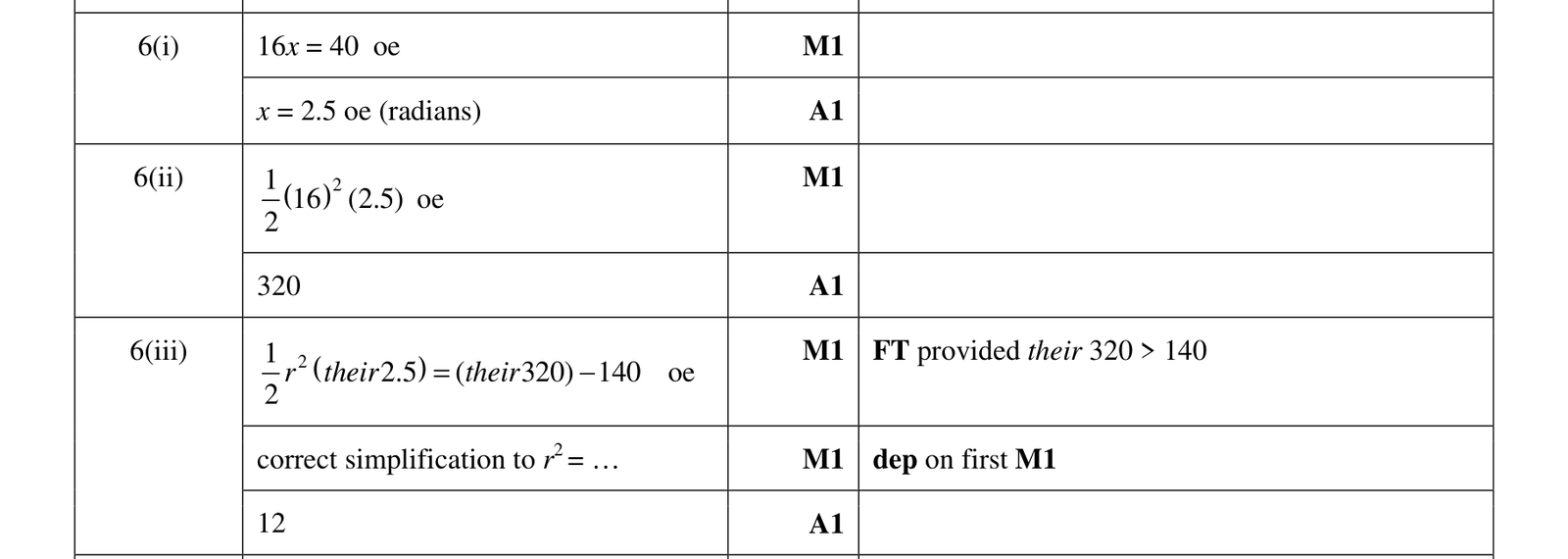
In the diagram \(AOB\) and \(DOC\) are sectors of a circle centre \(O\). The angle \(AOB\) is \(x\) radians. The length of the arc \(AB\) is \(40\text{ cm}\) and the radius \(OB\) is \(16\text{ cm}\).
(i) Find the value of \(x\).
(ii) Find the area of sector \(AOB\).
(iii) Given that the area of the shaded region \(ABCD\) is \(140\text{ cm}^2\), find the length of \(OC\).
0606 P22 - Jun 2018 - Q6 - 6 marks
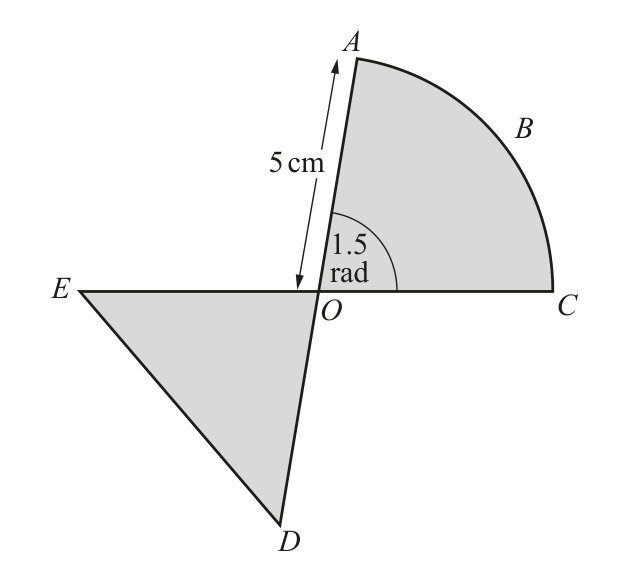
The diagram shows two shaded regions. \(ABC\) is an arc of a circle with centre \(O\), radius \(5\text{ cm}\), and angle \(AOC=1.5\) radians. \(AD\) and \(CE\) are diameters of the circle and \(DE\) is a straight line.
(i) Find the total perimeter of the shaded regions.
(ii) Find the total area of the shaded regions.

0606 P23 - Jun 2018 - Q6 - 7 marks
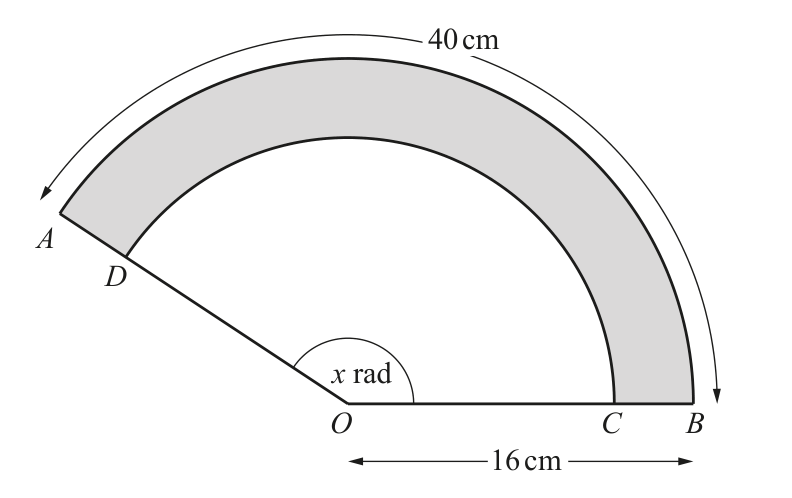
In the diagram \(AOB\) and \(DOC\) are sectors of a circle centre \(O\). The angle \(AOB\) is \(x\) radians. The length of the arc \(AB\) is \(40\text{ cm}\) and the radius \(OB\) is \(16\text{ cm}\).
(i) Find the value of \(x\).
(ii) Find the area of sector \(AOB\).
(iii) Given that the area of the shaded region \(ABCD\) is \(140\text{ cm}^2\), find the length of \(OC\).

0606 P11 - Nov 2018 - Q5 - 7 marks
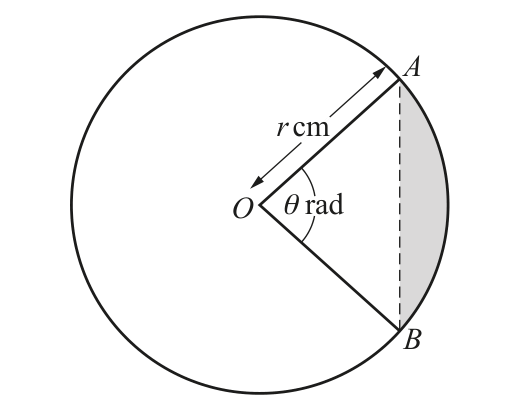
The diagram shows a circle with centre \(O\) and radius \(r\) cm. The minor arc \(AB\) is such that angle \(AOB\) is \(\theta\) radians. The area of the minor sector \(AOB\) is \(48\text{ cm}^2\).
(i) Show that \(\theta=\dfrac{96}{r^2}\).
(ii) Given that the minor arc \(AB\) has length \(12\) cm, find the value of \(r\) and of \(\theta\).
(iii) Using your values of \(r\) and \(\theta\), find the area of the shaded region.

0606 P12 - Nov 2018 - Q11 - 10 marks
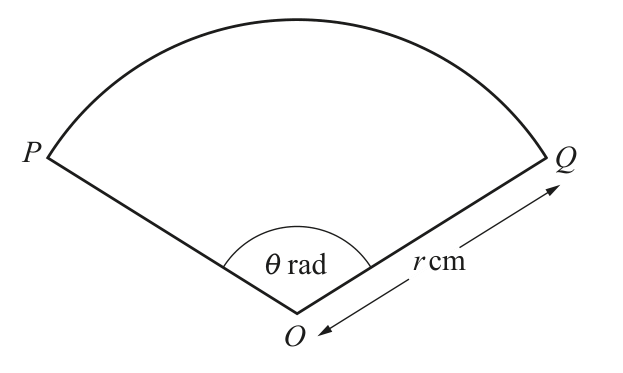
The diagram shows the sector \(OPQ\) of a circle, centre \(O\), radius \(r\) cm, where angle \(POQ=\theta\) radians. The perimeter of the sector is \(10\) cm.
(i) Show that the area, \(A\text{ cm}^2\), of the sector is given by
\(A=\frac{50\theta}{(2+\theta)^2}.\)
It is given that \(\theta\) can vary and \(A\) has a maximum value.
(ii) Find the maximum value of \(A\).

0606 P13 - Nov 2018 - Q2 - 6 marks
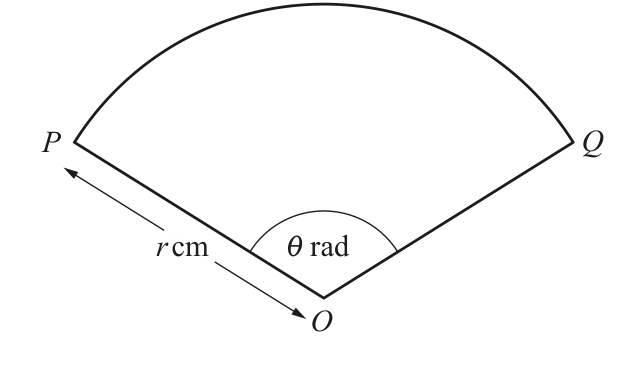
The diagram shows a sector \(POQ\) of a circle, centre \(O\), radius \(r\text{ cm}\), where angle \(POQ=\theta\) radians. The perimeter of the sector is \(20\text{ cm}\).
(i) Show that the area, \(A\text{ cm}^2\), of the sector is given by \(A=10r-r^2\).
It is given that \(r\) can vary and that \(A\) has a maximum value.
(ii) Find the value of \(\theta\) for which \(A\) has a maximum value.

0606 P11 - Jun 2017 - Q6 - 11 marks
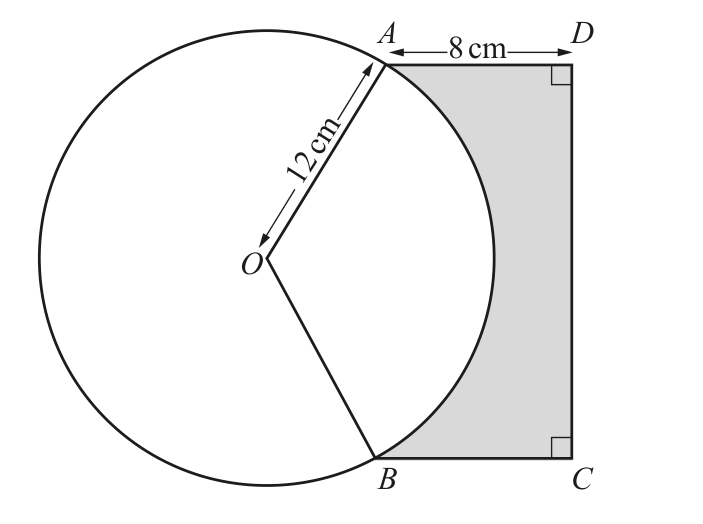
The diagram shows a circle, centre \(O\), radius \(12\text{ cm}\). The points \(A\) and \(B\) lie on the circumference of the circle and form a rectangle with points \(C\) and \(D\). The length of \(AD\) is \(8\text{ cm}\), and the area of the minor sector \(AOB\) is \(150\text{ cm}^2\).
(i) Show that angle \(AOB\) is \(2.08\) radians, correct to 2 decimal places.
(ii) Find the area of the shaded region \(ADCB\).
(iii) Find the perimeter of the shaded region \(ADCB\).

0606 P12 - Jun 2017 - Q10 - 11 marks
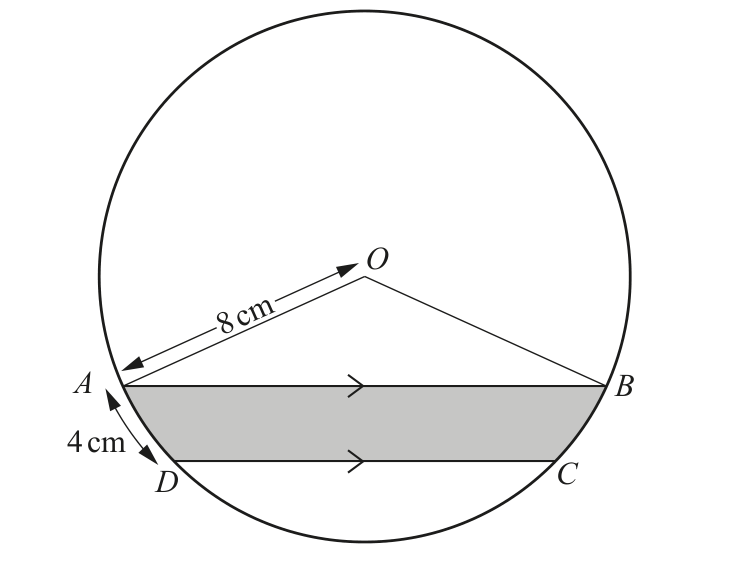
The diagram shows a circle, centre \(O\), radius \(8\text{ cm}\). Points \(A,B,C,D\) lie on the circumference such that \(AB\) is parallel to \(DC\). The length of the arc \(AD\) is \(4\text{ cm}\), and the length of the chord \(AB\) is \(15\text{ cm}\).
(i) Find, in radians, \(\angle AOD\).
(ii) Hence show that \(\angle DOC=1.43\) radians, correct to 2 decimal places.
(iii) Find the perimeter of the shaded region.
(iv) Find the area of the shaded region.

0606 P23 - Jun 2017 - Q8 - 8 marks
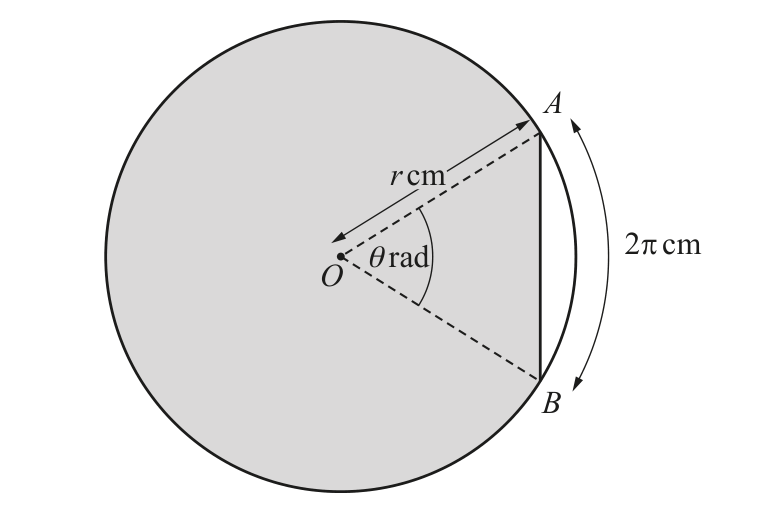
The diagram shows a circle, centre \(O\) of radius \(r\text{ cm}\), and a chord \(AB\). Angle \(AOB=\theta\) radians.
The length of the major arc \(AB\) is \(5\) times the length of the minor arc \(AB\). The minor arc \(AB\) has length \(2\pi\text{ cm}\).
(i) Find the value of \(\theta\) and of \(r\).
(ii) Calculate the exact perimeter of the shaded segment.
(iii) Calculate the exact area of the shaded segment.
0606 P11 - Nov 2017 - Q9 - 10 marks
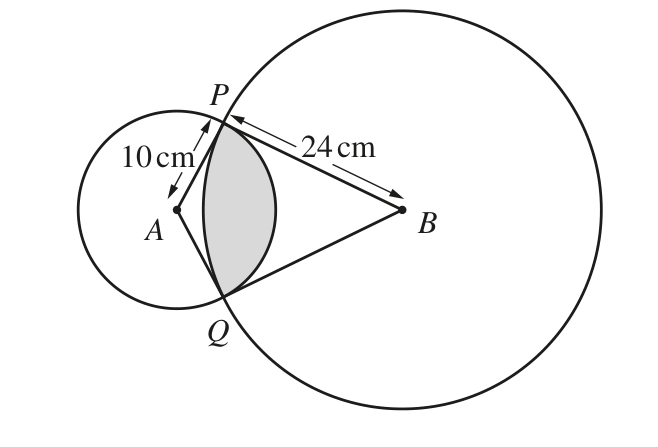
The diagram shows a circle, centre \(A\), radius \(10\) cm, intersecting a circle, centre \(B\), radius \(24\) cm. The two circles intersect at the points \(P\) and \(Q\). The radii \(AP\) and \(AQ\) are tangents to the circle with centre \(B\). The radii \(BP\) and \(BQ\) are tangents to the circle with centre \(A\).
(i) Show that angle \(PAQ\) is \(2.35\) radians, correct to 3 significant figures.
(ii) Find angle \(PBQ\) in radians.
(iii) Find the perimeter of the shaded region.
(iv) Find the area of the shaded region.

0606 P12 - Nov 2017 - Q10 - 8 marks
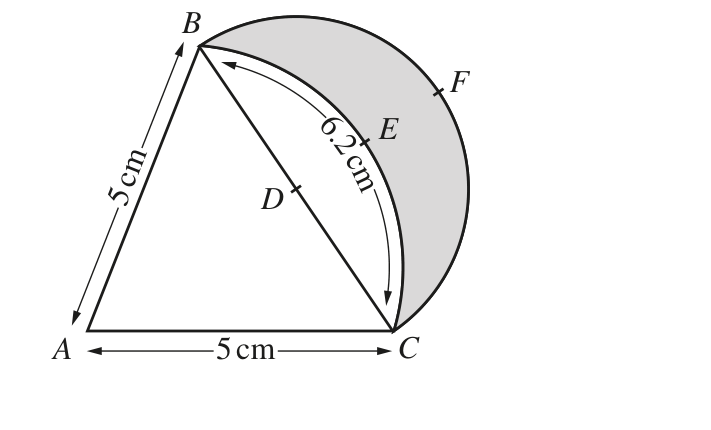
The diagram shows an isosceles triangle \(ABC\), where \(AB=AC=5\) cm. The arc \(BEC\) is part of the circle centre \(A\) and has length \(6.2\) cm. The point \(D\) is the midpoint of the line \(BC\). The arc \(BFC\) is a semi-circle centre \(D\).
(i) Show that angle \(BAC\) is \(1.24\) radians.
(ii) Find the perimeter of the shaded region.
(iii) Find the area of the shaded region.

0606 P13 - Nov 2017 - Q11 - 10 marks
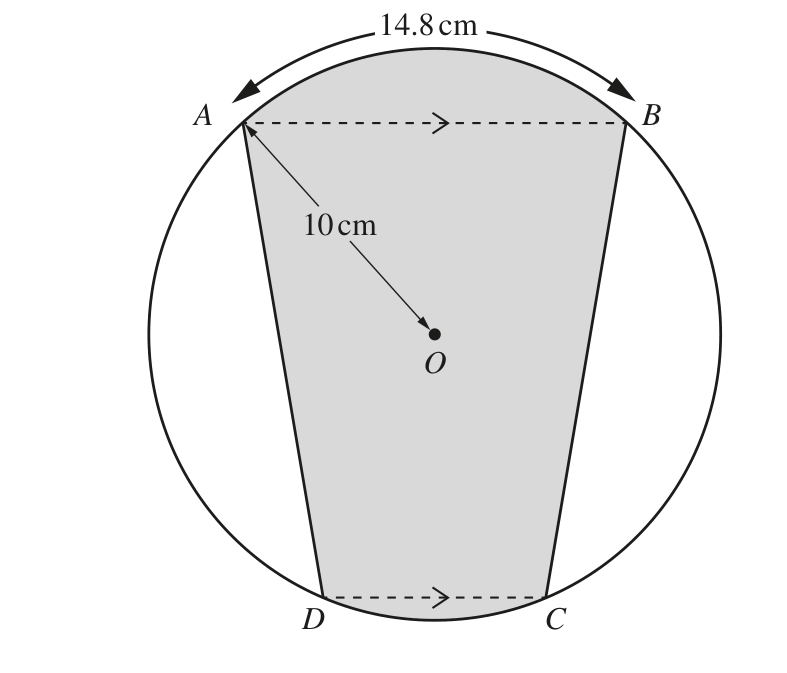
The diagram shows a circle, centre \(O\), radius \(10\text{ cm}\). The points \(A\), \(B\), \(C\), and \(D\) lie on the circumference of the circle such that \(AB\) is parallel to \(DC\). The length of the minor arc \(AB\) is \(14.8\text{ cm}\). The area of the minor sector \(ODC\) is \(21.8\text{ cm}^2\).
(i) Write down, in radians, angle \(AOB\).
(ii) Find, in radians, angle \(DOC\).
(iii) Find the perimeter of the shaded region.
(iv) Find the area of the shaded region.