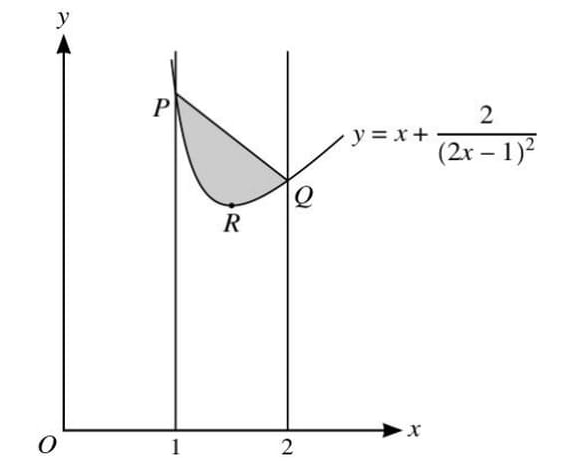
(a) To find the stationary point \(R\), we need to find \(\frac{dy}{dx}\) and set it to zero. The derivative is \(\frac{dy}{dx} = -\frac{8}{(2x-1)^3} + 1\).
Substitute \(x = \frac{3}{2}\) into the derivative: \(\frac{dy}{dx} = -\frac{8}{8} + 1 = 0\). Hence, the \(x\)-coordinate of \(R\) is \(\frac{3}{2}\).
When \(x = \frac{3}{2}\), \(y = \frac{2}{4} + \frac{3}{2} = 2\). Thus, the \(y\)-coordinate of \(R\) is 2.
(b) The \(y\)-coordinate of \(P\) is 3, and the \(y\)-coordinate of \(Q\) is \(\frac{20}{9}\).
The area under the curve from \(x = 1\) to \(x = 2\) is given by:
\(\int_{1}^{2} \left( \frac{2}{(2x-1)^2} + x \right) \, dx = \left[ \frac{1}{3} x^3 + 2x - \frac{1}{2x-1} \right]_{1}^{2}\).
Evaluating this integral gives \(\frac{13}{6}\).
The area of the trapezium formed by the lines \(x = 1\), \(x = 2\), and the line \(y = x\) is \(\frac{1}{2} \left( 3 + \frac{20}{9} \right) = \frac{47}{18}\).
Thus, the exact value of the area of the shaded region is \(\frac{47}{18}\).