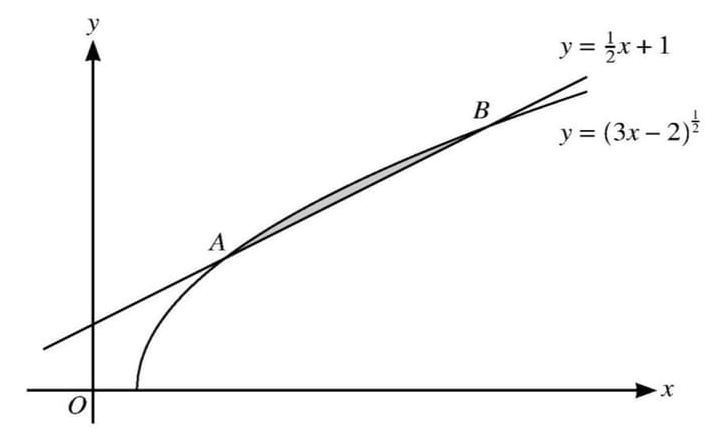
(a) To find the points of intersection, set the equations equal: \((3x - 2)^{\frac{1}{2}} = \frac{1}{2}x + 1\).
Square both sides: \(3x - 2 = \left( \frac{1}{2}x + 1 \right)^2\).
Expand the right side: \(3x - 2 = \frac{1}{4}x^2 + x + 1\).
Rearrange to form a quadratic equation: \(\frac{1}{4}x^2 - 2x + 3 = 0\).
Multiply through by 4 to clear the fraction: \(x^2 - 8x + 12 = 0\).
Factorize: \((x - 6)(x - 2) = 0\).
Thus, \(x = 2\) or \(x = 6\).
Substitute back to find \(y\):
For \(x = 2\), \(y = \frac{1}{2}(2) + 1 = 2\).
For \(x = 6\), \(y = \frac{1}{2}(6) + 1 = 4\).
Coordinates are \((2, 2)\) and \((6, 4)\).
(b) The area between the curve and the line is given by the integral:
\(\text{Area} = \int_{2}^{6} \left( (3x - 2)^{\frac{1}{2}} - \left( \frac{1}{2}x + 1 \right) \right) \, dx\).
Integrate each part:
\(\int (3x - 2)^{\frac{1}{2}} \, dx = \frac{2}{9}(3x - 2)^{\frac{3}{2}}\).
\(\int \left( \frac{1}{2}x + 1 \right) \, dx = \frac{1}{4}x^2 + x\).
Evaluate from 2 to 6:
\(\left[ \frac{2}{9}(3x - 2)^{\frac{3}{2}} \right]_{2}^{6} - \left[ \frac{1}{4}x^2 + x \right]_{2}^{6}\).
Calculate each part:
\(\frac{2}{9}(16)^{\frac{3}{2}} - \frac{2}{9}(4)^{\frac{3}{2}} - \left( \frac{1}{4}(36) + 6 - \left( \frac{1}{4}(4) + 2 \right) \right)\).
\(= \frac{4}{9}\).