June 2021 p13 q11
1264
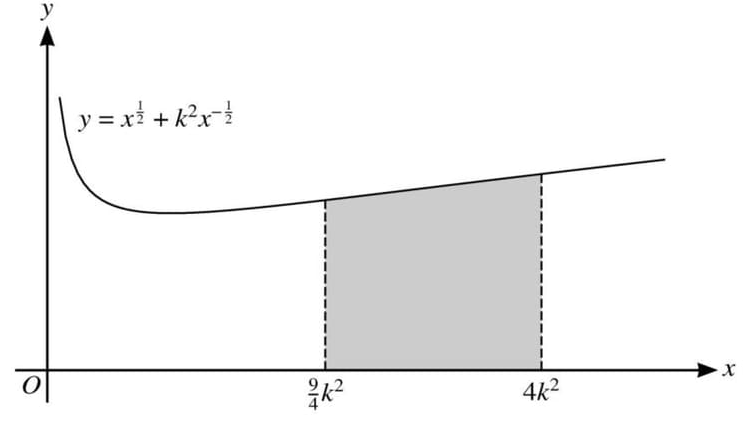
The diagram shows part of the curve with equation \(y = x^{\frac{1}{2}} + k^2 x^{-\frac{1}{2}}\), where \(k\) is a positive constant.
(a) Find the coordinates of the minimum point of the curve, giving your answer in terms of \(k\).
The tangent at the point on the curve where \(x = 4k^2\) intersects the y-axis at \(P\).
(b) Find the y-coordinate of \(P\) in terms of \(k\).
The shaded region is bounded by the curve, the x-axis and the lines \(x = \frac{9}{4}k^2\) and \(x = 4k^2\).
(c) Find the area of the shaded region in terms of \(k\).
Solution
(a) Differentiate \(y = x^{\frac{1}{2}} + k^2 x^{-\frac{1}{2}}\) to find \(\frac{dy}{dx} = \frac{1}{2}x^{-\frac{1}{2}} - \frac{1}{2}k^2 x^{-\frac{3}{2}}\).
Set \(\frac{dy}{dx} = 0\) to find critical points: \(\frac{1}{2}x^{-\frac{1}{2}} = \frac{1}{2}k^2 x^{-\frac{3}{2}}\).
Simplify to get \(x = k^2\). Substitute back into the original equation to find \(y = 2k\).
Thus, the minimum point is \((k^2, 2k)\).
(b) At \(x = 4k^2\), find \(\frac{dy}{dx} = \frac{1}{4k} - \frac{1}{16k} = \frac{3}{16k}\).
The y-coordinate at \(x = 4k^2\) is \(y = 2k + \frac{k}{2} = \frac{5k}{2}\).
The equation of the tangent is \(y - \frac{5k}{2} = \frac{3}{16k}(x - 4k^2)\).
When \(x = 0\), \(y = \frac{7k}{4}\).
(c) Integrate \(\int (x^{\frac{1}{2}} + k^2 x^{-\frac{1}{2}}) \, dx\) to get \(\frac{2}{3}x^{\frac{3}{2}} + 2k^2 x^{\frac{1}{2}}\).
Apply limits from \(x = \frac{9}{4}k^2\) to \(x = 4k^2\).
Calculate the definite integral: \(\left[ \frac{16k^3}{3} + 4k^3 \right] - \left[ \frac{9k^3}{4} + 3k^3 \right] = \frac{49k^3}{12}\).
Log in to record attempts.