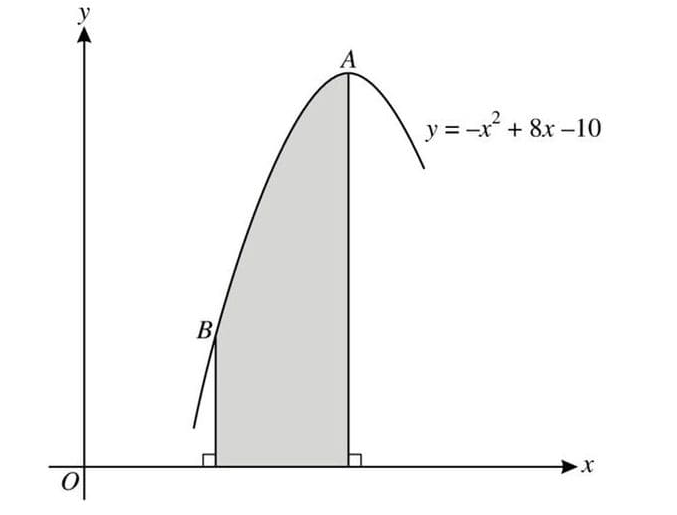
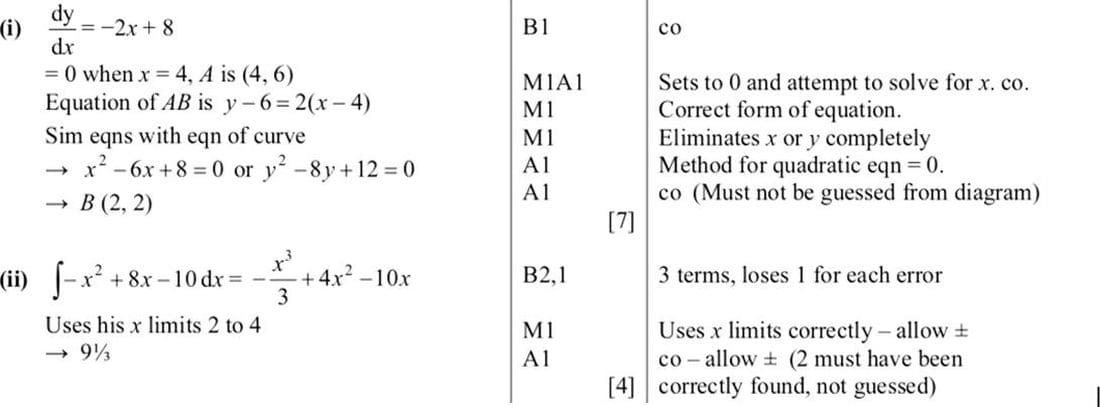
(i) To find the coordinates of \(A\), we need to find the maximum point of the curve \(y = -x^2 + 8x - 10\). The derivative is \(\frac{dy}{dx} = -2x + 8\). Setting \(\frac{dy}{dx} = 0\) gives \(-2x + 8 = 0\), so \(x = 4\). Substituting \(x = 4\) into the equation of the curve gives \(y = -(4)^2 + 8(4) - 10 = 6\). Thus, \(A(4, 6)\).
The gradient of line \(BA\) is 2, so the equation of line \(AB\) is \(y - 6 = 2(x - 4)\). Simplifying gives \(y = 2x - 2\).
To find \(B\), solve the system of equations: \(y = -x^2 + 8x - 10\) and \(y = 2x - 2\). Equating gives \(-x^2 + 8x - 10 = 2x - 2\), which simplifies to \(x^2 - 6x + 8 = 0\). Solving this quadratic equation gives \(x = 2\) or \(x = 4\). For \(x = 2\), \(y = 2(2) - 2 = 2\). Thus, \(B(2, 2)\).
(ii) To find the area of the shaded region, evaluate \(\int_{2}^{4} (-x^2 + 8x - 10) \, dx\). The integral is \(\int (-x^2 + 8x - 10) \, dx = -\frac{x^3}{3} + 4x^2 - 10x\).
Evaluate from 2 to 4: \(\left[-\frac{(4)^3}{3} + 4(4)^2 - 10(4)\right] - \left[-\frac{(2)^3}{3} + 4(2)^2 - 10(2)\right]\).
Calculating gives \(\left[-\frac{64}{3} + 64 - 40\right] - \left[-\frac{8}{3} + 16 - 20\right] = \left[-\frac{64}{3} + 24\right] - \left[-\frac{8}{3} - 4\right]\).
This simplifies to \(\frac{28}{3} + \frac{20}{3} = \frac{48}{3} = 16\).
Thus, the area of the shaded region is \(9\frac{1}{3}\).