Past Exam Questions
← Back9709 P12 - Nov 2020 - Q10
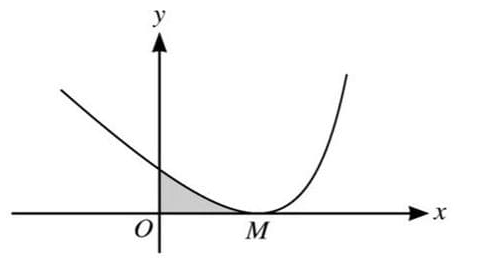
The diagram shows part of the curve \(y = \frac{2}{(3 - 2x)^2} - x\) and its minimum point \(M\), which lies on the \(x\)-axis.
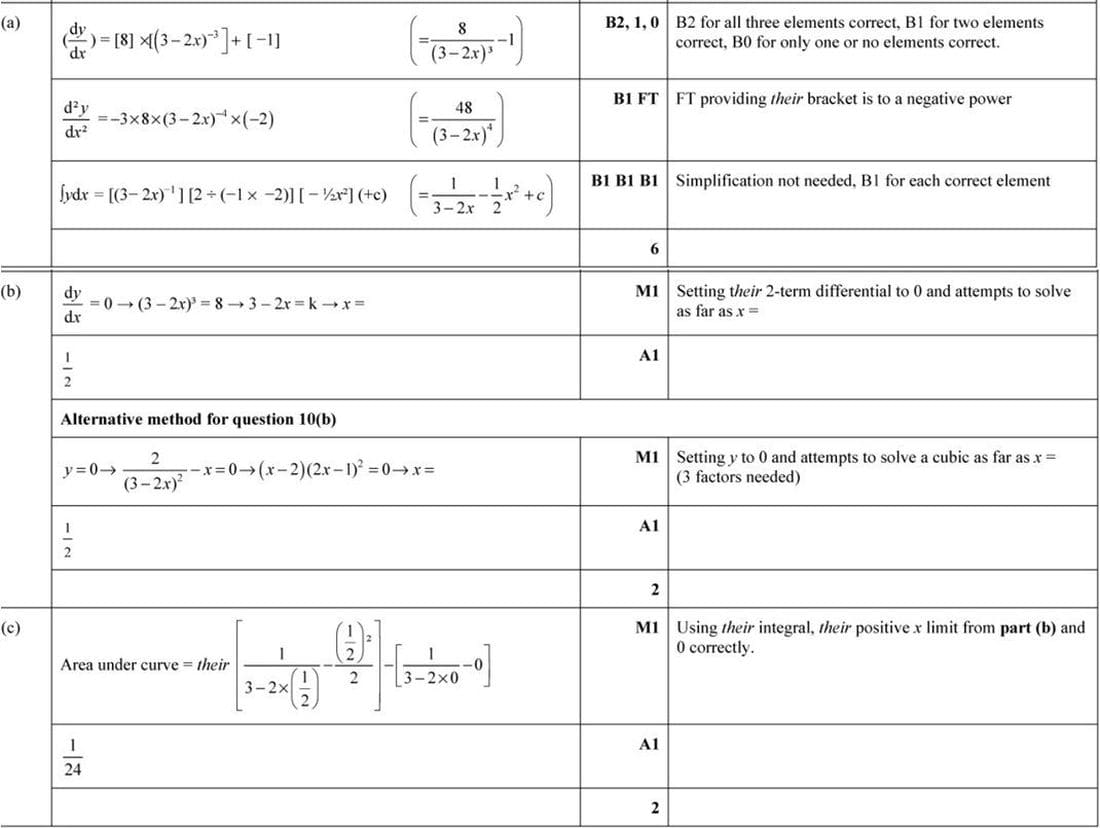
(a) Find expressions for \(\frac{dy}{dx}\), \(\frac{d^2y}{dx^2}\) and \(\int y \, dx\).
(b) Find, by calculation, the \(x\)-coordinate of \(M\).
(c) Find the area of the shaded region bounded by the curve and the coordinate axes.
9709 P11 - Nov 2020 - Q12
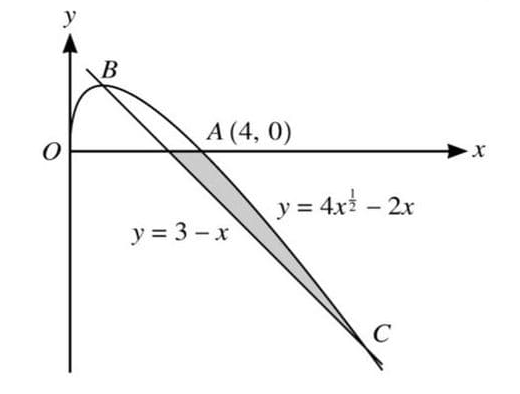
The diagram shows a curve with equation \(y = 4x^{\frac{1}{2}} - 2x\) for \(x \geq 0\), and a straight line with equation \(y = 3 - x\). The curve crosses the x-axis at \(A(4, 0)\) and crosses the straight line at \(B\) and \(C\).
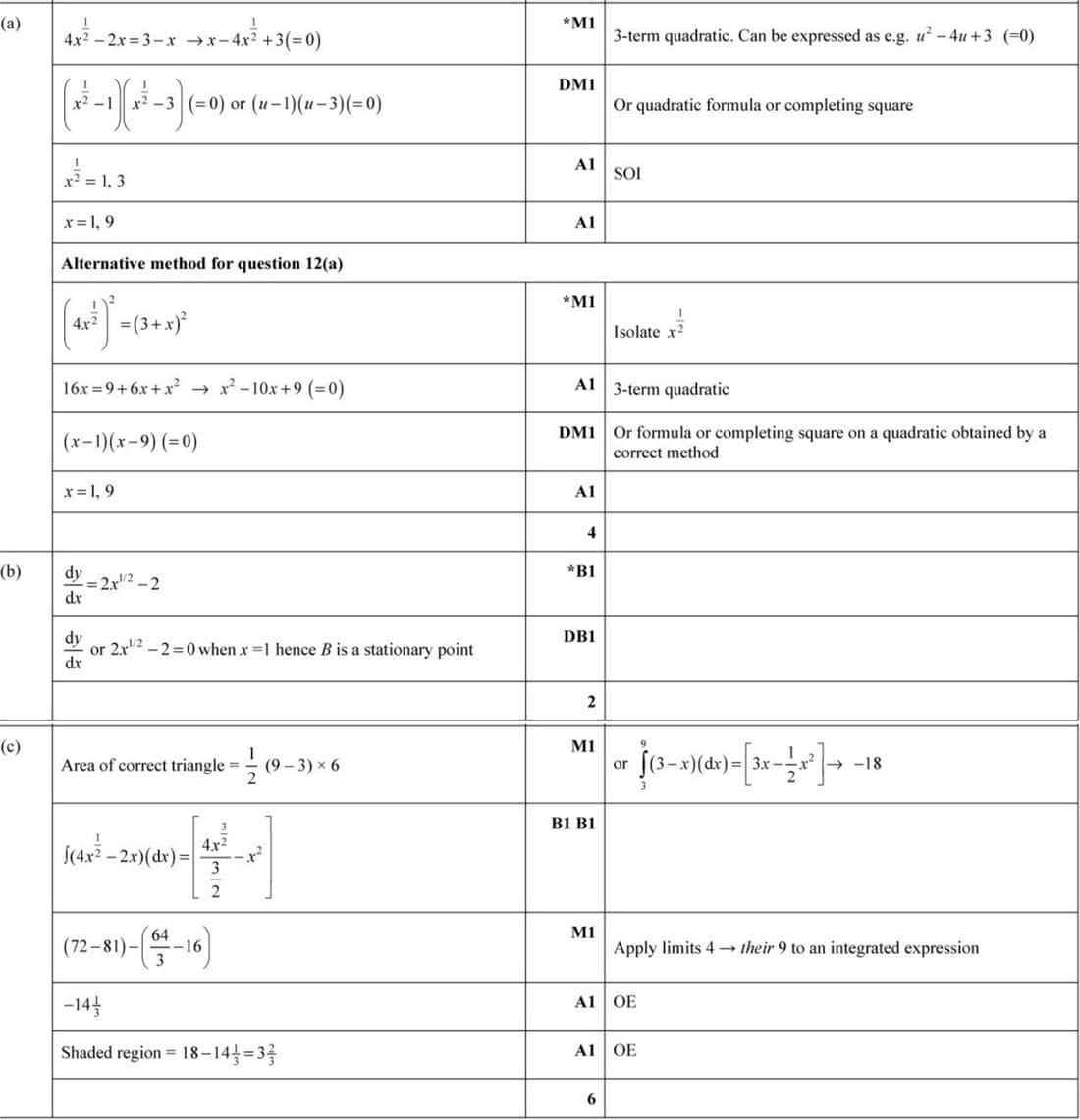
(a) Find, by calculation, the x-coordinates of \(B\) and \(C\).
(b) Show that \(B\) is a stationary point on the curve.
(c) Find the area of the shaded region.
9709 P13 - Jun 2020 - Q11
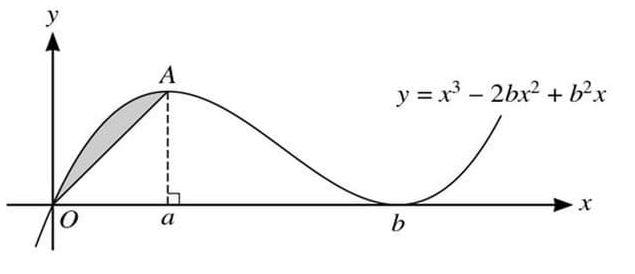
The diagram shows part of the curve with equation \(y = x^3 - 2bx^2 + b^2x\) and the line \(OA\), where \(A\) is the maximum point on the curve. The \(x\)-coordinate of \(A\) is \(a\) and the curve has a minimum point at \((b, 0)\), where \(a\) and \(b\) are positive constants.
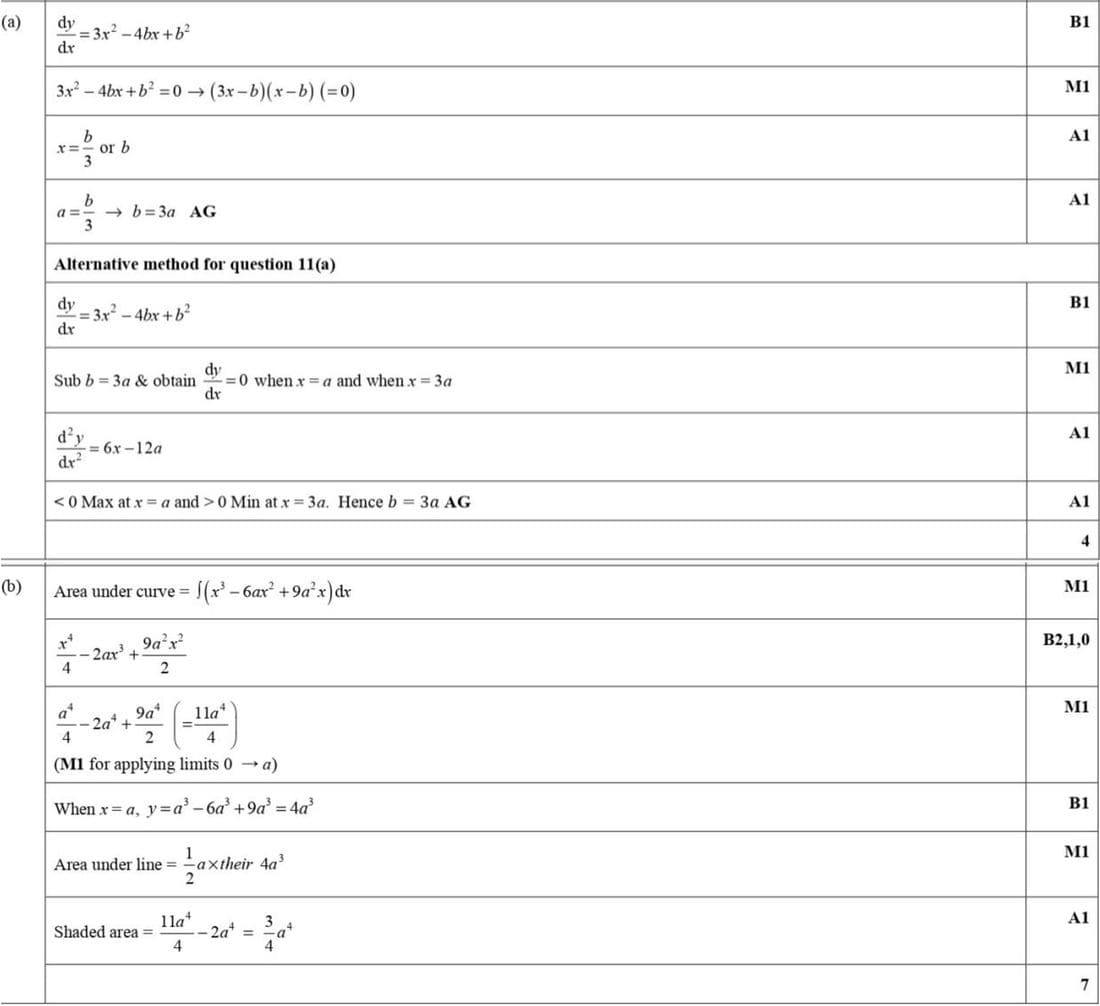
(a) Show that \(b = 3a\).
(b) Show that the area of the shaded region between the line and the curve is \(ka^4\), where \(k\) is a fraction to be found.
9709 P12 - Nov 2019 - Q10
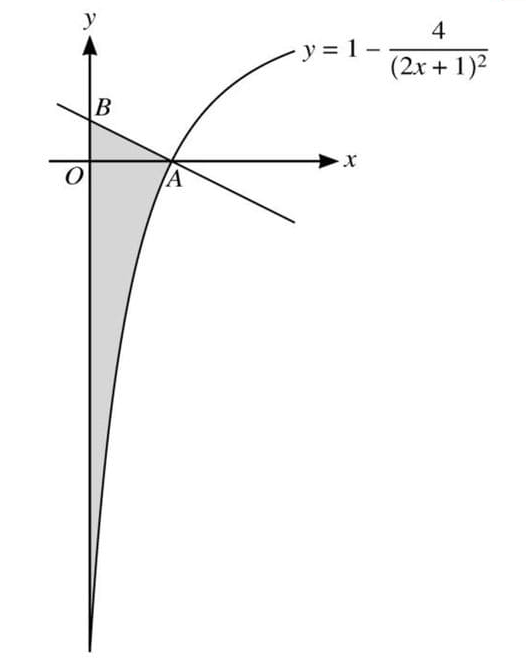
The diagram shows part of the curve \(y = 1 - \frac{4}{(2x+1)^2}\). The curve intersects the x-axis at \(A\). The normal to the curve at \(A\) intersects the y-axis at \(B\).
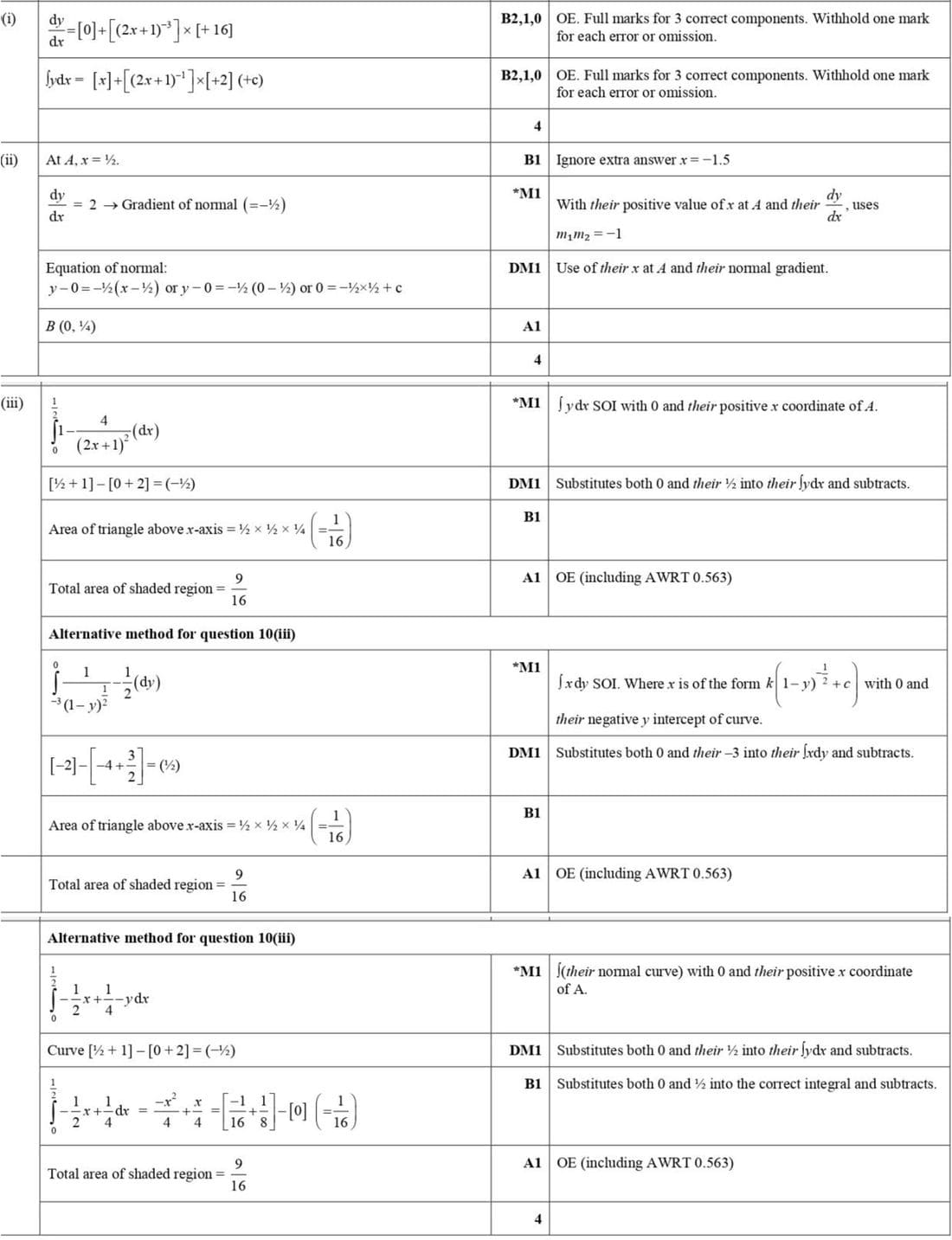
(i) Obtain expressions for \(\frac{dy}{dx}\) and \(\int y \, dx\).
(ii) Find the coordinates of \(B\).
(iii) Find, showing all necessary working, the area of the shaded region.
9709 P12 - Nov 2023 - Q9
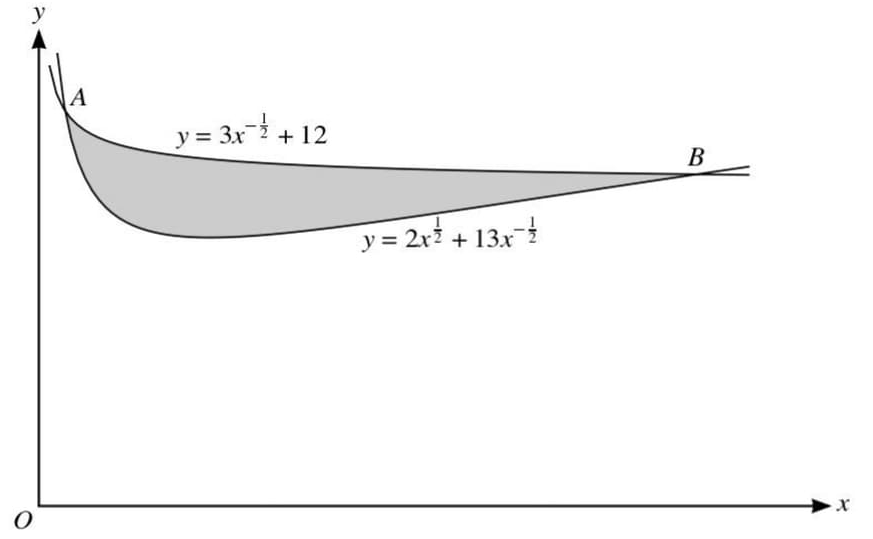
The diagram shows curves with equations \(y = 2x^{\frac{1}{2}} + 13x^{-\frac{1}{2}}\) and \(y = 3x^{-\frac{1}{2}} + 12\). The curves intersect at points \(A\) and \(B\).
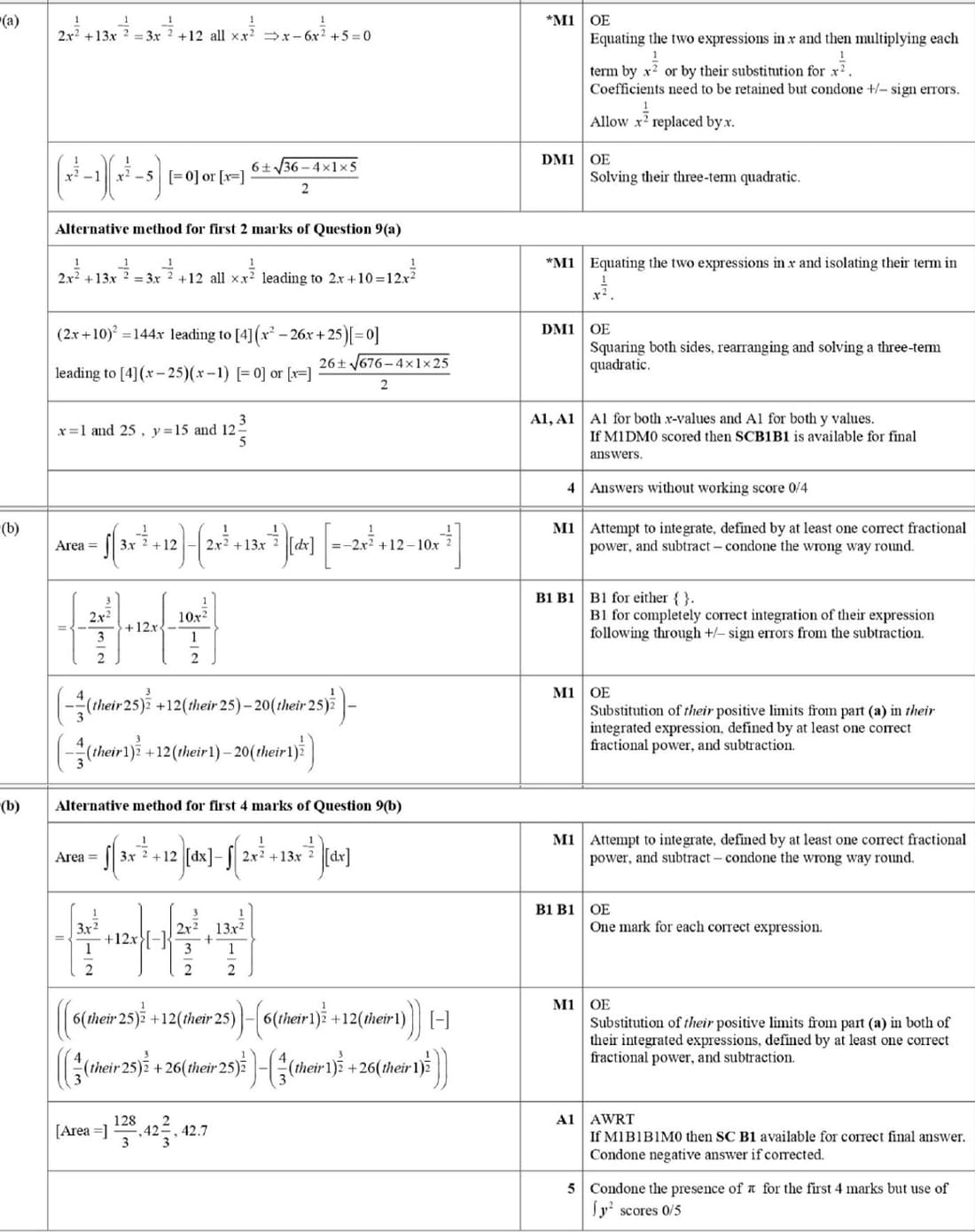
(a) Find the coordinates of \(A\) and \(B\).
(b) Hence find the area of the shaded region.
9709 P13 - Jun 2019 - Q10
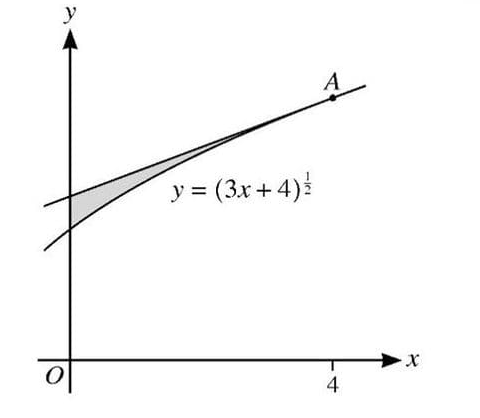
The diagram shows part of the curve with equation \(y = (3x + 4)^{\frac{1}{2}}\) and the tangent to the curve at the point A. The \(x\)-coordinate of A is 4.
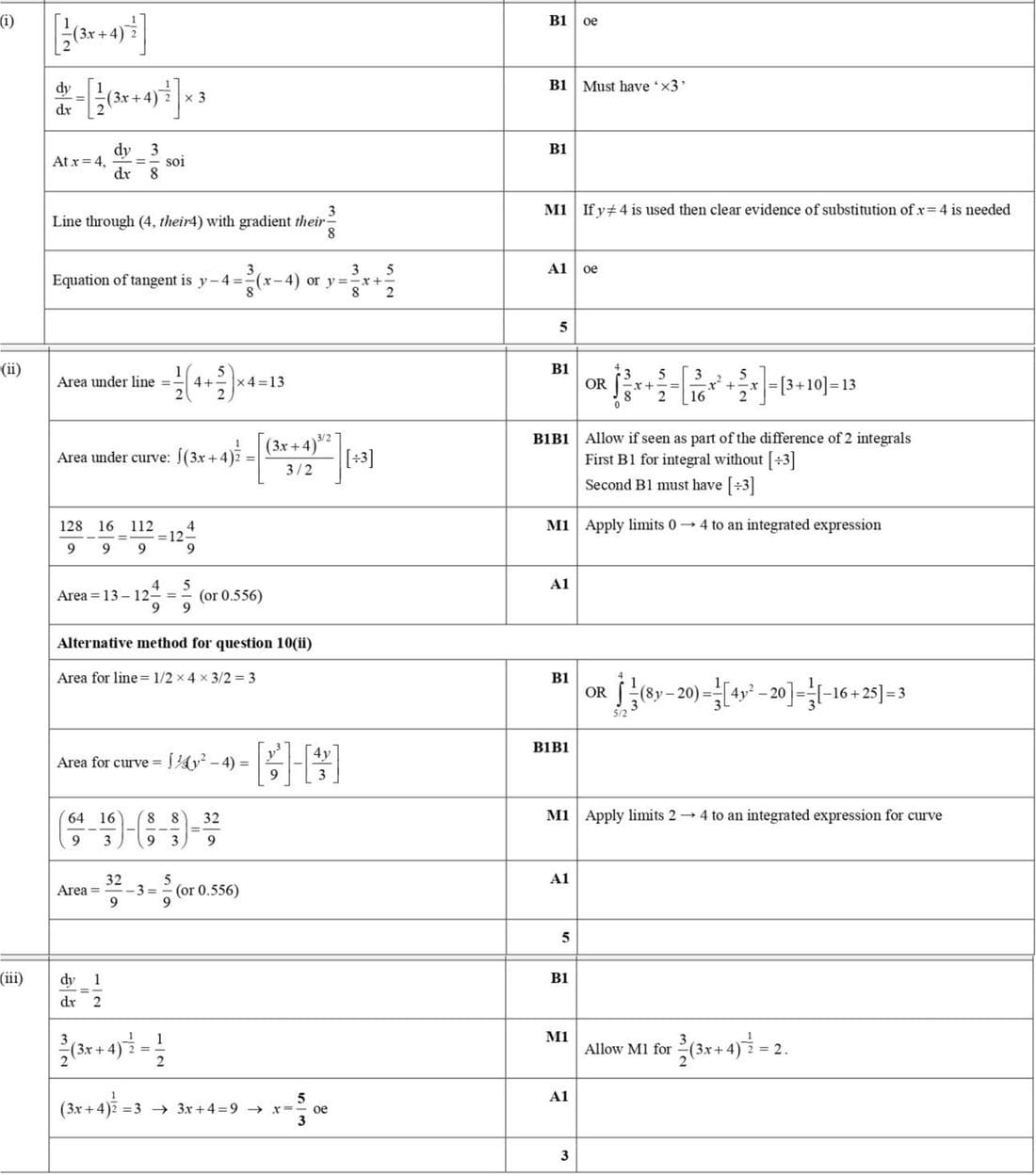
(i) Find the equation of the tangent to the curve at A.
(ii) Find, showing all necessary working, the area of the shaded region.
(iii) A point is moving along the curve. At the point P the \(y\)-coordinate is increasing at half the rate at which the \(x\)-coordinate is increasing. Find the \(x\)-coordinate of P.
9709 P12 - Jun 2019 - Q11
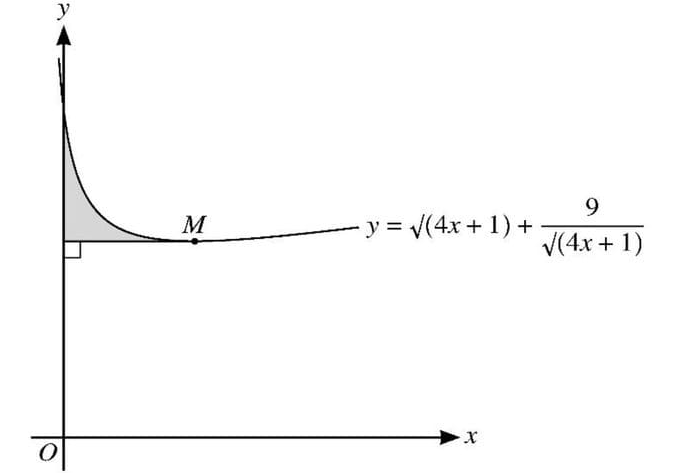
The diagram shows part of the curve \(y = \sqrt{4x+1} + \frac{9}{\sqrt{4x+1}}\) and the minimum point \(M\).
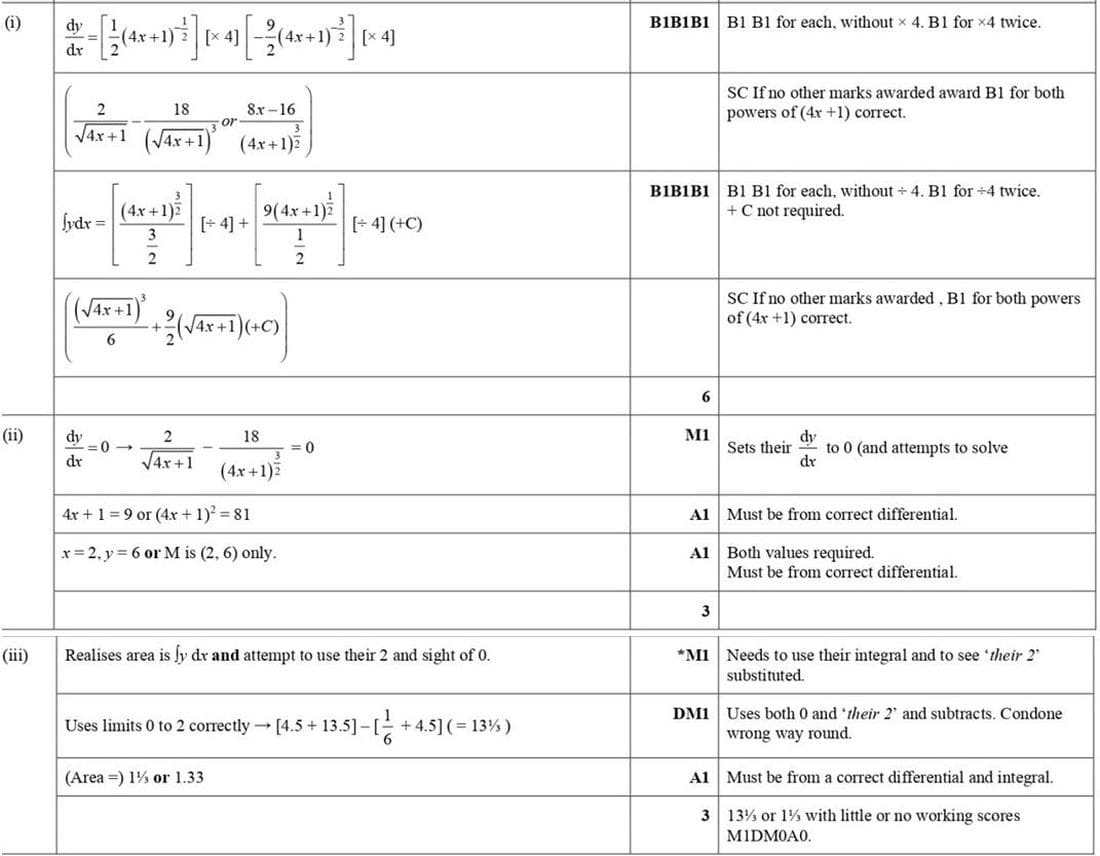
(i) Find expressions for \(\frac{dy}{dx}\) and \(\int y \, dx\).
(ii) Find the coordinates of \(M\).
The shaded region is bounded by the curve, the \(y\)-axis and the line through \(M\) parallel to the \(x\)-axis.
(iii) Find, showing all necessary working, the area of the shaded region.
9709 P11 - Jun 2019 - Q11
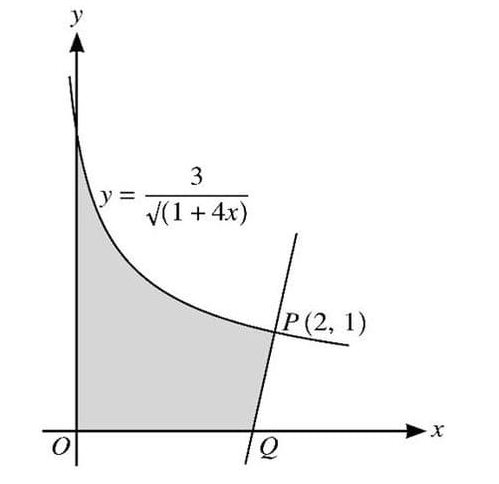
The diagram shows part of the curve \(y = \frac{3}{\sqrt{1 + 4x}}\) and a point \(P(2, 1)\) lying on the curve. The normal to the curve at \(P\) intersects the \(x\)-axis at \(Q\).
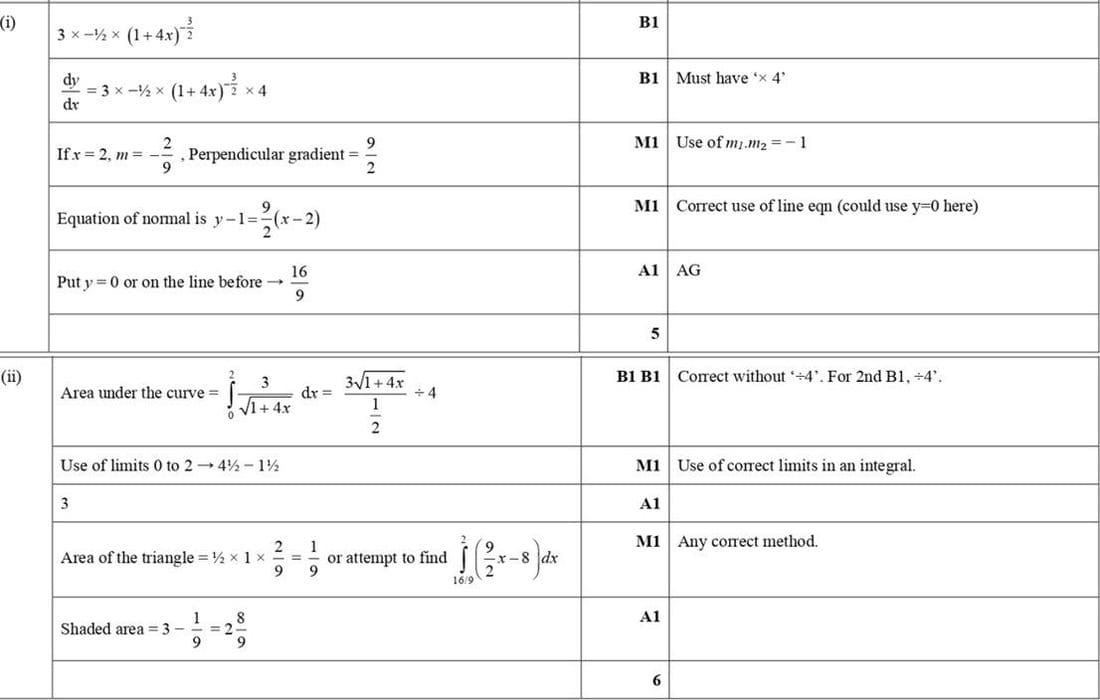
(i) Show that the \(x\)-coordinate of \(Q\) is \(\frac{16}{9}\).
(ii) Find, showing all necessary working, the area of the shaded region.
9709 P12 - Nov 2018 - Q11
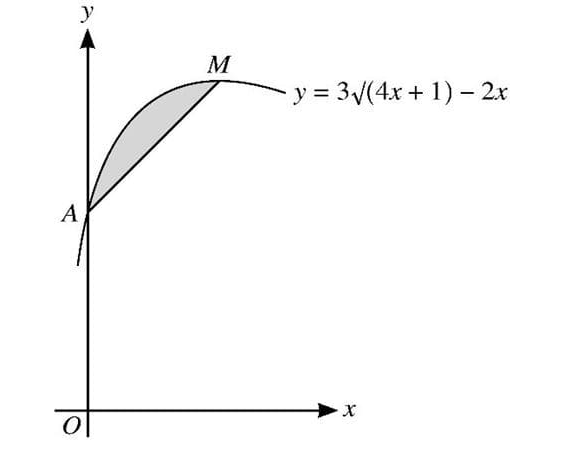
The diagram shows part of the curve \(y = 3\sqrt{4x + 1} - 2x\). The curve crosses the y-axis at \(A\) and the stationary point on the curve is \(M\).
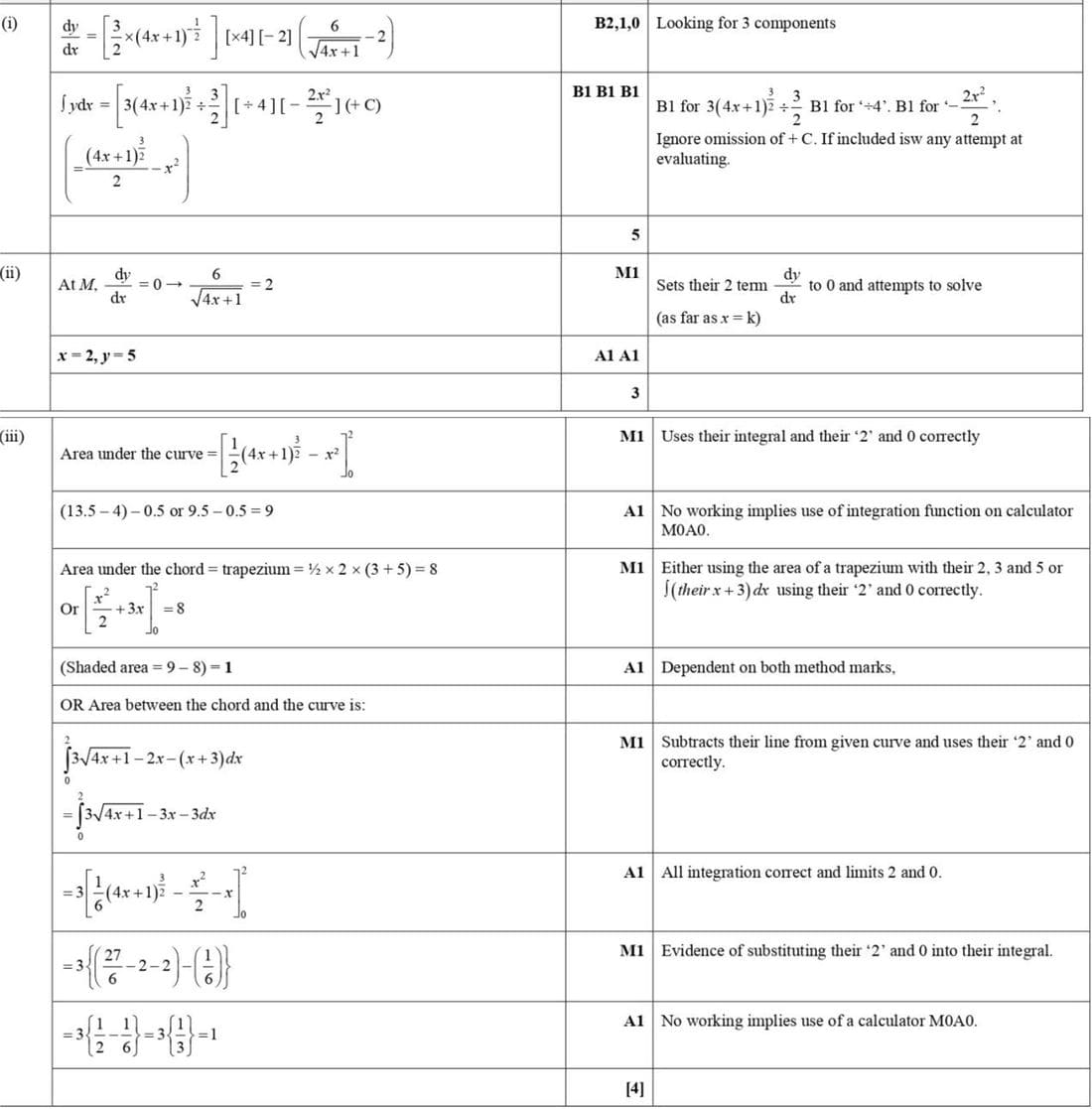
(i) Obtain expressions for \(\frac{dy}{dx}\) and \(\int y \, dx\).
(ii) Find the coordinates of \(M\).
(iii) Find, showing all necessary working, the area of the shaded region.
9709 P11 - Nov 2018 - Q7
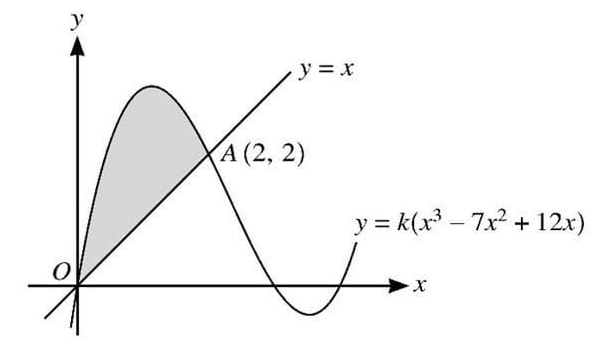
The diagram shows part of the curve with equation \(y = k(x^3 - 7x^2 + 12x)\) for some constant \(k\). The curve intersects the line \(y = x\) at the origin \(O\) and at the point \(A (2, 2)\).
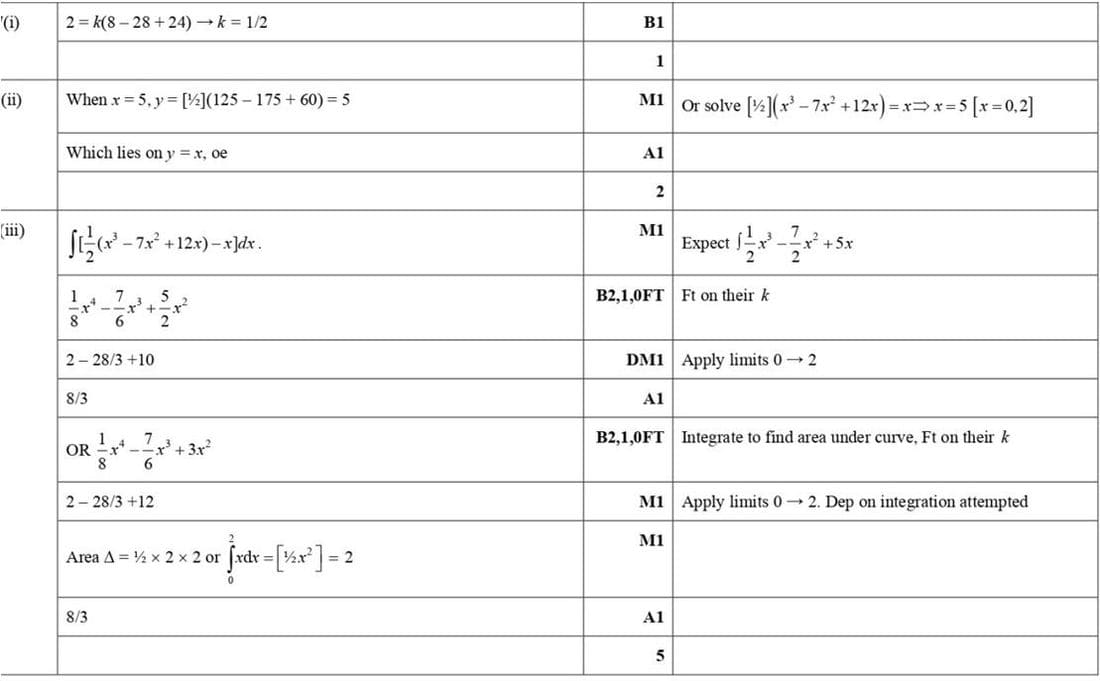
- Find the value of \(k\).
- Verify that the curve meets the line \(y = x\) again when \(x = 5\).
- Find, showing all necessary working, the area of the shaded region.
9709 P11 - Jun 2018 - Q10
The curve with equation \(y = x^3 - 2x^2 + 5x\) passes through the origin.
Showing all necessary working, find the area of the region enclosed by the curve, the \(x\)-axis and the line \(x = 6\).

9709 P12 - Mar 2018 - Q11
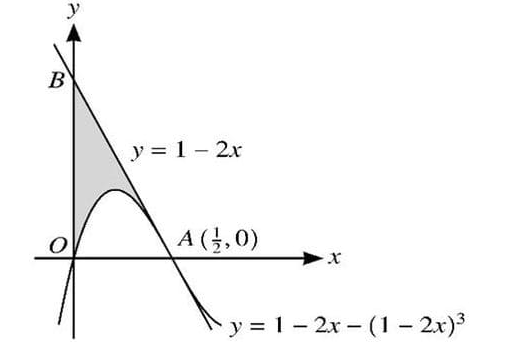
The diagram shows part of the curve \(y = 1 - 2x - (1 - 2x)^3\) intersecting the x-axis at the origin \(O\) and at \(A \left( \frac{1}{2}, 0 \right)\). The line \(AB\) intersects the y-axis at \(B\) and has equation \(y = 1 - 2x\).
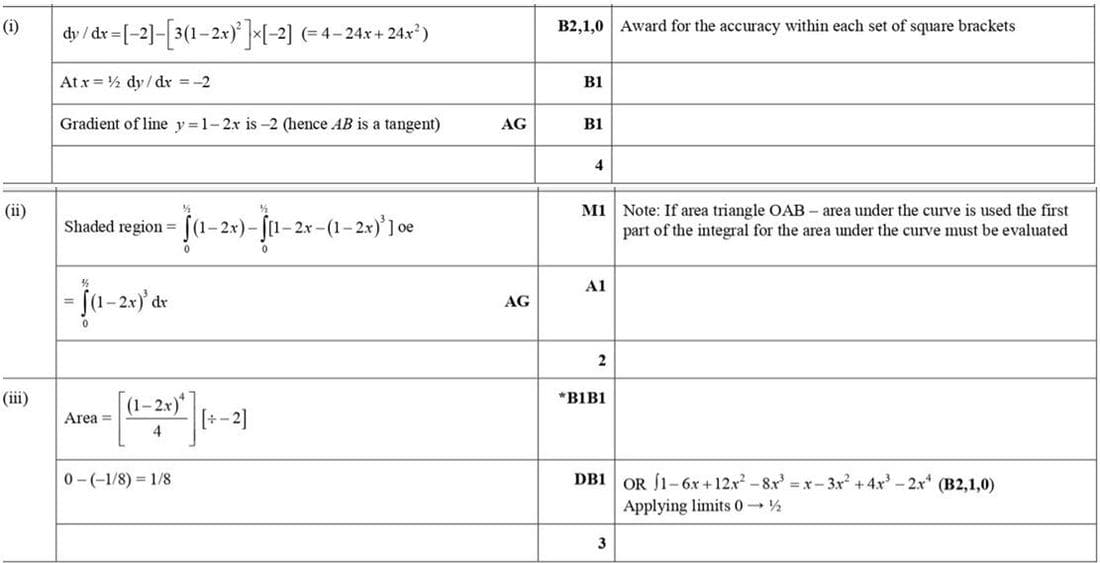
(i) Show that \(AB\) is the tangent to the curve at \(A\).
(ii) Show that the area of the shaded region can be expressed as \(\int_0^{\frac{1}{2}} (1 - 2x)^3 \, dx\).
(iii) Hence, showing all necessary working, find the area of the shaded region.
9709 P13 - Nov 2017 - Q8
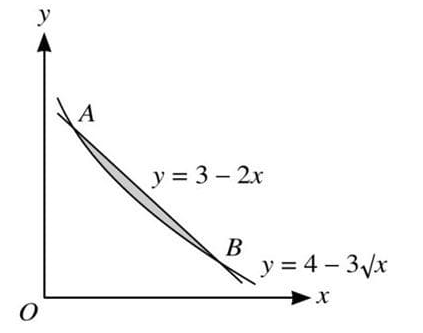
The diagram shows parts of the graphs of \(y = 3 - 2x\) and \(y = 4 - \frac{3}{\sqrt{x}}\) intersecting at points \(A\) and \(B\).
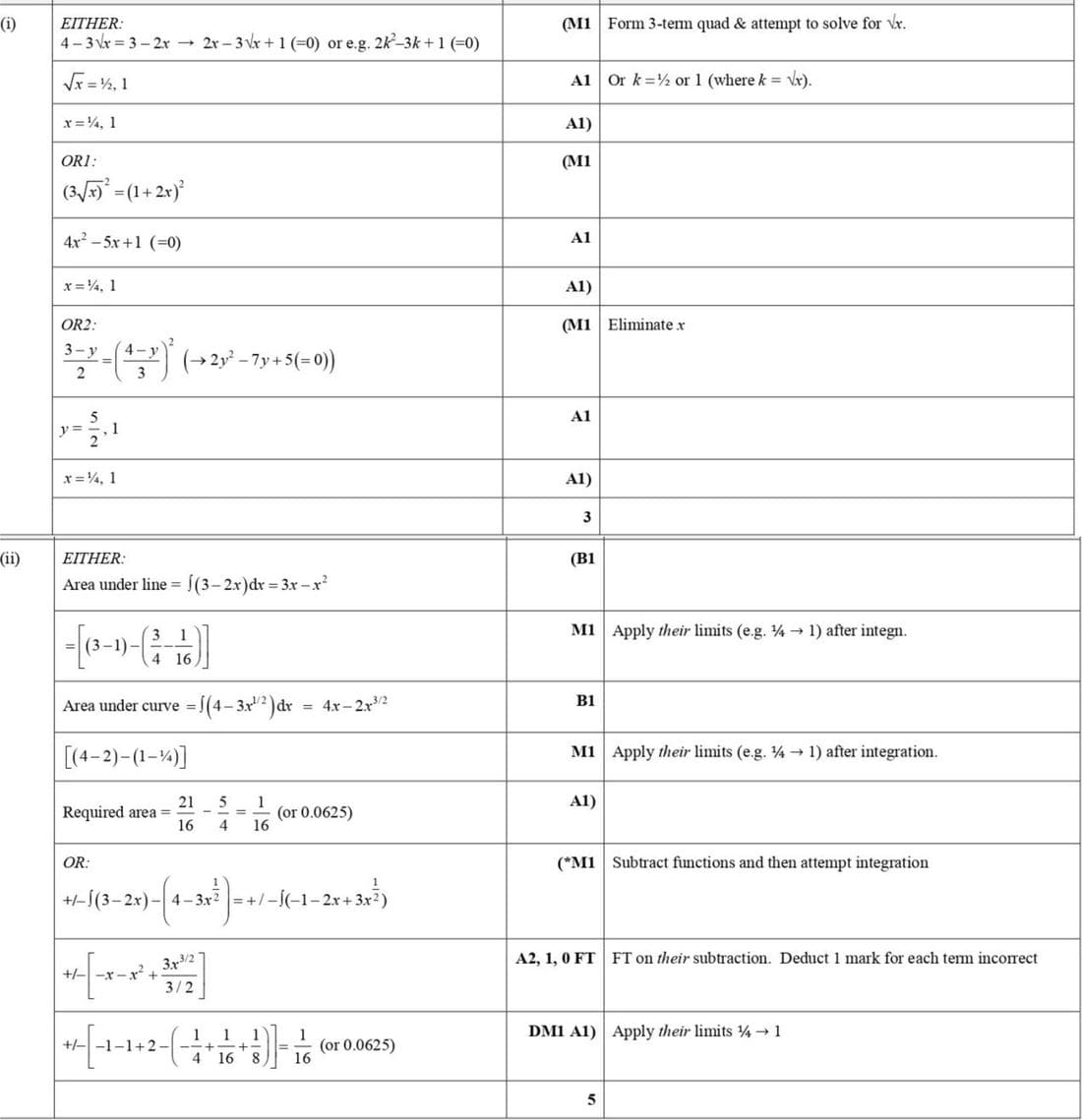
(i) Find by calculation the \(x\)-coordinates of \(A\) and \(B\).
(ii) Find, showing all necessary working, the area of the shaded region.
9709 P12 - Nov 2017 - Q10
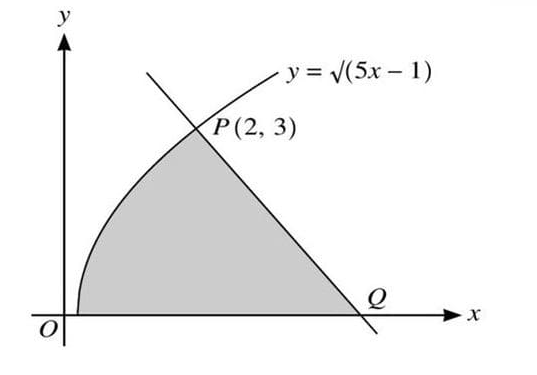
The diagram shows part of the curve \(y = \sqrt{5x - 1}\) and the normal to the curve at the point \(P(2, 3)\). This normal meets the x-axis at \(Q\).
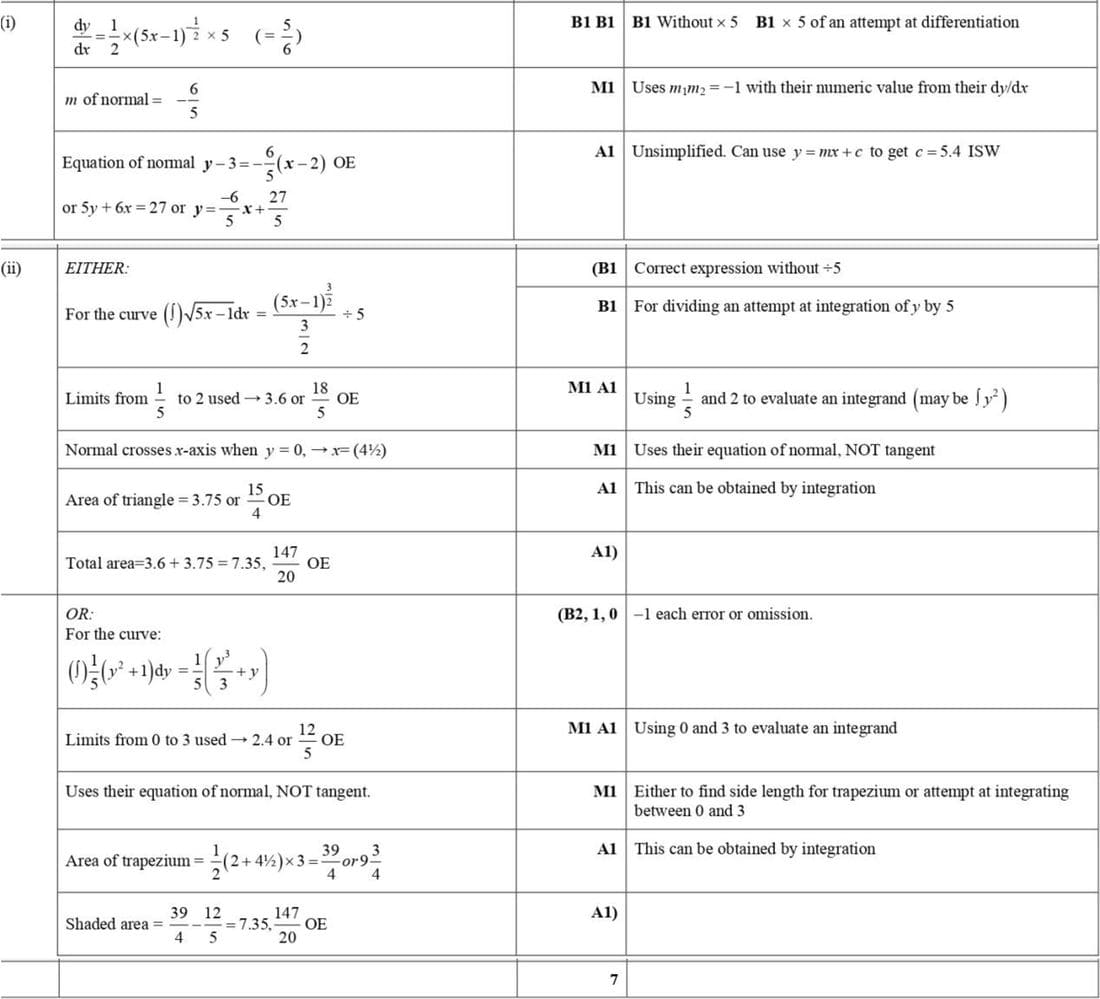
(i) Find the equation of the normal at \(P\).
(ii) Find, showing all necessary working, the area of the shaded region.
9709 P12 - Mar 2017 - Q10
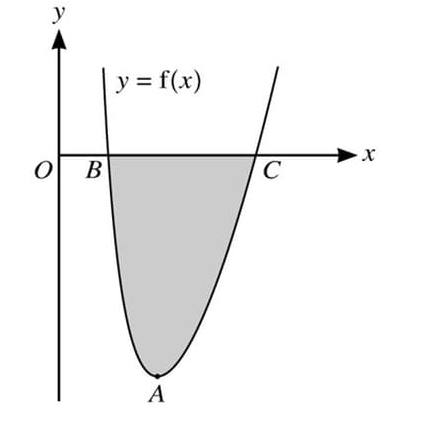
The diagram shows the curve \(y = f(x)\) defined for \(x > 0\). The curve has a minimum point at \(A\) and crosses the \(x\)-axis at \(B\) and \(C\). It is given that \(\frac{dy}{dx} = 2x - \frac{2}{x^3}\) and that the curve passes through the point \(\left(4, \frac{189}{16}\right)\).
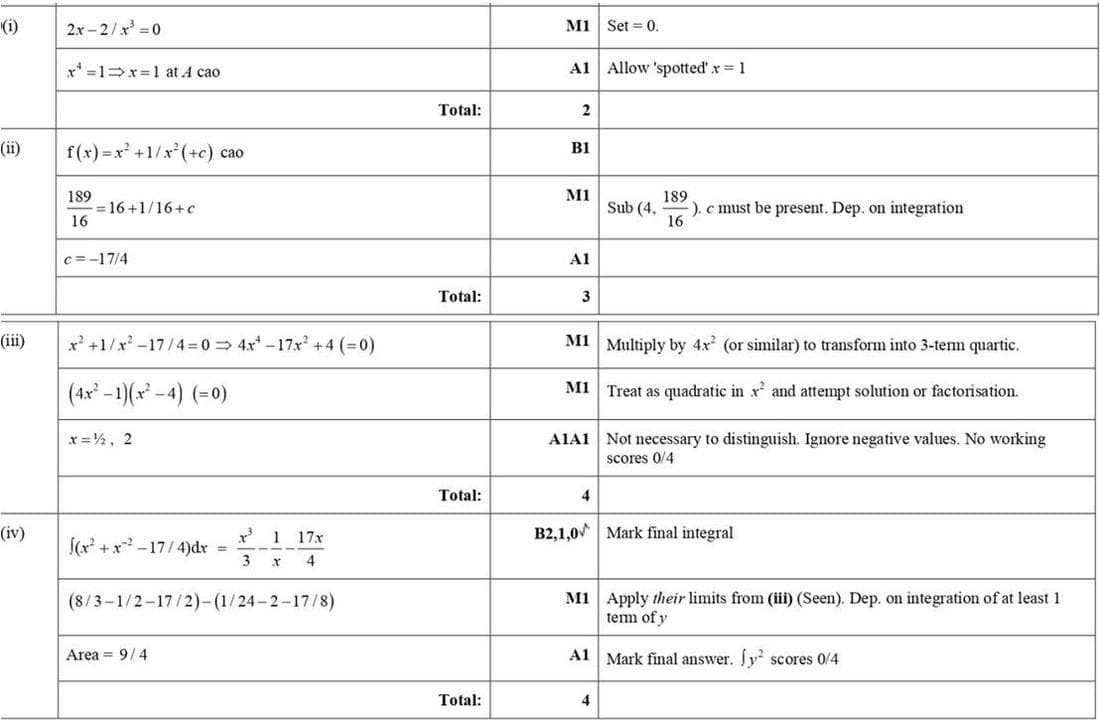
(i) Find the \(x\)-coordinate of \(A\).
(ii) Find \(f(x)\).
(iii) Find the \(x\)-coordinates of \(B\) and \(C\).
(iv) Find, showing all necessary working, the area of the shaded region.
9709 P11 - Nov 2023 - Q8
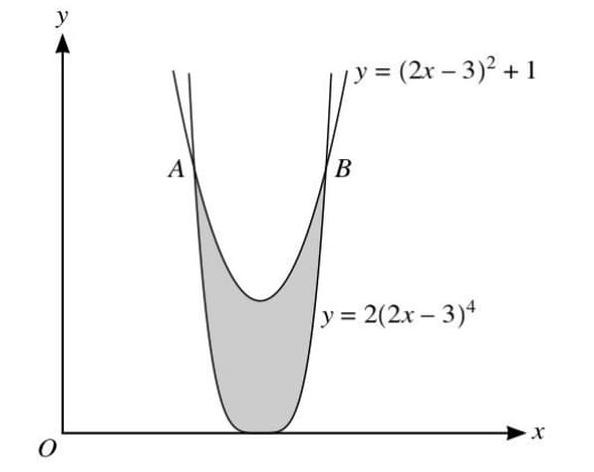
The diagram shows the curves with equations \(y = 2(2x - 3)^4\) and \(y = (2x - 3)^2 + 1\) meeting at points \(A\) and \(B\).
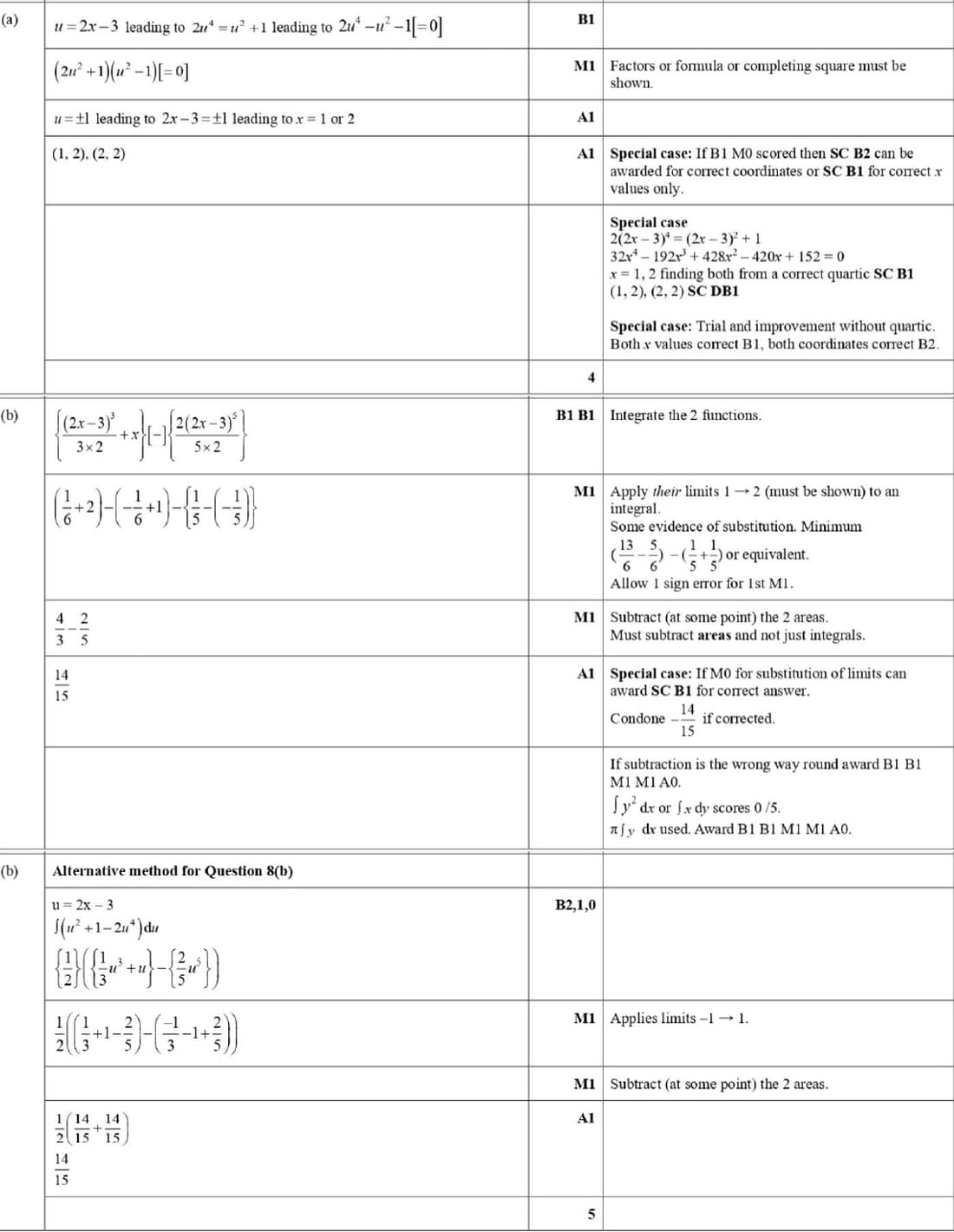
(a) By using the substitution \(u = 2x - 3\), find, by calculation, the coordinates of \(A\) and \(B\). [4]
(b) Find the exact area of the shaded region. [5]
9709 P11 - Nov 2016 - Q7
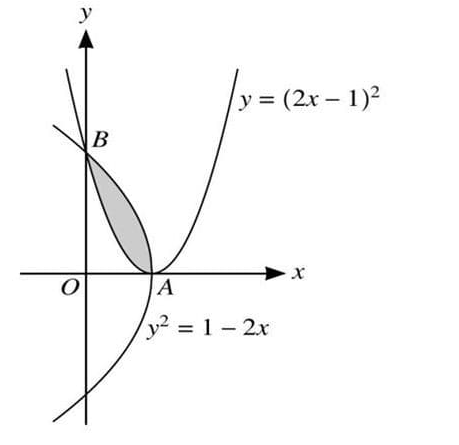
The diagram shows parts of the curves \(y = (2x - 1)^2\) and \(y^2 = 1 - 2x\), intersecting at points \(A\) and \(B\).
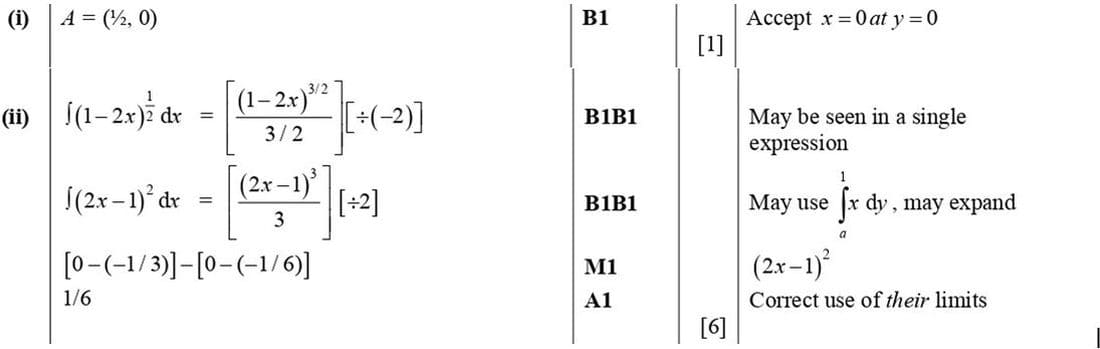
(i) State the coordinates of \(A\).
(ii) Find, showing all necessary working, the area of the shaded region.
Question #1284
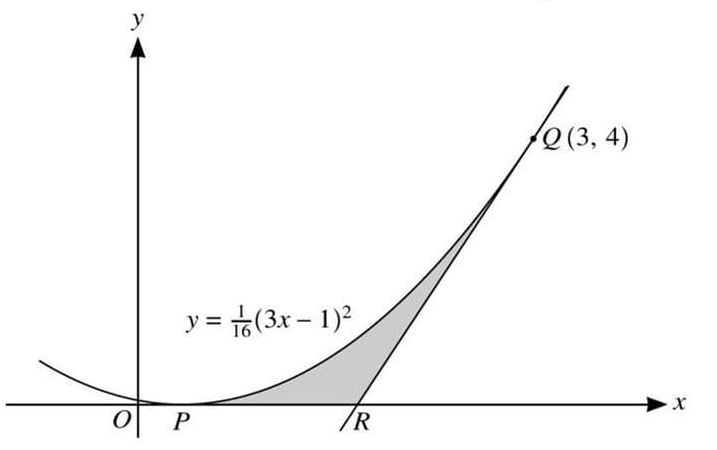
The diagram shows part of the curve \(y = \frac{1}{16}(3x-1)^2\), which touches the \(x\)-axis at the point \(P\). The point \(Q (3, 4)\) lies on the curve and the tangent to the curve at \(Q\) crosses the \(x\)-axis at \(R\).
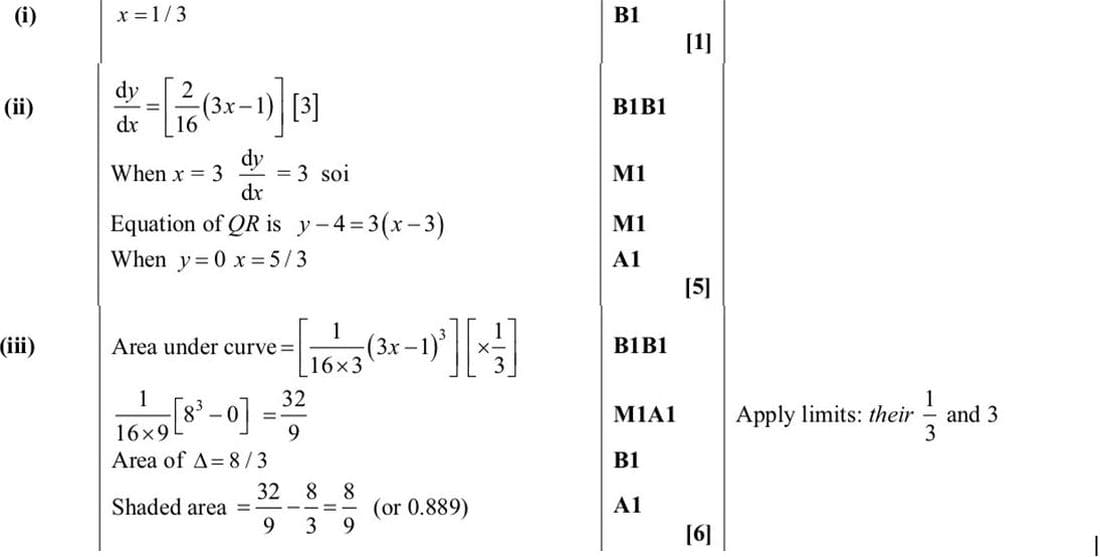
(i) State the \(x\)-coordinate of \(P\).
Showing all necessary working, find by calculation
(ii) the \(x\)-coordinate of \(R\),
(iii) the area of the shaded region \(PQR\).
9709 P13 - Nov 2015 - Q10
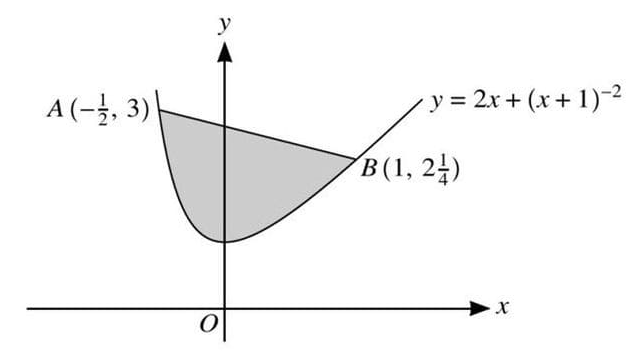
The points \(A\left(-\frac{1}{2}, 3\right)\) and \(B\left(1, 2\frac{1}{4}\right)\) lie on the curve \(y = 2x + (x+1)^{-2}\), as shown in the diagram.
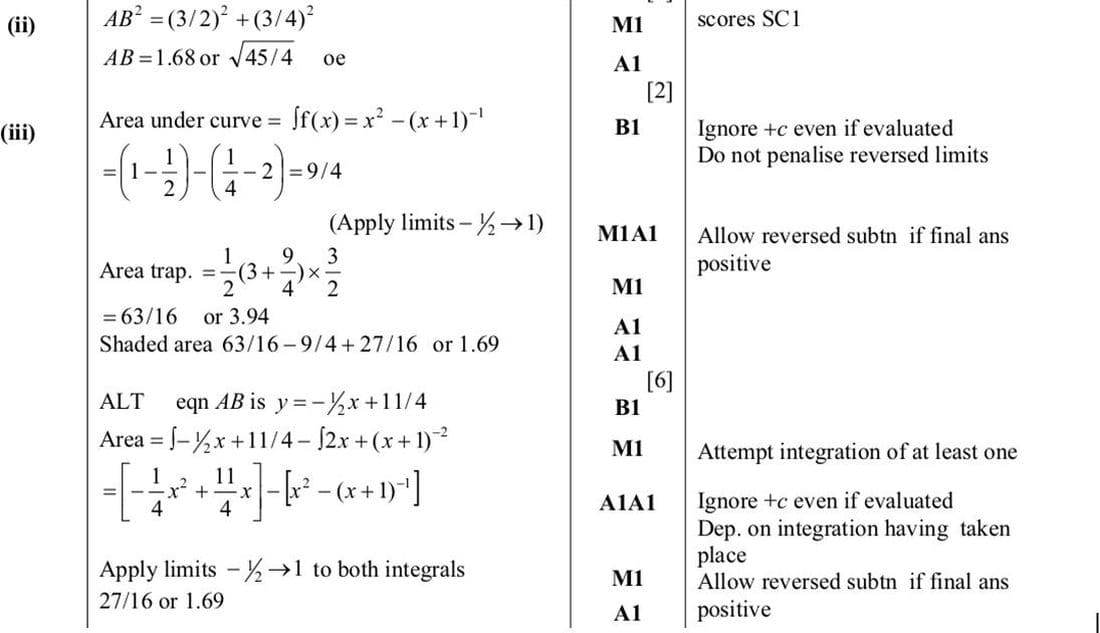
(ii) Find the distance \(AB\).
(iii) Find, showing all necessary working, the area of the shaded region.
9709 P13 - Jun 2015 - Q10
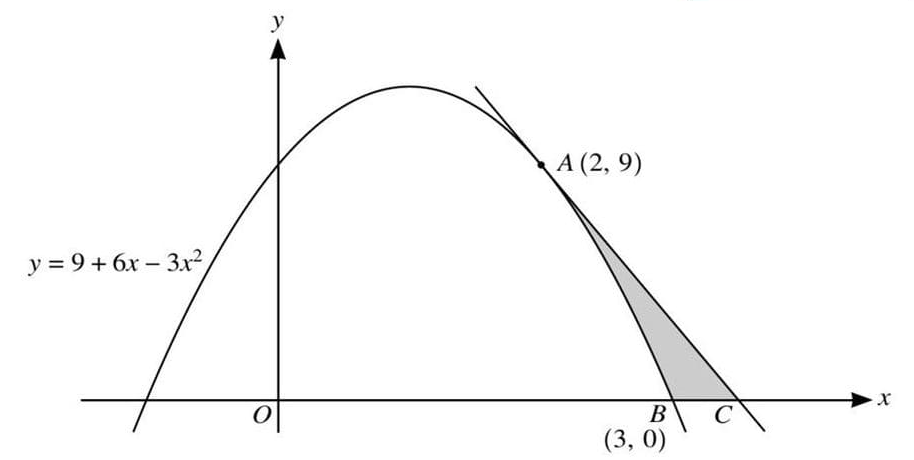
Points A (2, 9) and B (3, 0) lie on the curve \(y = 9 + 6x - 3x^2\), as shown in the diagram. The tangent at A intersects the x-axis at C. Showing all necessary working,
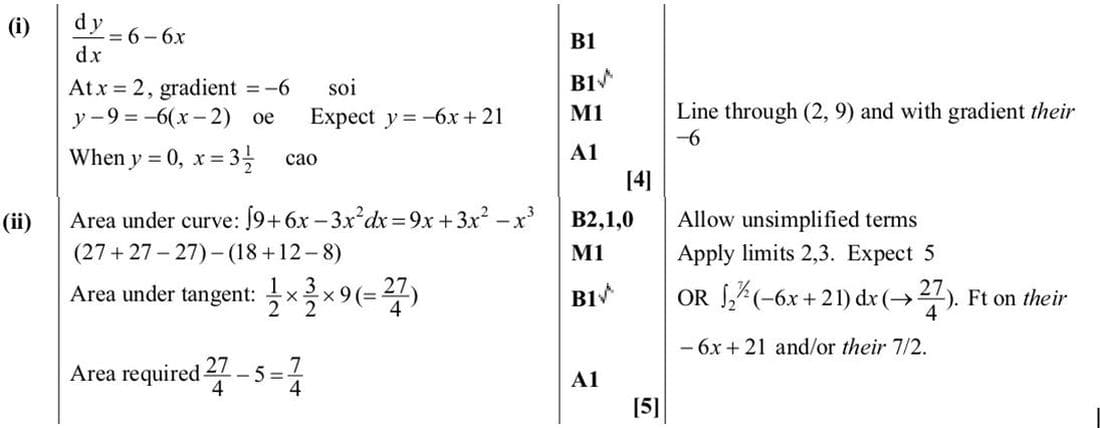
(i) find the equation of the tangent AC and hence find the x-coordinate of C,
(ii) find the area of the shaded region ABC.