Browsing as Guest. Progress, bookmarks and attempts are disabled.
Log in to track your work.
Nov 2015 p11 q11
1338
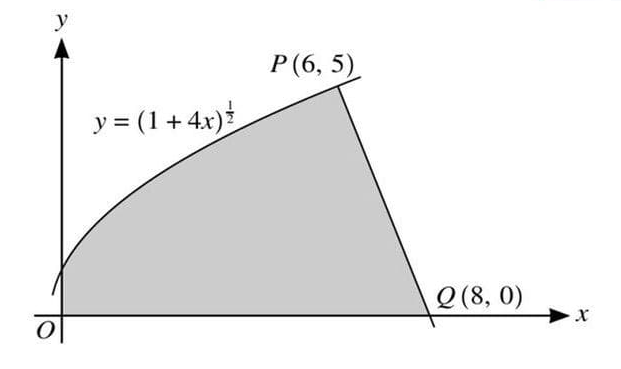
The diagram shows part of the curve \(y = (1 + 4x)^{\frac{1}{2}}\) and a point \(P(6, 5)\) lying on the curve. The line \(PQ\) intersects the \(x\)-axis at \(Q(8, 0)\).
(i) Show that \(PQ\) is a normal to the curve. [5]
(ii) Find, showing all necessary working, the exact volume of revolution obtained when the shaded region is rotated through \(360^\circ\) about the \(x\)-axis. [7]
[In part (ii) you may find it useful to apply the fact that the volume, \(V\), of a cone of base radius \(r\) and vertical height \(h\), is given by \(V = \frac{1}{3} \pi r^2 h\).]
Solution
(i) To show that \(PQ\) is a normal to the curve, we first find the derivative of the curve \(y = (1 + 4x)^{\frac{1}{2}}\).
The derivative is \(\frac{dy}{dx} = \frac{1}{2}(1 + 4x)^{-\frac{1}{2}} \times 4 = 2(1 + 4x)^{-\frac{1}{2}}\).
At \(x = 6\), \(\frac{dy}{dx} = \frac{2}{5}\).
The gradient of the normal at \(P\) is \(-\frac{1}{2}\).
The gradient of \(PQ\) is \(-\frac{5}{2}\), hence \(PQ\) is a normal, or \(m_1 m_2 = -1\).
(ii) To find the volume of revolution, we calculate the volume for the curve and the line separately.
Volume for the curve: \(V = \pi \int (1 + 4x) \, dx\).
Integrating \(y^2 = (1 + 4x)\), we get \(\pi \left[ x + 2x^2 \right]\) from 0 to 6.
\(= \pi [6 + 72 - 0] = 78\pi\).
Volume for the line: \(V = \frac{1}{3} \pi \times 5^2 \times 2 = \frac{50}{3} \pi\).
Total volume: \(78\pi + \frac{50}{3}\pi = 94\frac{2}{3}\pi\) or \(\frac{284\pi}{3}\).