Past Exam Questions
← Back9709 P1 - Jun 2008 - Q9
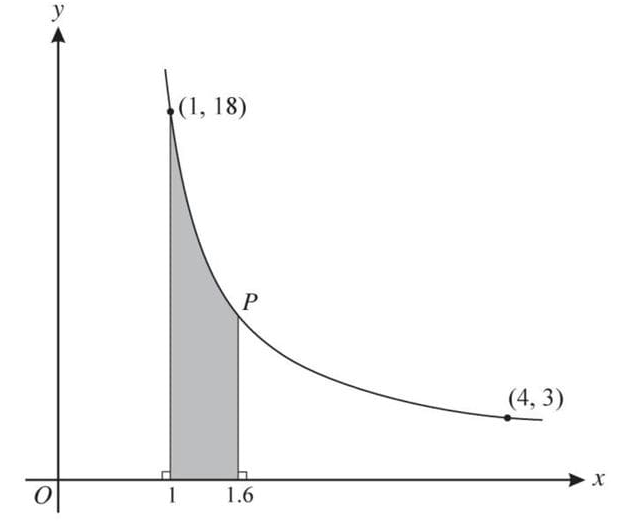
The diagram shows a curve for which \(\frac{dy}{dx} = -\frac{k}{x^3}\), where \(k\) is a constant. The curve passes through the points \((1, 18)\) and \((4, 3)\).
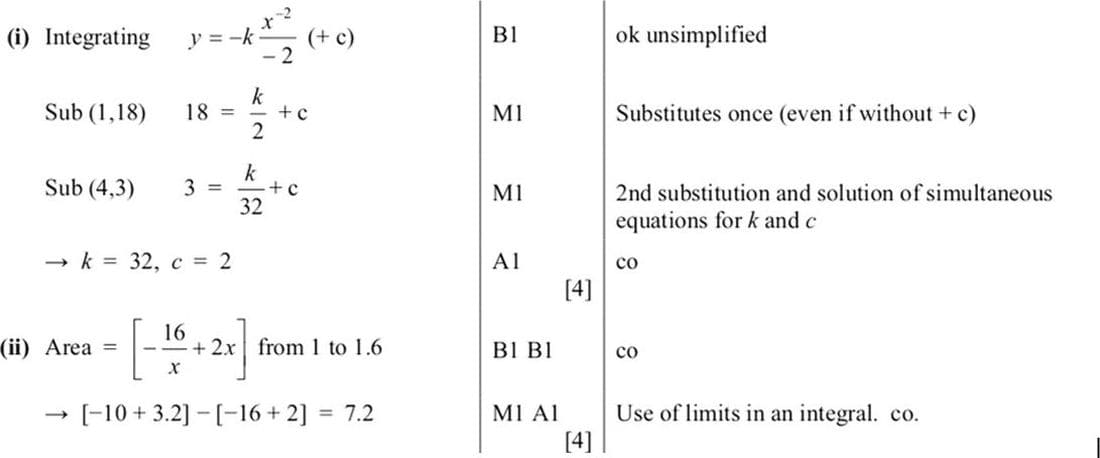
(i) Show, by integration, that the equation of the curve is \(y = \frac{16}{x^2} + 2\).
The point \(P\) lies on the curve and has \(x\)-coordinate 1.6.
(ii) Find the area of the shaded region.
9709 P1 - Nov 2007 - Q2
Find the area of the region enclosed by the curve \(y = 2\sqrt{x}\), the x-axis and the lines \(x = 1\) and \(x = 4\).

9709 P1 - Jun 2007 - Q10
The equation of a curve is \(y = 2x + \frac{8}{x^2}\).
Find the area of the region enclosed by the curve, the x-axis and the lines \(x = 1\) and \(x = 2\).

9709 P1 - Nov 2006 - Q7
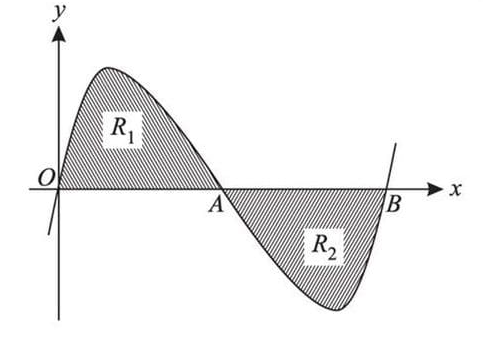
The diagram shows the curve \(y = x(x-1)(x-2)\), which crosses the x-axis at the points \(O(0, 0)\), \(A(1, 0)\), and \(B(2, 0)\).
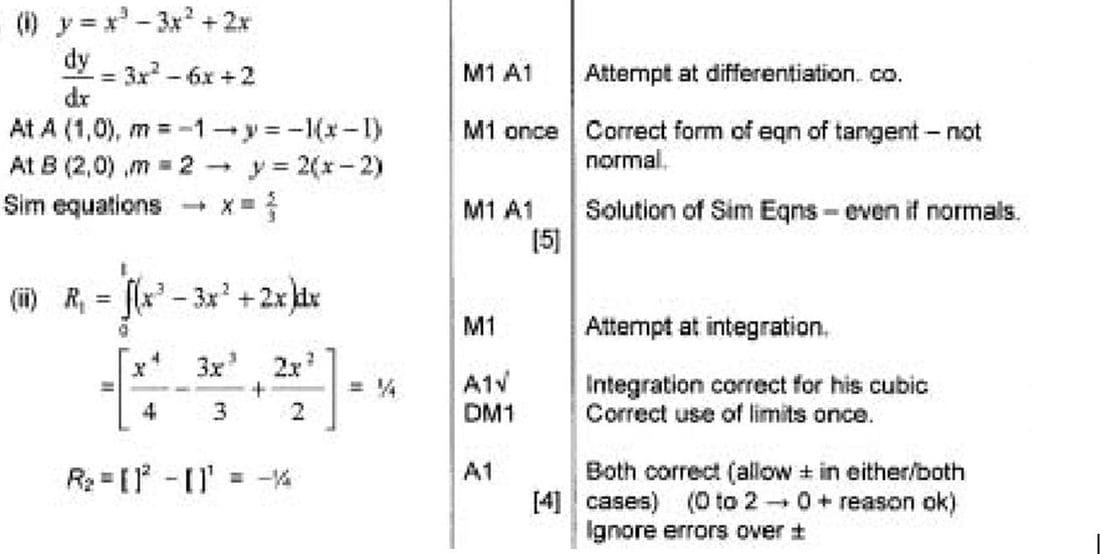
(i) The tangents to the curve at the points \(A\) and \(B\) meet at the point \(C\). Find the x-coordinate of \(C\).
(ii) Show by integration that the area of the shaded region \(R_1\) is the same as the area of the shaded region \(R_2\).
9709 P1 - Jun 2006 - Q10
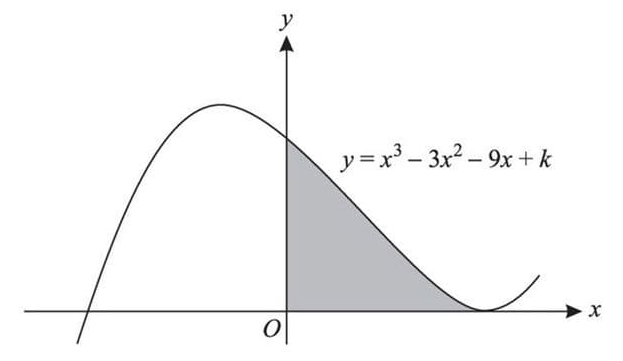
The diagram shows the curve \(y = x^3 - 3x^2 - 9x + k\), where \(k\) is a constant. The curve has a minimum point on the \(x\)-axis.
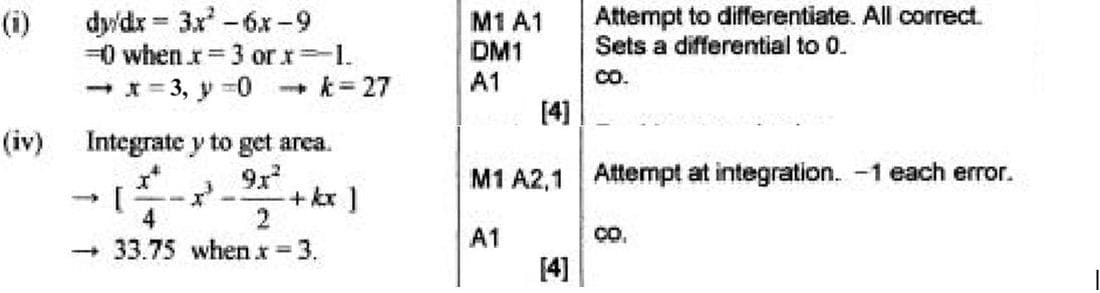
(i) Find the value of \(k\).
(iv) Find the area of the shaded region.
9709 P1 - Nov 2005 - Q10
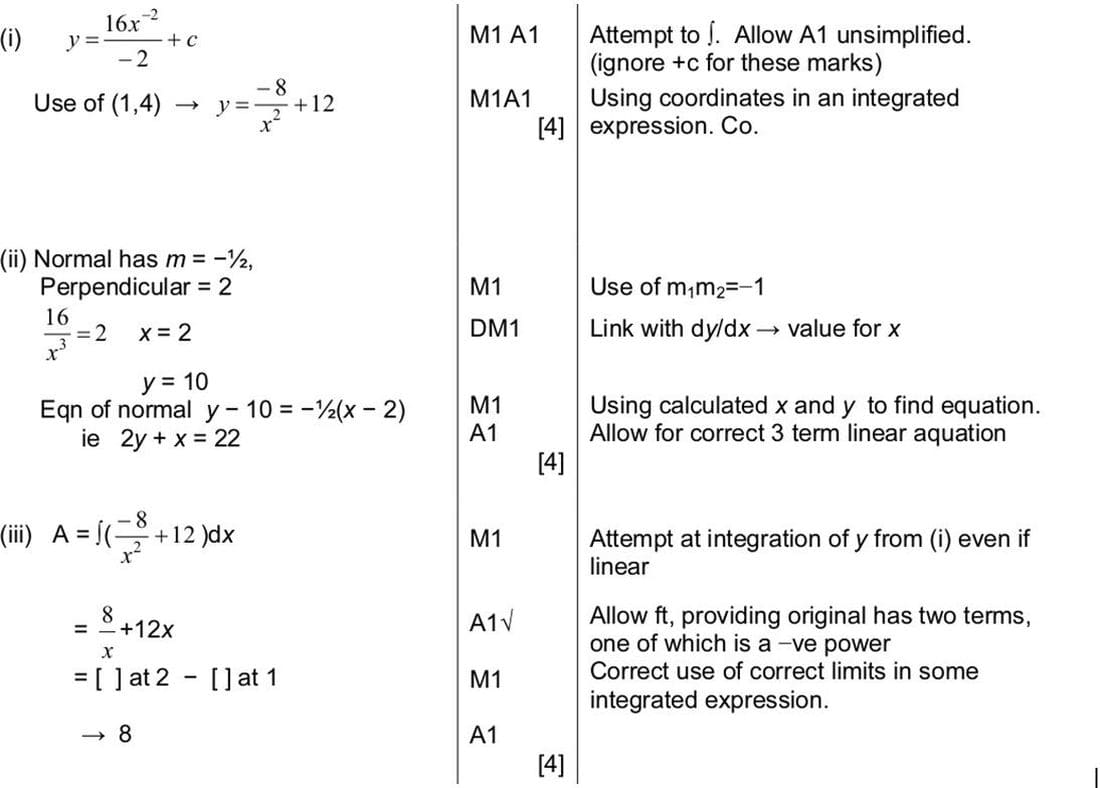
A curve is such that \(\frac{dy}{dx} = \frac{16}{x^3}\), and \((1, 4)\) is a point on the curve.
(i) Find the equation of the curve. [4]
(ii) A line with gradient \(-\frac{1}{2}\) is a normal to the curve. Find the equation of this normal, giving your answer in the form \(ax + by = c\). [4]
(iii) Find the area of the region enclosed by the curve, the \(x\)-axis and the lines \(x = 1\) and \(x = 2\). [4]
9709 P1 - Jun 2005 - Q9
A curve has equation \(y = \frac{4}{\sqrt{x}}\).
Find the area of the region enclosed by the curve, the x-axis and the lines \(x = 1\) and \(x = 4\).

9709 P1 - Jun 2003 - Q10
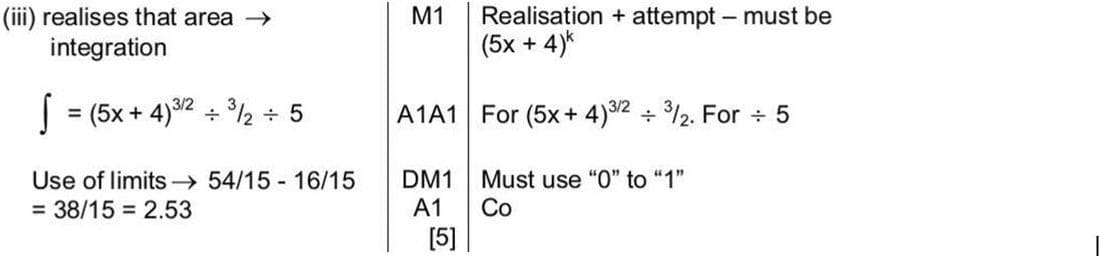
The equation of a curve is \(y = \sqrt{5x + 4}\).
Find the area enclosed by the curve, the \(x\)-axis, the \(y\)-axis and the line \(x = 1\).
9709 P12 - Nov 2022 - Q11
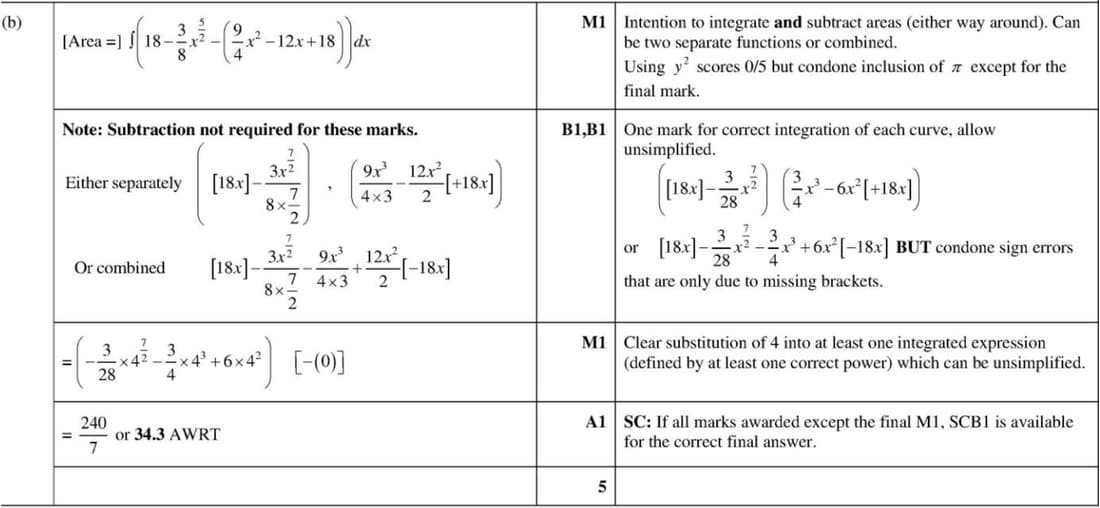
The diagram shows the curves with equations \(y = \frac{9}{4}x^2 - 12x + 18\) and \(y = 18 - \frac{3}{8}x^{\frac{5}{2}}\). The curves intersect at the points (0, 18) and (4, 6).
Find the area of the shaded region.

9709 P1 - Nov 2002 - Q10
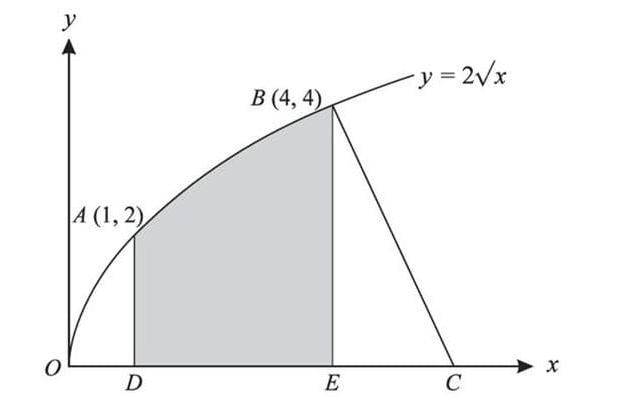
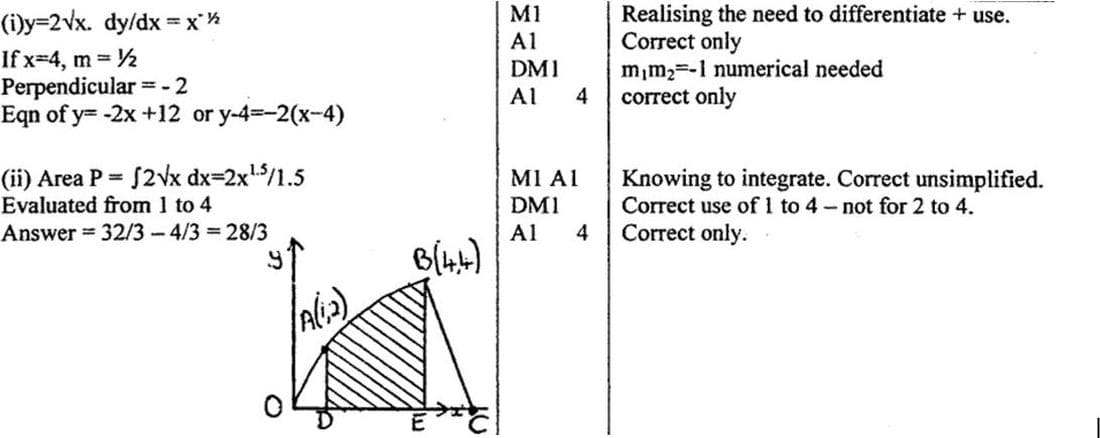
The diagram shows the points A (1, 2) and B (4, 4) on the curve \(y = 2\sqrt{x}\). The line BC is the normal to the curve at B, and C lies on the x-axis. Lines AD and BE are perpendicular to the x-axis.
(i) Find the equation of the normal BC.
(ii) Find the area of the shaded region.
9709 P1 - Jun 2002 - Q3
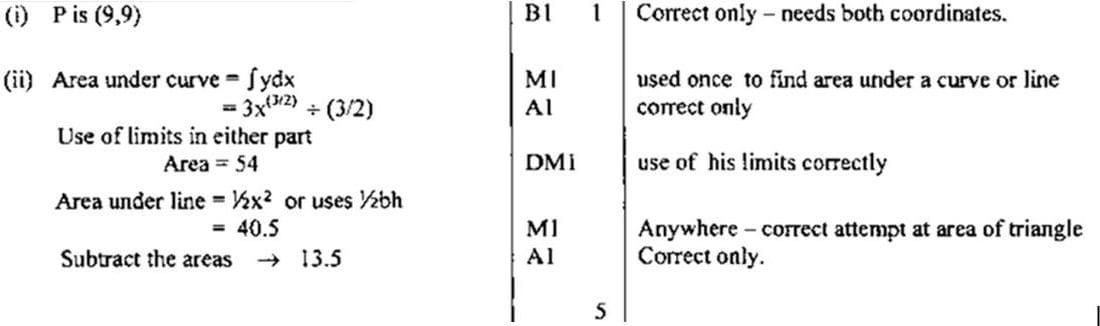
The diagram shows the curve \(y = 3\sqrt{x}\) and the line \(y = x\) intersecting at \(O\) and \(P\). Find
(i) the coordinates of \(P\),
(ii) the area of the shaded region.

9709 P11 - Nov 2022 - Q10
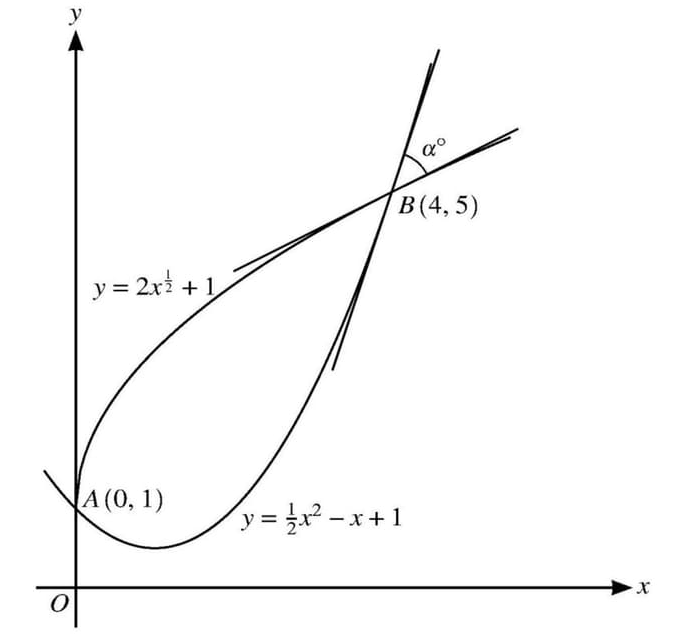
Curves with equations \(y = 2x^{\frac{1}{2}} + 1\) and \(y = \frac{1}{2}x^2 - x + 1\) intersect at \(A(0, 1)\) and \(B(4, 5)\), as shown in the diagram.
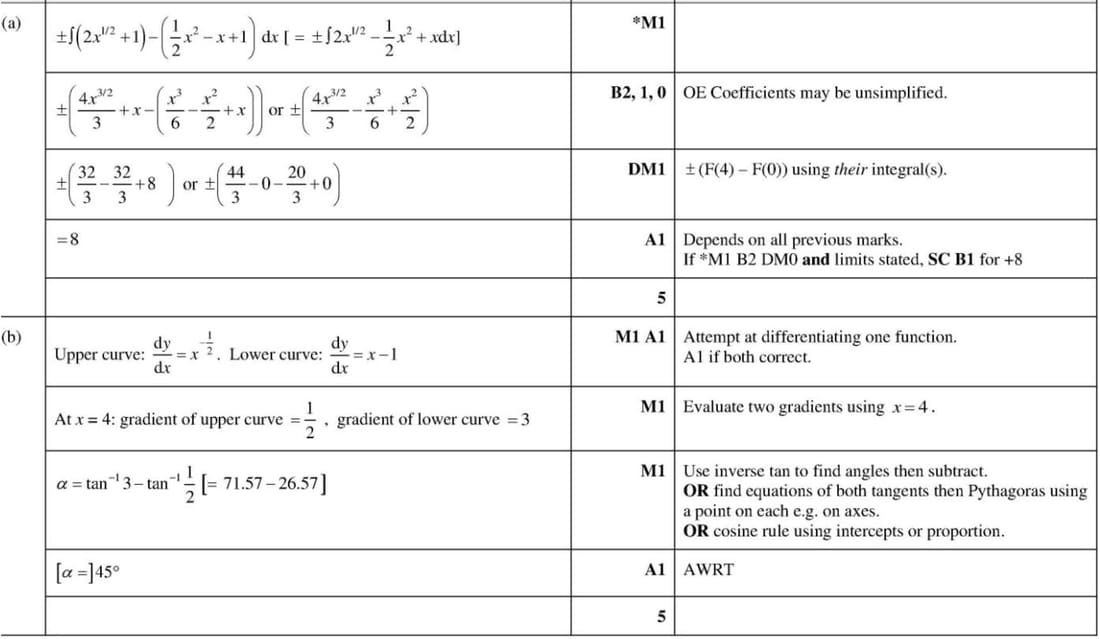
(a) Find the area of the region between the two curves.
The acute angle between the two tangents at \(B\) is denoted by \(\alpha^\circ\), and the scales on the axes are the same.
(b) Find \(\alpha\).
9709 P13 - Jun 2022 - Q8
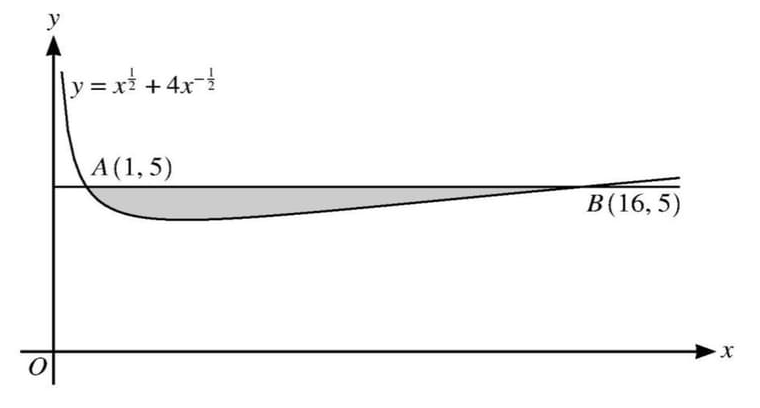
The diagram shows the curve with equation \(y = x^{\frac{1}{2}} + 4x^{-\frac{1}{2}}\). The line \(y = 5\) intersects the curve at the points \(A(1, 5)\) and \(B(16, 5)\).
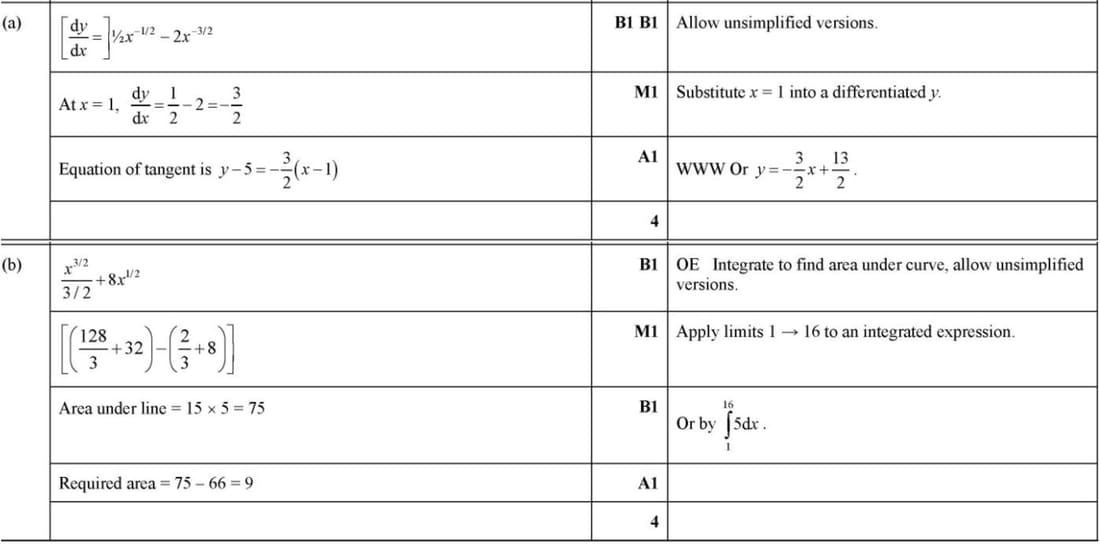
(a) Find the equation of the tangent to the curve at the point \(A\).
(b) Calculate the area of the shaded region.
9709 P12 - Jun 2022 - Q6
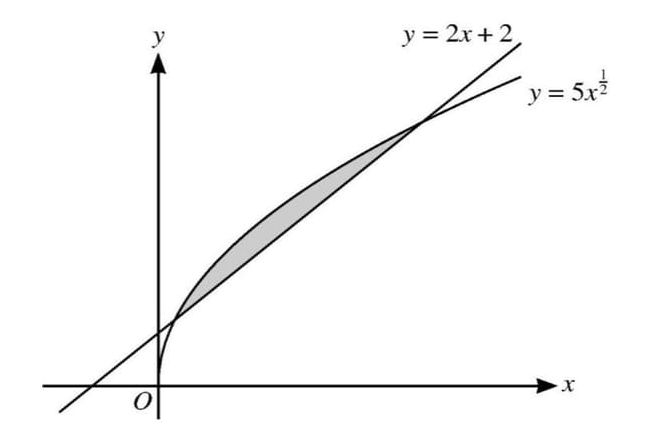
The diagram shows the curve with equation \(y = 5x^{\frac{1}{2}}\) and the line with equation \(y = 2x + 2\).
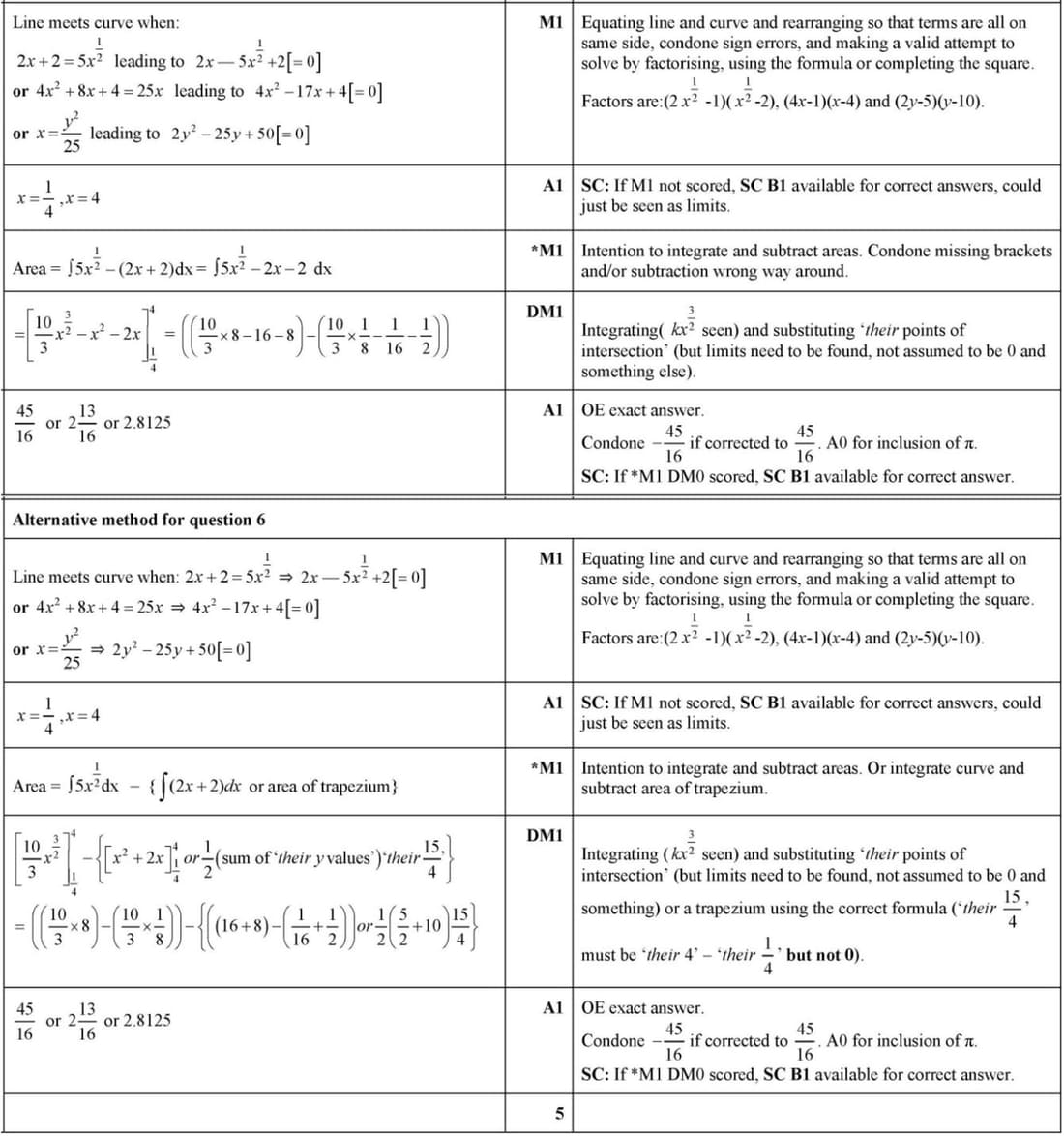
Find the exact area of the shaded region which is bounded by the line and the curve.
9709 P11 - Jun 2023 - Q10
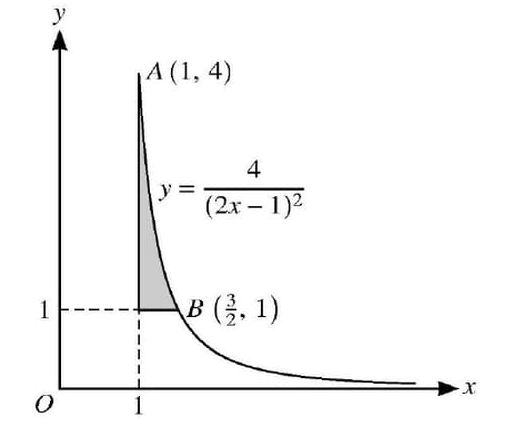
The diagram shows part of the curve with equation \(y = \frac{4}{(2x-1)^2}\) and parts of the lines \(x = 1\) and \(y = 1\). The curve passes through the points \(A(1, 4)\) and \(B\left( \frac{3}{2}, 1 \right)\).
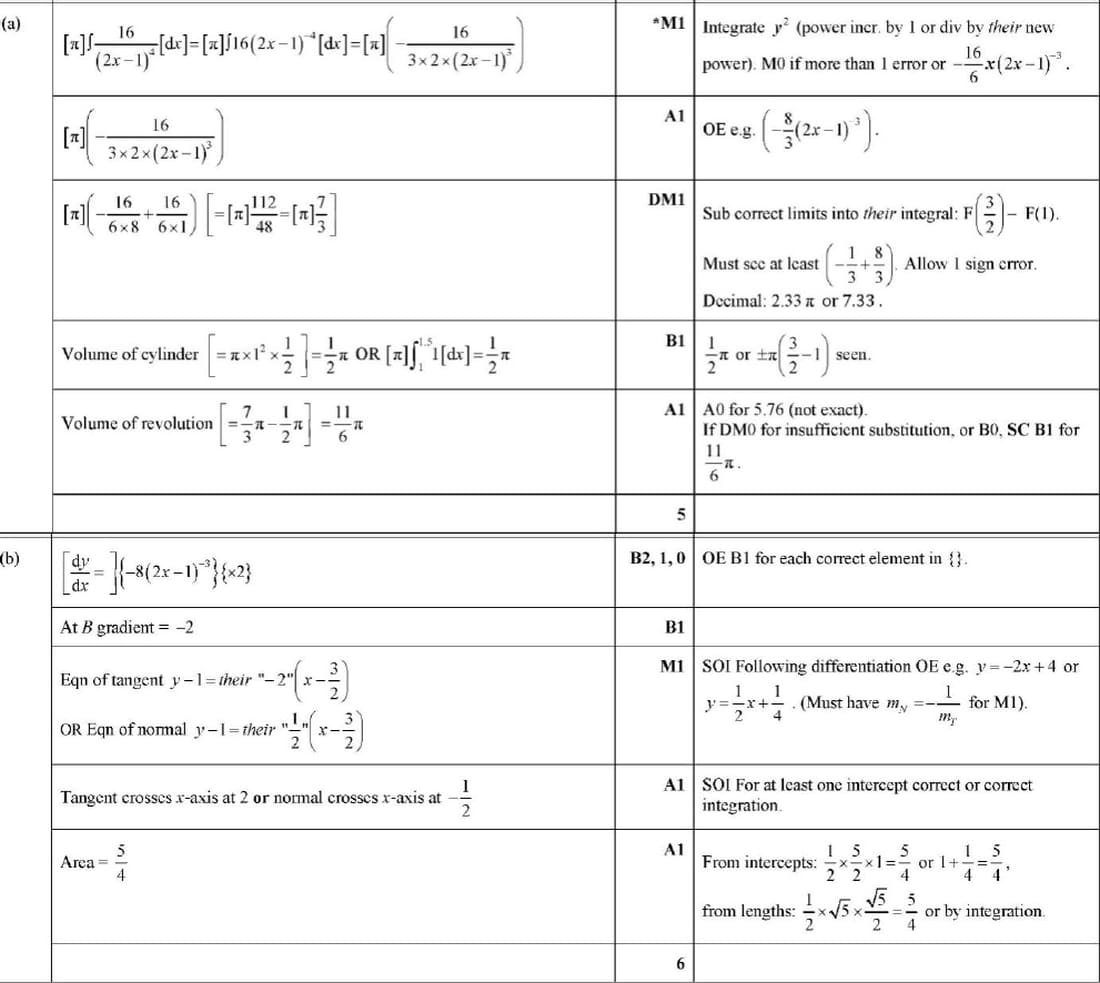
(a) Find the exact volume generated when the shaded region is rotated through 360° about the x-axis.
(b) A triangle is formed from the tangent to the curve at \(B\), the normal to the curve at \(B\) and the x-axis. Find the area of this triangle.
9709 P13 - Nov 2019 - Q11
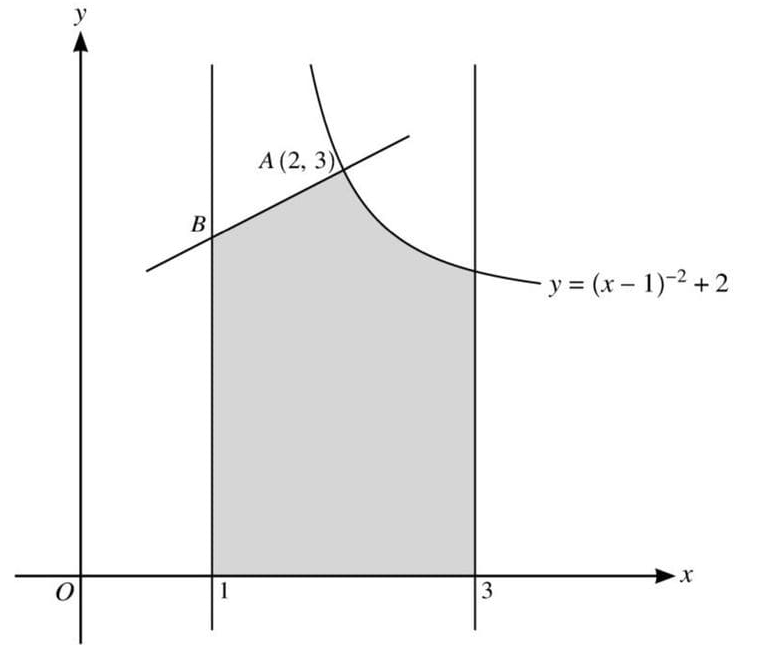
The diagram shows part of the curve \(y = (x-1)^{-2} + 2\), and the lines \(x = 1\) and \(x = 3\). The point \(A\) on the curve has coordinates \((2, 3)\). The normal to the curve at \(A\) crosses the line \(x = 1\) at \(B\).
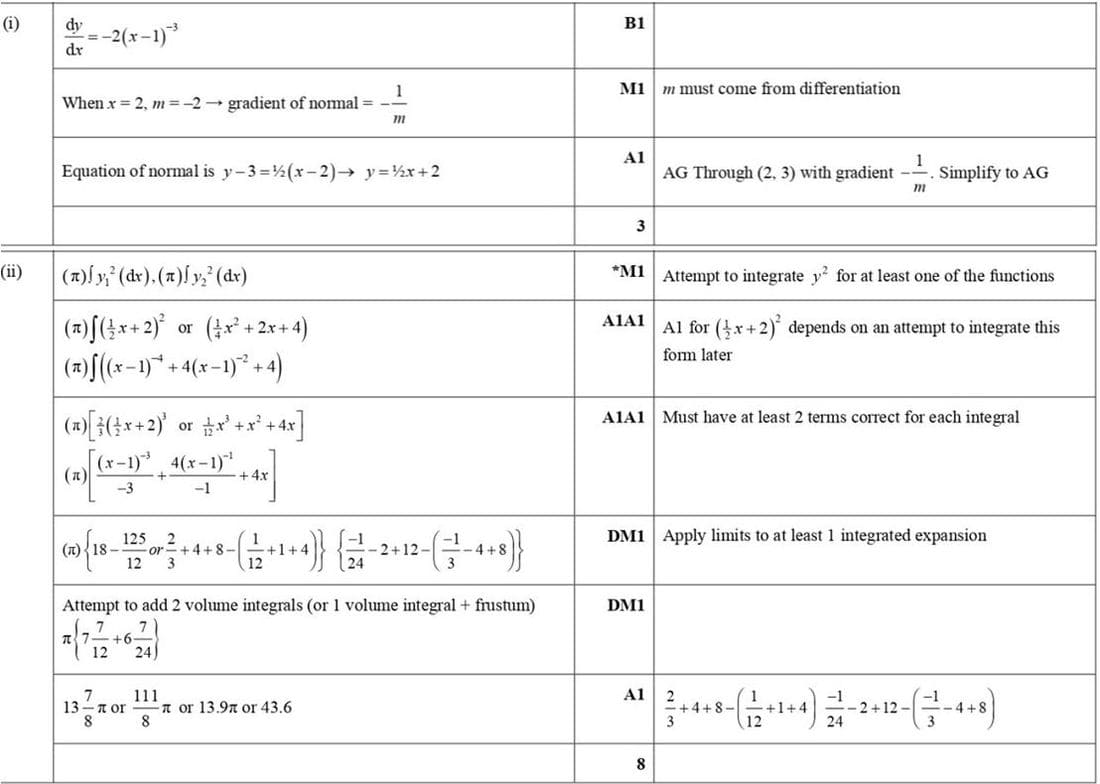
(i) Show that the normal \(AB\) has equation \(y = \frac{1}{2}x + 2\).
(ii) Find, showing all necessary working, the volume of revolution obtained when the shaded region is rotated through 360° about the \(x\)-axis.
9709 P11 - Nov 2019 - Q11
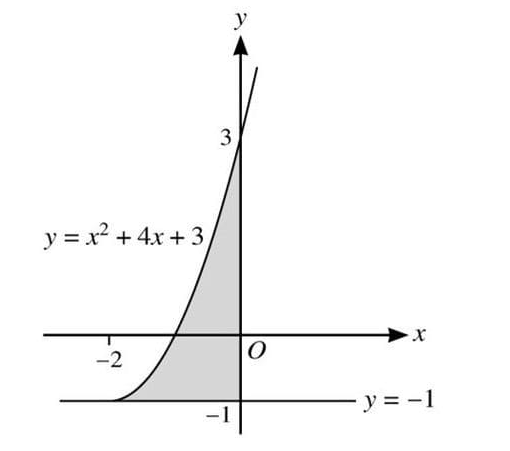
The diagram shows a shaded region bounded by the y-axis, the line \(y = -1\) and the part of the curve \(y = x^2 + 4x + 3\) for which \(x \geq -2\).
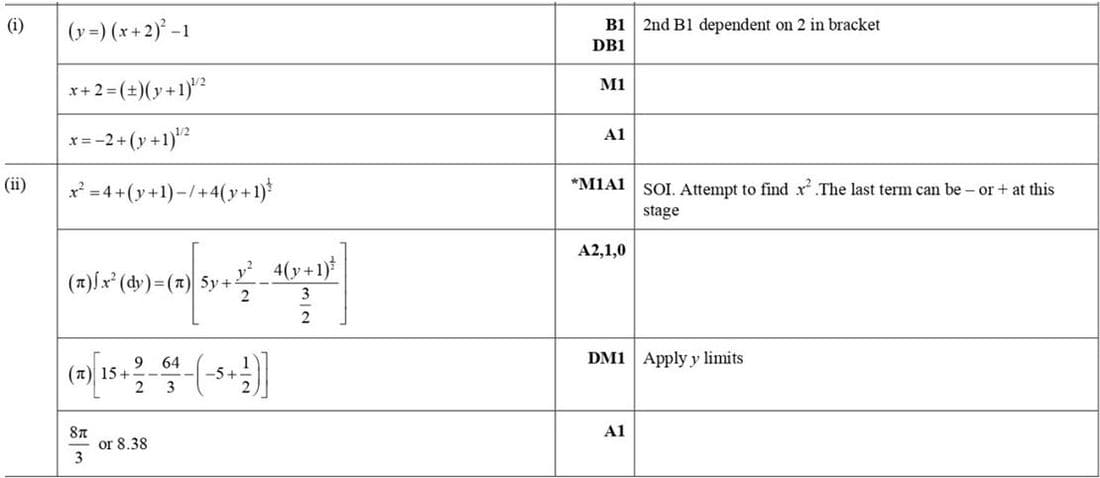
(i) Express \(y = x^2 + 4x + 3\) in the form \(y = (x + a)^2 + b\), where \(a\) and \(b\) are constants. Hence, for \(x \geq -2\), express \(x\) in terms of \(y\).
(ii) Hence, showing all necessary working, find the volume obtained when the shaded region is rotated through 360° about the y-axis.
9709 P12 - Mar 2019 - Q9
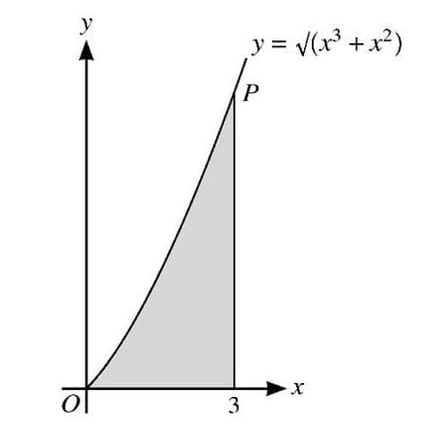
The diagram shows part of the curve with equation \(y = \sqrt{x^3 + x^2}\). The shaded region is bounded by the curve, the x-axis and the line \(x = 3\).
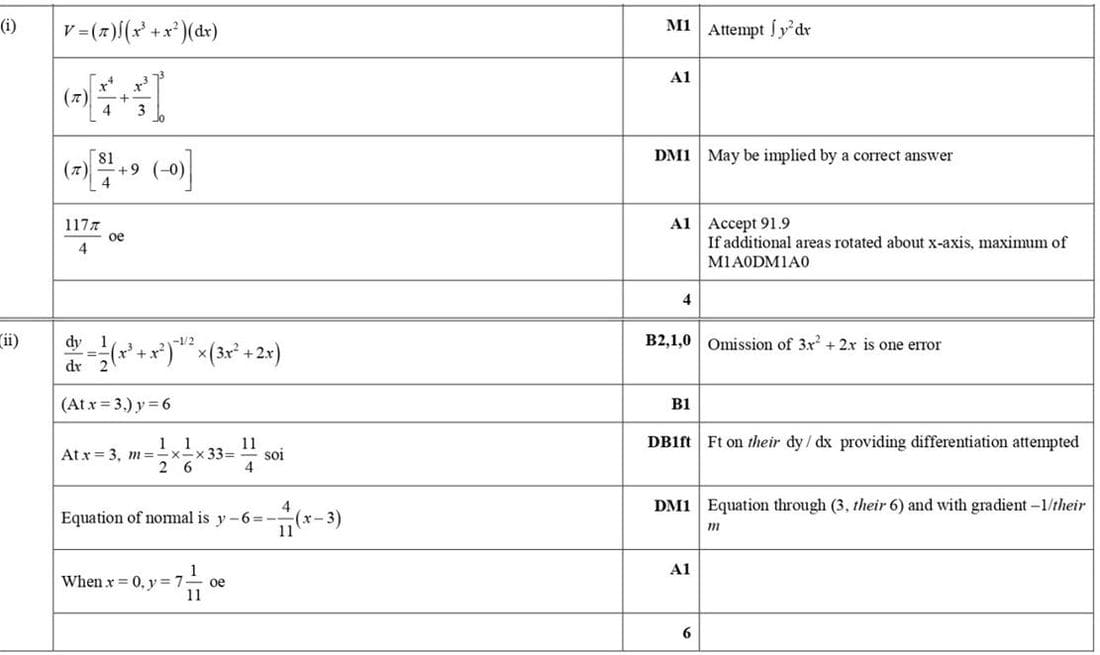
(i) Find, showing all necessary working, the volume obtained when the shaded region is rotated through 360° about the x-axis. [4]
(ii) \(P\) is the point on the curve with x-coordinate 3. Find the y-coordinate of the point where the normal to the curve at \(P\) crosses the y-axis. [6]
9709 P13 - Nov 2018 - Q10
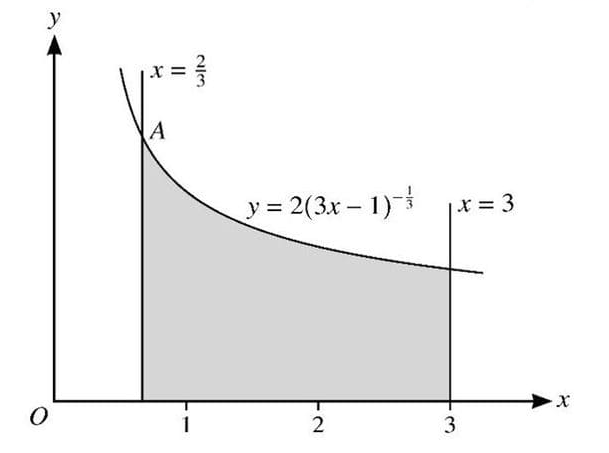
The diagram shows part of the curve \(y = 2(3x - 1)^{-\frac{1}{3}}\) and the lines \(x = \frac{2}{3}\) and \(x = 3\). The curve and the line \(x = \frac{2}{3}\) intersect at the point \(A\).
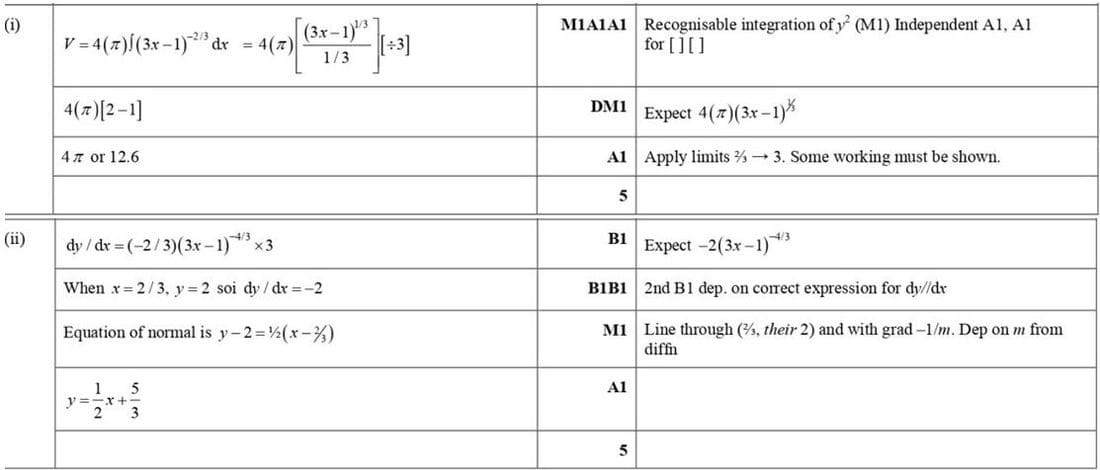
(i) Find, showing all necessary working, the volume obtained when the shaded region is rotated through \(360^\circ\) about the \(x\)-axis.
(ii) Find the equation of the normal to the curve at \(A\), giving your answer in the form \(y = mx + c\).
9709 P13 - Jun 2018 - Q11
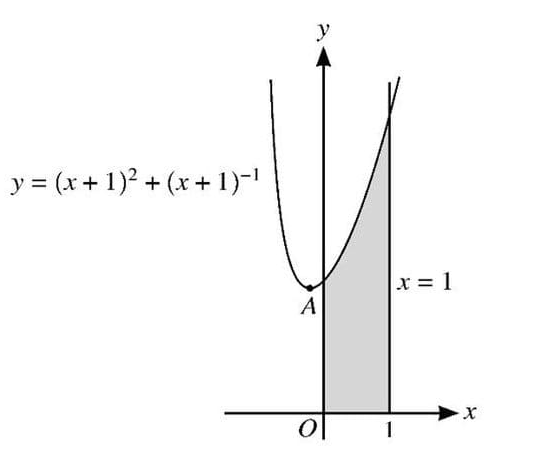
The diagram shows part of the curve \(y = (x+1)^2 + (x+1)^{-1}\) and the line \(x = 1\). The point \(A\) is the minimum point on the curve.
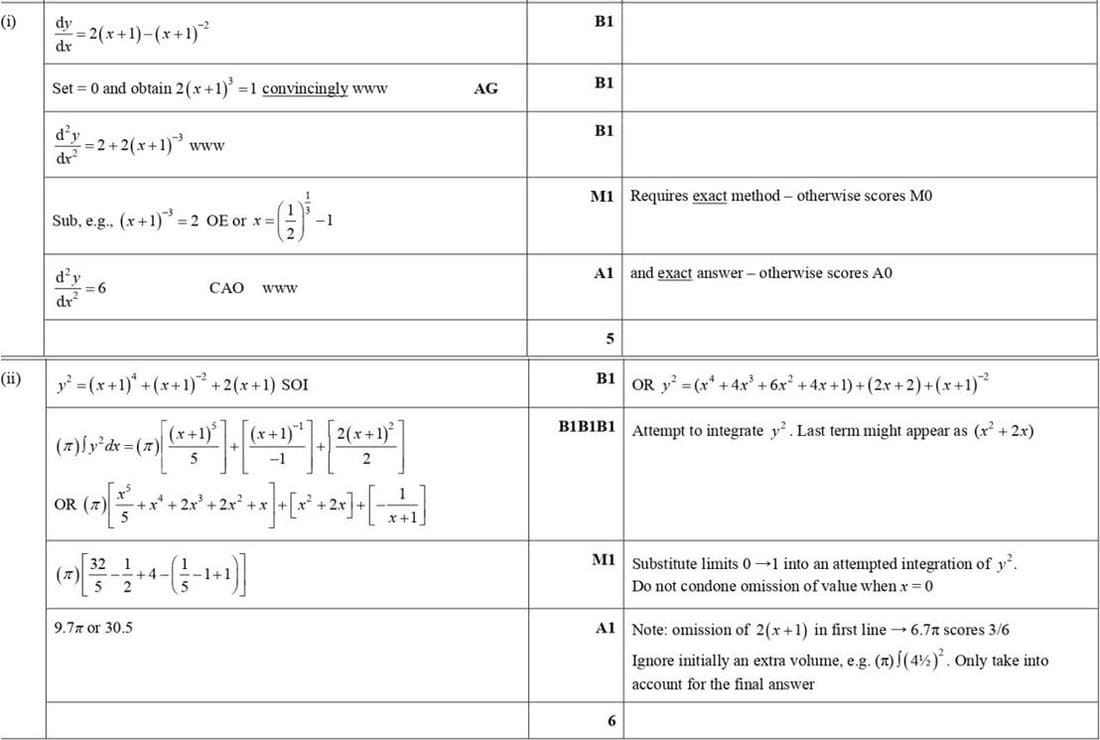
(i) Show that the \(x\)-coordinate of \(A\) satisfies the equation \(2(x+1)^3 = 1\) and find the exact value of \(\frac{d^2y}{dx^2}\) at \(A\).
(ii) Find, showing all necessary working, the volume obtained when the shaded region is rotated through 360° about the \(x\)-axis.