9709 P11 - Nov 2018 - Q6
1371
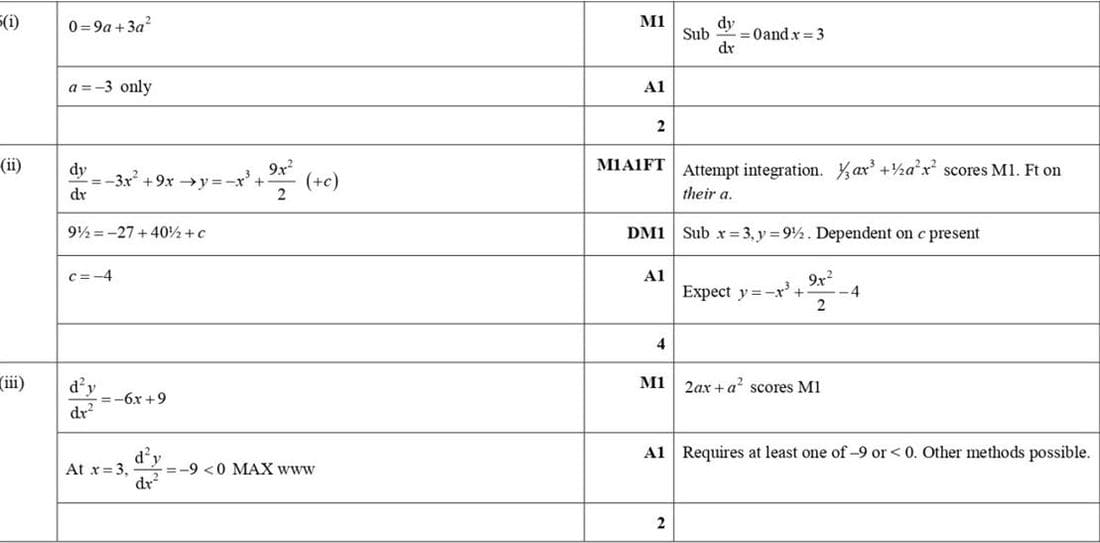
A curve has a stationary point at \((3, 9\frac{1}{2})\) and has an equation for which \(\frac{dy}{dx} = ax^2 + a^2 x\), where \(a\) is a non-zero constant.
- Find the value of \(a\).
- Find the equation of the curve.
- Determine, showing all necessary working, the nature of the stationary point.