9709 P11 - Jun 2020 - Q11
1367
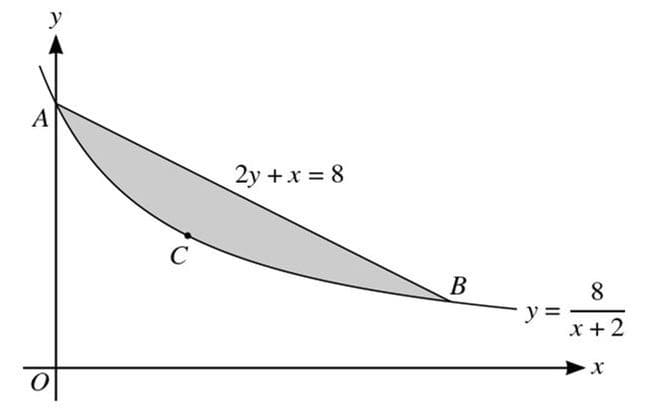
The diagram shows part of the curve \(y = \frac{8}{x+2}\) and the line \(2y + x = 8\), intersecting at points \(A\) and \(B\). The point \(C\) lies on the curve and the tangent to the curve at \(C\) is parallel to \(AB\).
(a) Find, by calculation, the coordinates of \(A\), \(B\) and \(C\). [6]
(b) Find the volume generated when the shaded region, bounded by the curve and the line, is rotated through 360° about the \(x\)-axis. [6]
Solutions locked. Please sign in with access to view them.