Past Exam Questions
← Back9709 P11 - Jun 2015 - Q10
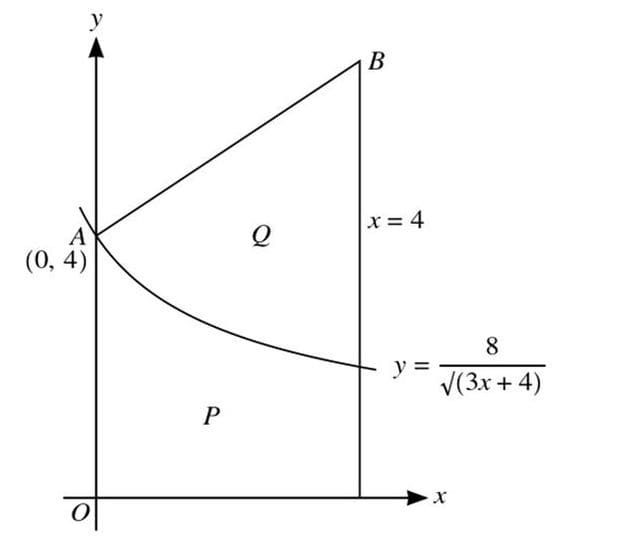
The diagram shows part of the curve \(y = \frac{8}{\sqrt{3x+4}}\). The curve intersects the y-axis at \(A (0, 4)\). The normal to the curve at \(A\) intersects the line \(x = 4\) at the point \(B\).
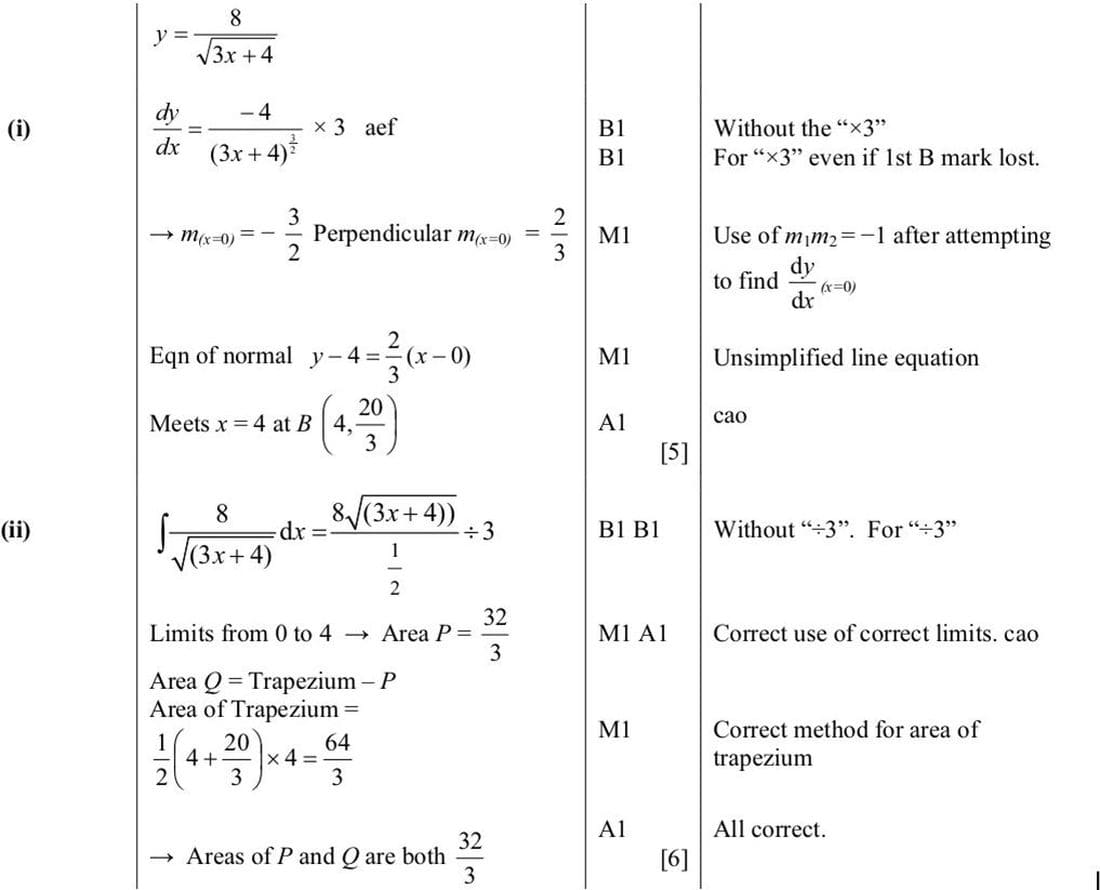
(i) Find the coordinates of \(B\).
(ii) Show, with all necessary working, that the areas of the regions marked \(P\) and \(Q\) are equal.
9709 P13 - Nov 2014 - Q9
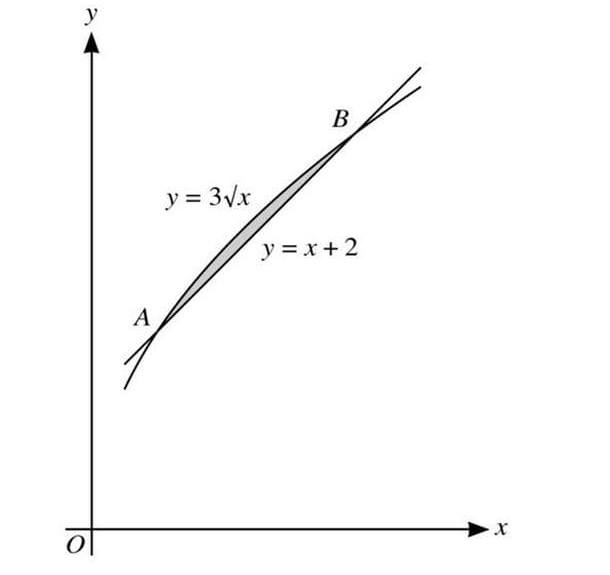
The diagram shows parts of the graphs of \(y = x + 2\) and \(y = 3\sqrt{x}\) intersecting at points \(A\) and \(B\).
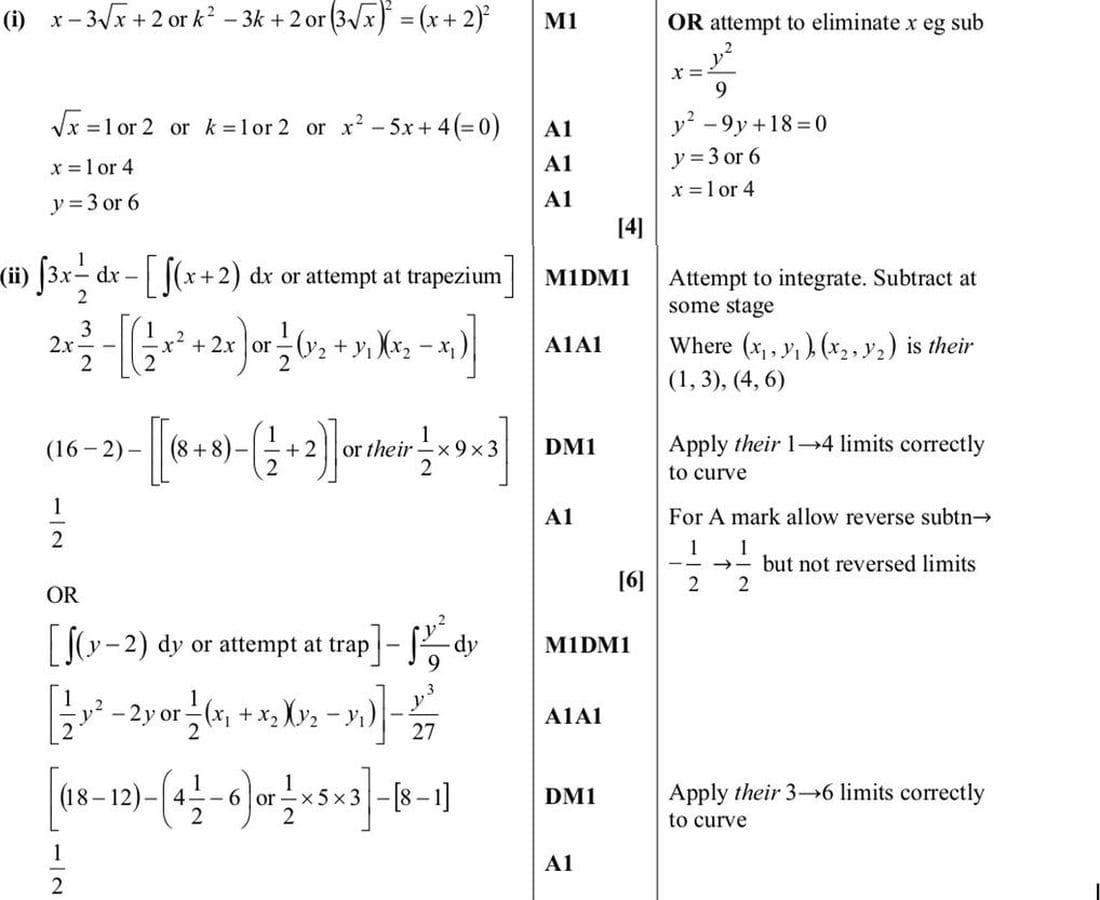
- Write down an equation satisfied by the x-coordinates of \(A\) and \(B\). Solve this equation and hence find the coordinates of \(A\) and \(B\). [4]
- Find by integration the area of the shaded region. [6]
9709 P11 - Nov 2014 - Q11
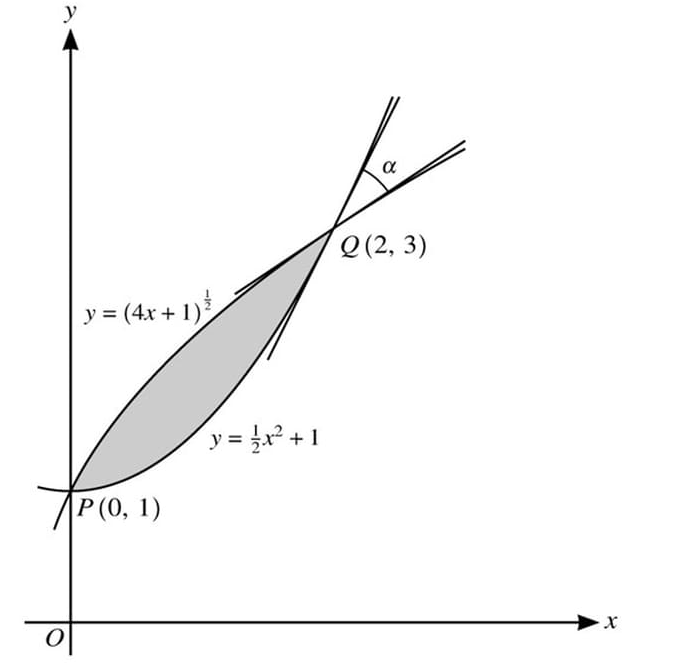
The diagram shows parts of the curves \(y = (4x + 1)^{\frac{1}{2}}\) and \(y = \frac{1}{2}x^2 + 1\) intersecting at points \(P(0, 1)\) and \(Q(2, 3)\). The angle between the tangents to the two curves at \(Q\) is \(\alpha\).
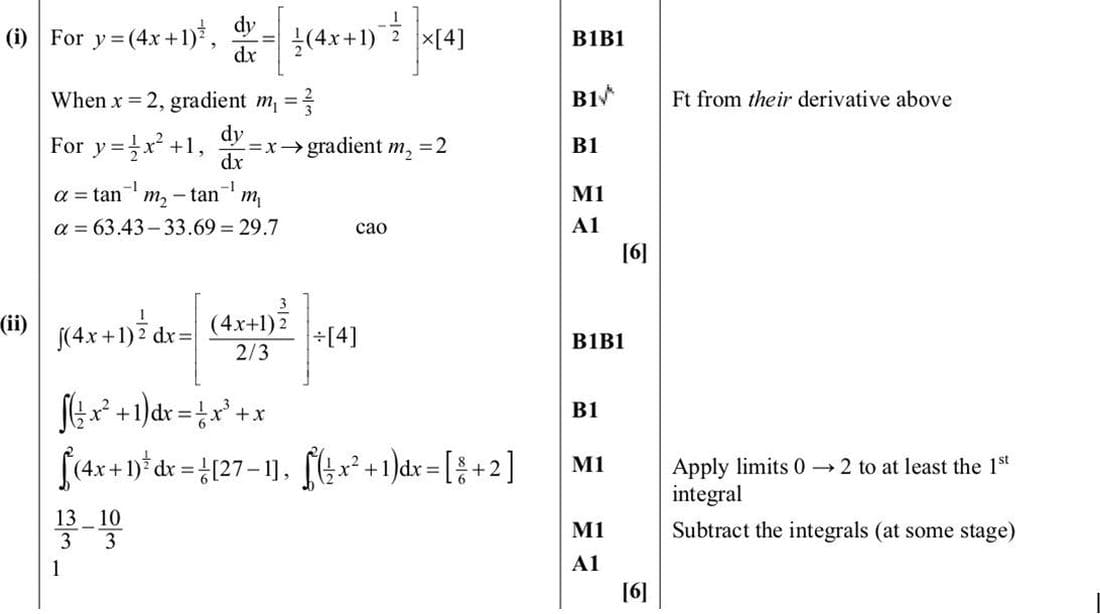
(i) Find \(\alpha\), giving your answer in degrees correct to 3 significant figures.
(ii) Find by integration the area of the shaded region.
9709 P13 - Jun 2014 - Q10
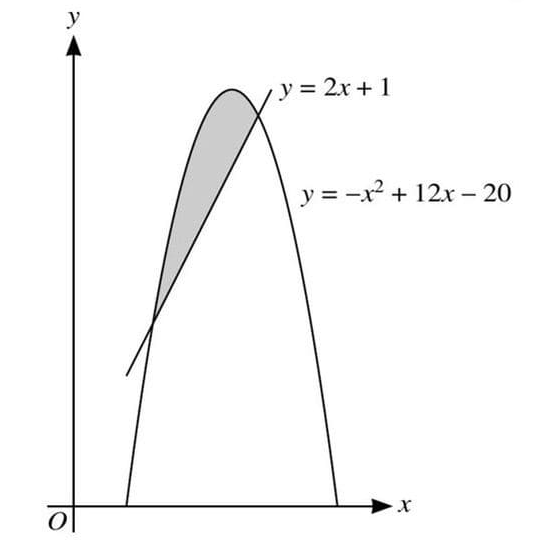
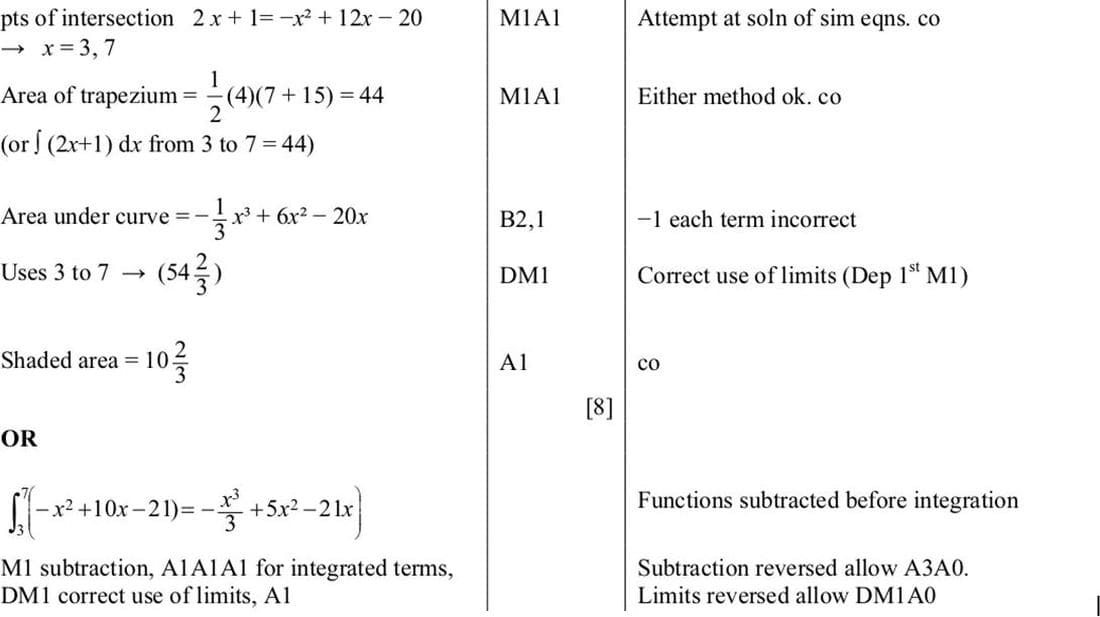
The diagram shows the curve \(y = -x^2 + 12x - 20\) and the line \(y = 2x + 1\). Find, showing all necessary working, the area of the shaded region.
9709 P12 - Jun 2014 - Q9
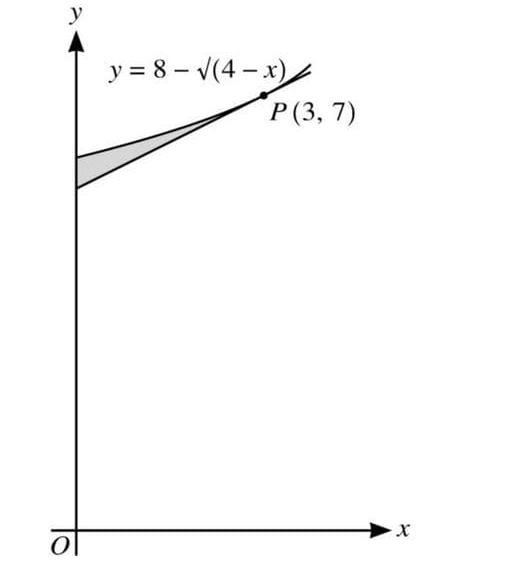
The diagram shows part of the curve \(y = 8 - \sqrt{4 - x}\) and the tangent to the curve at \(P(3, 7)\).
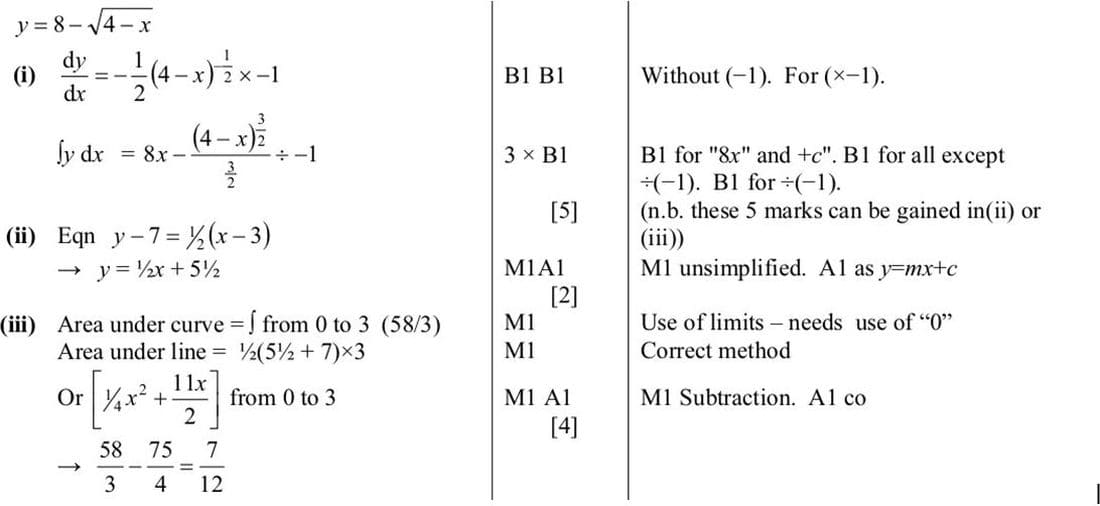
(i) Find expressions for \(\frac{dy}{dx}\) and \(\int y \, dx\).
(ii) Find the equation of the tangent to the curve at \(P\) in the form \(y = mx + c\).
(iii) Find, showing all necessary working, the area of the shaded region.
9709 P11 - Jun 2014 - Q11
A line has equation \(y = 2x + c\) and a curve has equation \(y = 8 - 2x - x^2\).
For the case where \(c = 11\), find the \(x\)-coordinates of the points of intersection of the line and the curve. Find also, by integration, the area of the region between the line and the curve.
9709 P13 - Jun 2023 - Q10
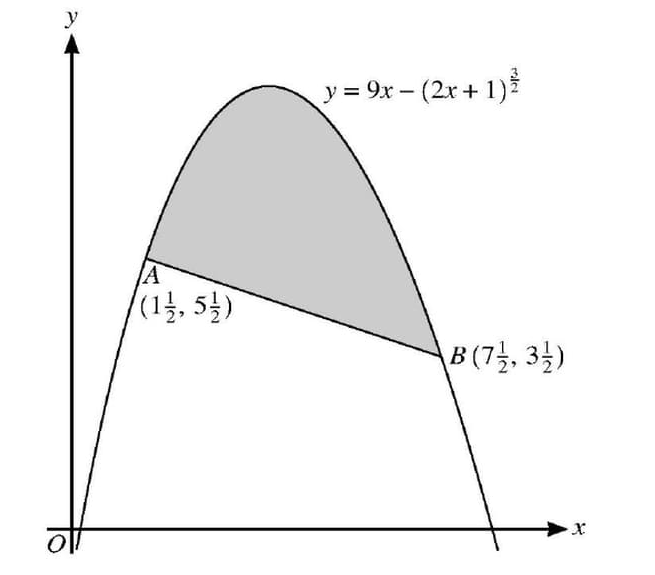
The diagram shows the points \(A \left(1\frac{1}{2}, 5\frac{1}{2}\right)\) and \(B \left(7\frac{1}{2}, 3\frac{1}{2}\right)\) lying on the curve with equation \(y = 9x - (2x + 1)^{\frac{3}{2}}\).
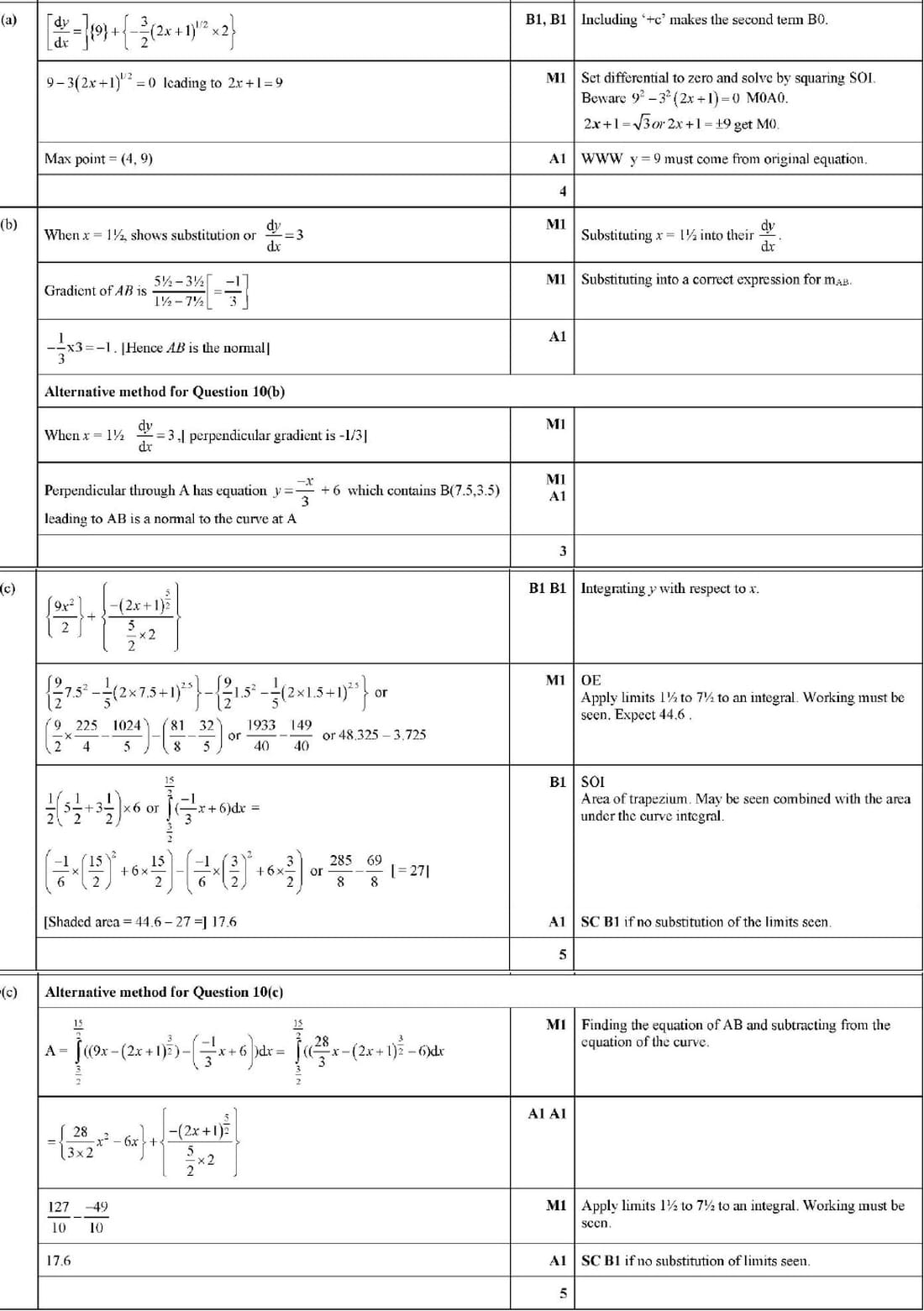
(a) Find the coordinates of the maximum point of the curve.
(b) Verify that the line \(AB\) is the normal to the curve at \(A\).
(c) Find the area of the shaded region.
9709 P11 - Nov 2013 - Q10
The diagram shows the curve \(y = (3 - 2x)^3\) and the tangent to the curve at the point \(\left( \frac{1}{2}, 8 \right)\).
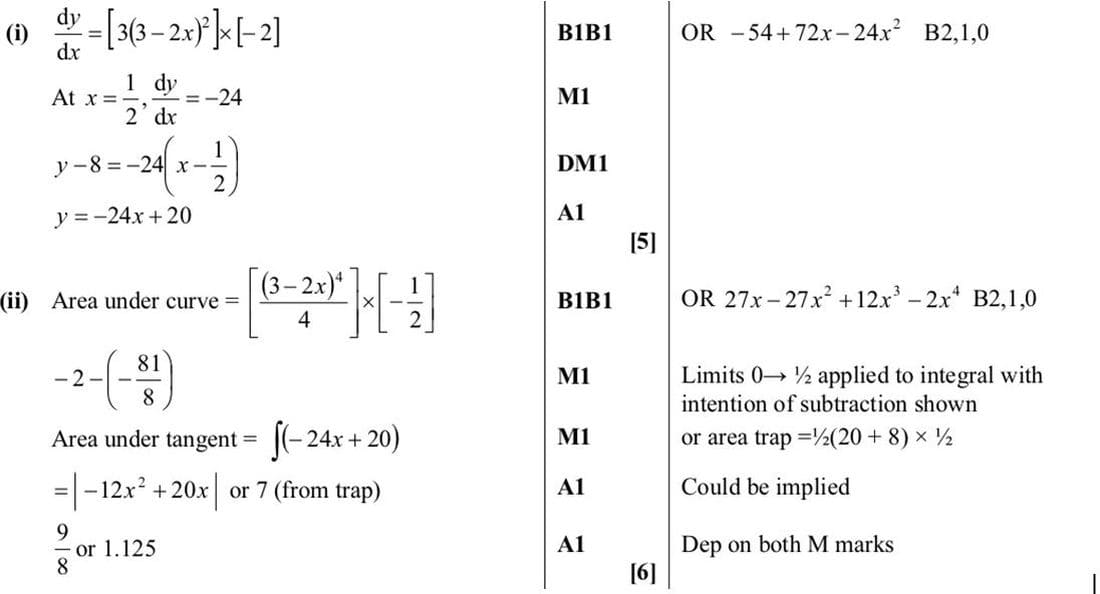
(i) Find the equation of this tangent, giving your answer in the form \(y = mx + c\).
(ii) Find the area of the shaded region.

9709 P13 - Jun 2013 - Q11
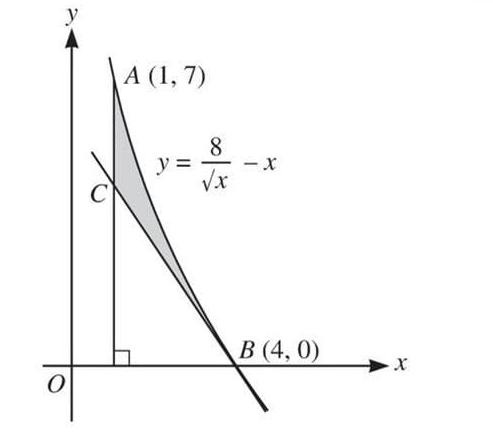
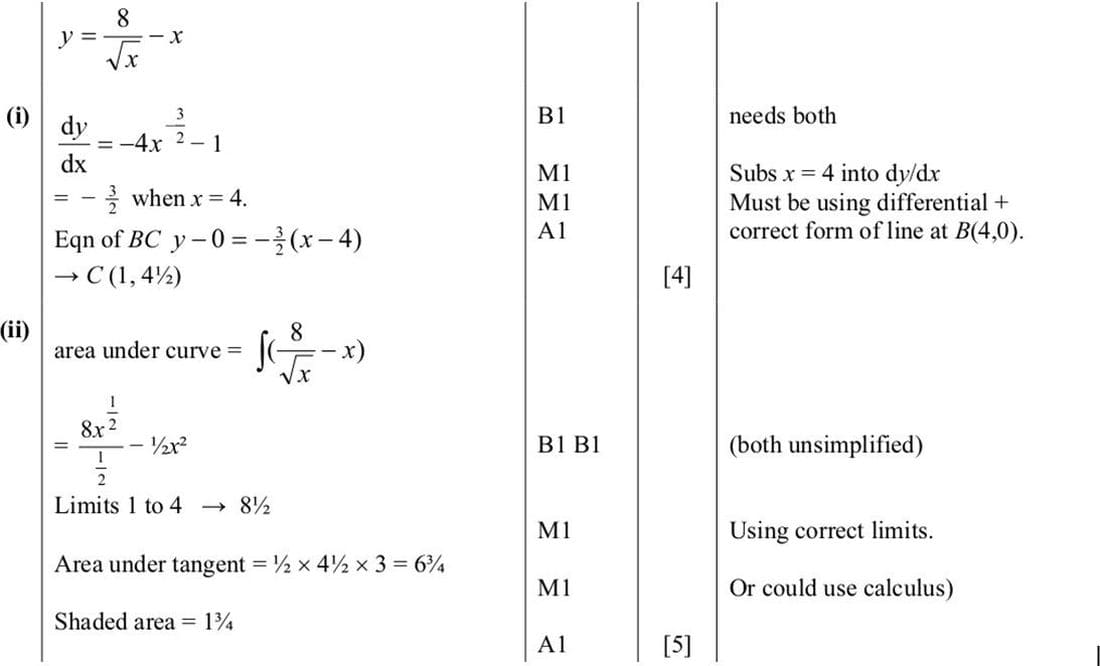
The diagram shows part of the curve \(y = \frac{8}{\sqrt{x}} - x\) and points \(A (1, 7)\) and \(B (4, 0)\) which lie on the curve. The tangent to the curve at \(B\) intersects the line \(x = 1\) at the point \(C\).
(i) Find the coordinates of \(C\).
(ii) Find the area of the shaded region.
9709 P12 - Jun 2013 - Q11
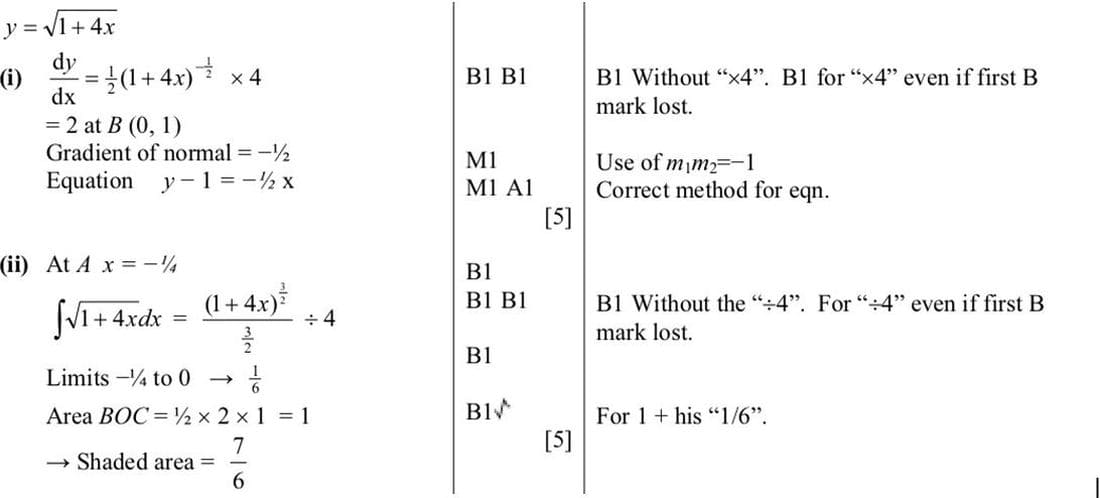
The diagram shows the curve \(y = \sqrt{1 + 4x}\), which intersects the x-axis at \(A\) and the y-axis at \(B\). The normal to the curve at \(B\) meets the x-axis at \(C\). Find
(i) the equation of \(BC\),
(ii) the area of the shaded region.

9709 P11 - Jun 2013 - Q10
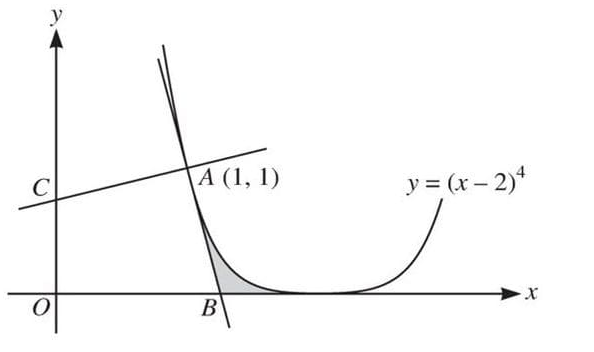
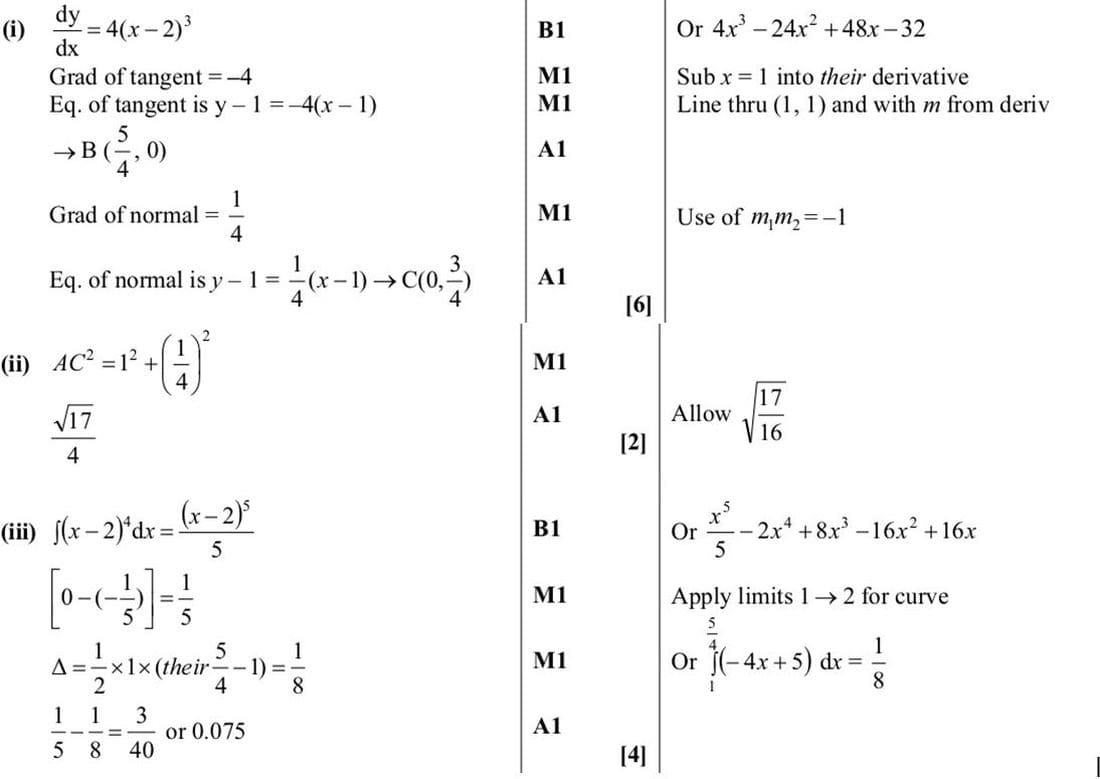
The diagram shows part of the curve \(y = (x - 2)^4\) and the point \(A (1, 1)\) on the curve. The tangent at \(A\) cuts the \(x\)-axis at \(B\) and the normal at \(A\) cuts the \(y\)-axis at \(C\).
- Find the coordinates of \(B\) and \(C\).
- Find the distance \(AC\), giving your answer in the form \(\frac{\sqrt{a}}{b}\), where \(a\) and \(b\) are integers.
- Find the area of the shaded region.
9709 P13 - Nov 2012 - Q11
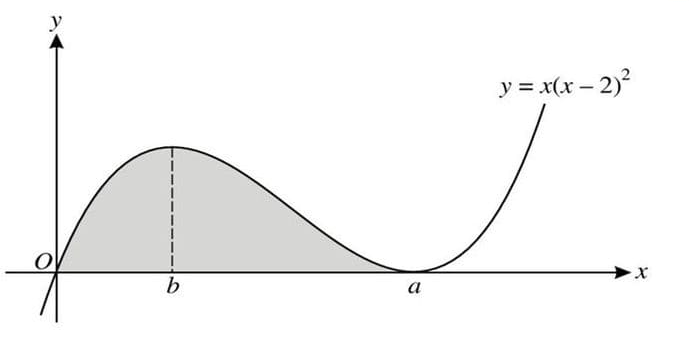
The diagram shows the curve with equation \(y = x(x - 2)^2\). The minimum point on the curve has coordinates \((a, 0)\) and the \(x\)-coordinate of the maximum point is \(b\), where \(a\) and \(b\) are constants.
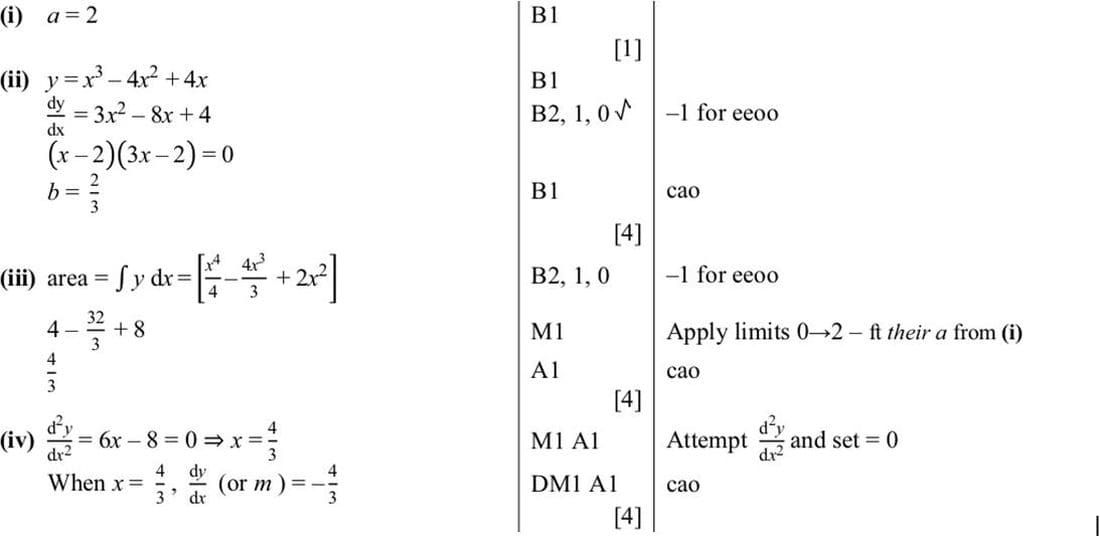
- State the value of \(a\).
- Find the value of \(b\).
- Find the area of the shaded region.
- The gradient, \(\frac{dy}{dx}\), of the curve has a minimum value \(m\). Find the value of \(m\).
9709 P11 - Nov 2012 - Q8
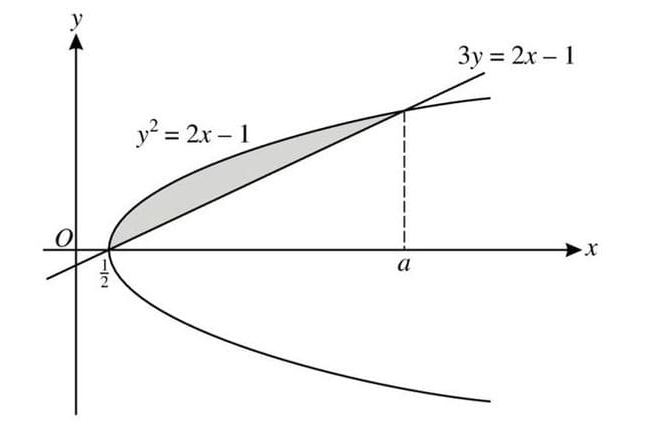
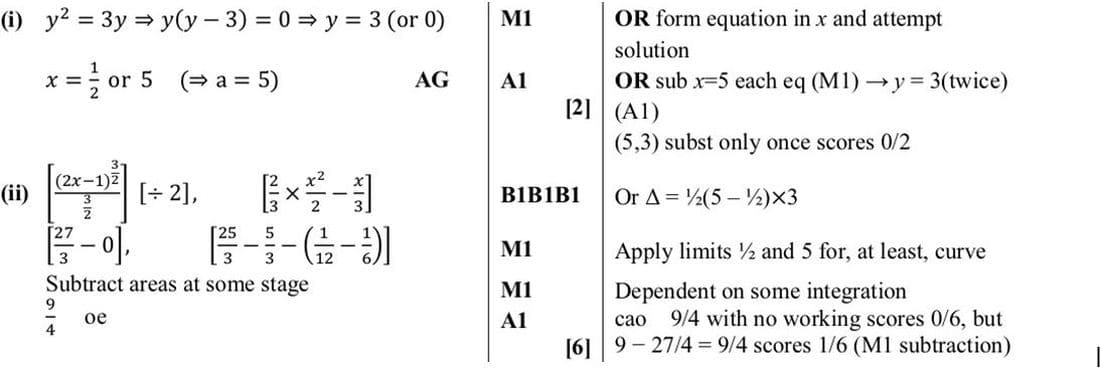
The diagram shows the curve \(y^2 = 2x - 1\) and the straight line \(3y = 2x - 1\). The curve and straight line intersect at \(x = \frac{1}{2}\) and \(x = a\), where \(a\) is a constant.
(i) Show that \(a = 5\).
(ii) Find, showing all necessary working, the area of the shaded region.
9709 P12 - Jun 2012 - Q9
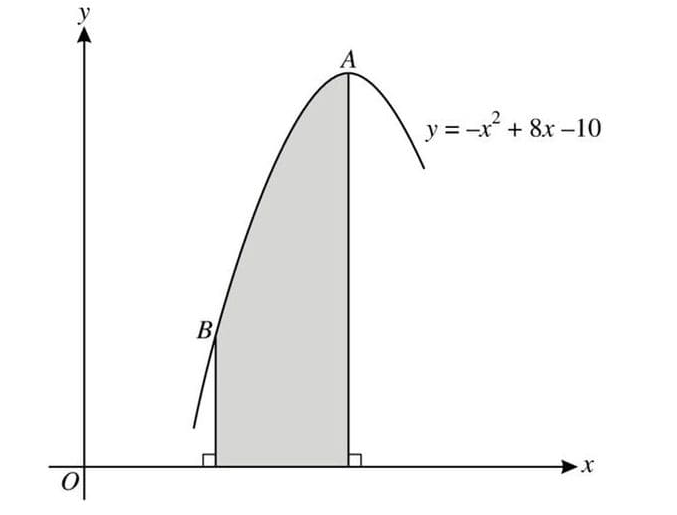
The diagram shows part of the curve \(y = -x^2 + 8x - 10\) which passes through the points \(A\) and \(B\). The curve has a maximum point at \(A\) and the gradient of the line \(BA\) is 2.
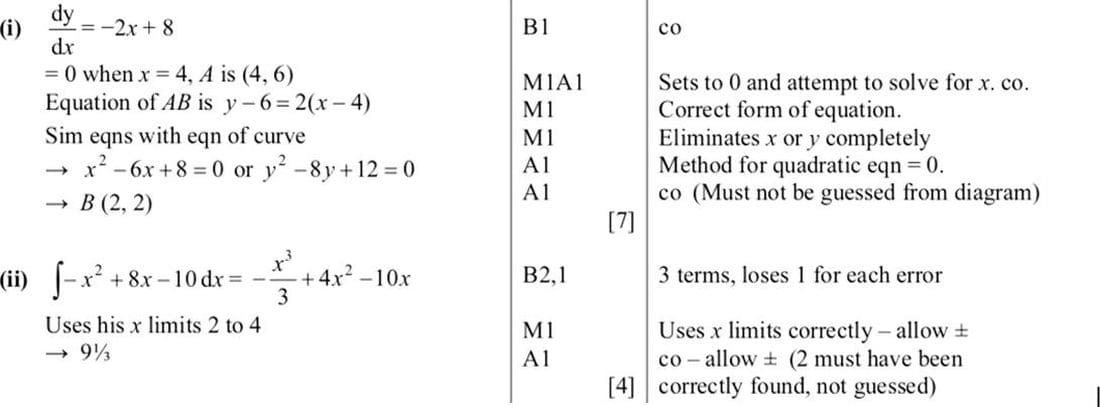
(i) Find the coordinates of \(A\) and \(B\).
(ii) Find \(\int y \, dx\) and hence evaluate the area of the shaded region.
9709 P13 - Nov 2010 - Q11
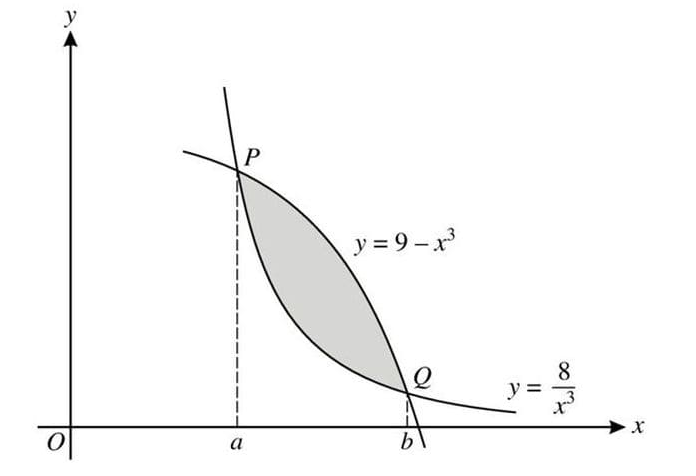
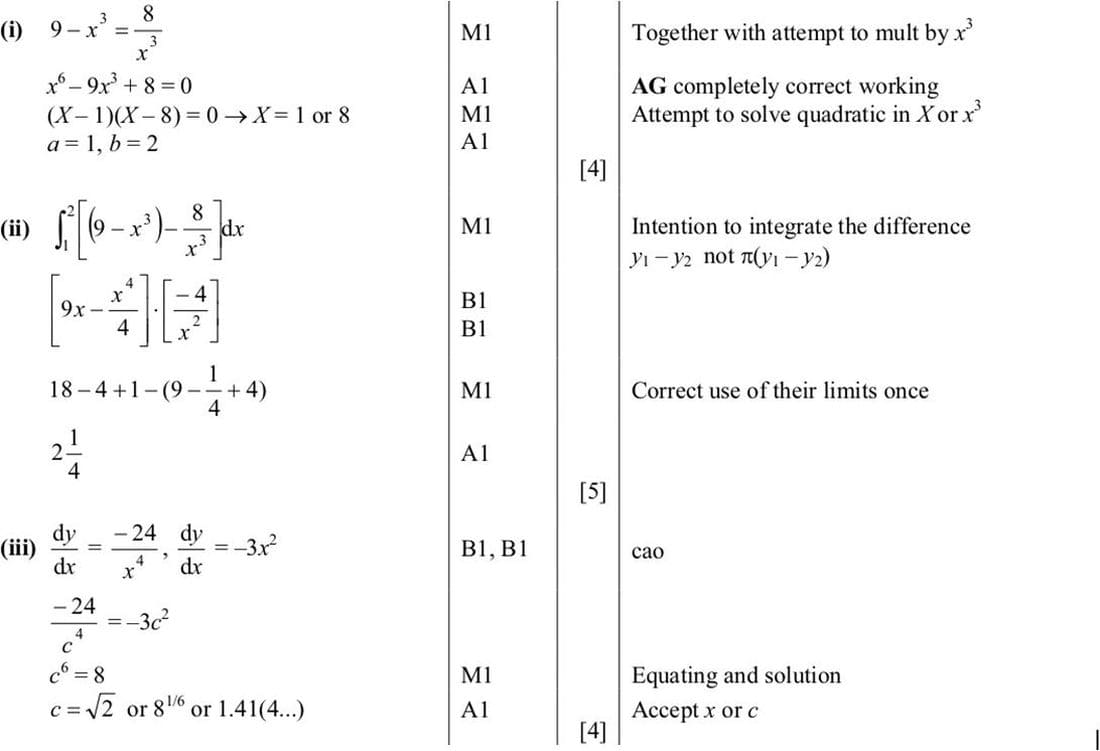
The diagram shows parts of the curves \(y = 9 - x^3\) and \(y = \frac{8}{x^3}\) and their points of intersection \(P\) and \(Q\). The \(x\)-coordinates of \(P\) and \(Q\) are \(a\) and \(b\) respectively.
(i) Show that \(x = a\) and \(x = b\) are roots of the equation \(x^6 - 9x^3 + 8 = 0\). Solve this equation and hence state the value of \(a\) and the value of \(b\).
(ii) Find the area of the shaded region between the two curves.
(iii) The tangents to the two curves at \(x = c\) (where \(a < c < b\)) are parallel to each other. Find the value of \(c\).
9709 P12 - Jun 2010 - Q9
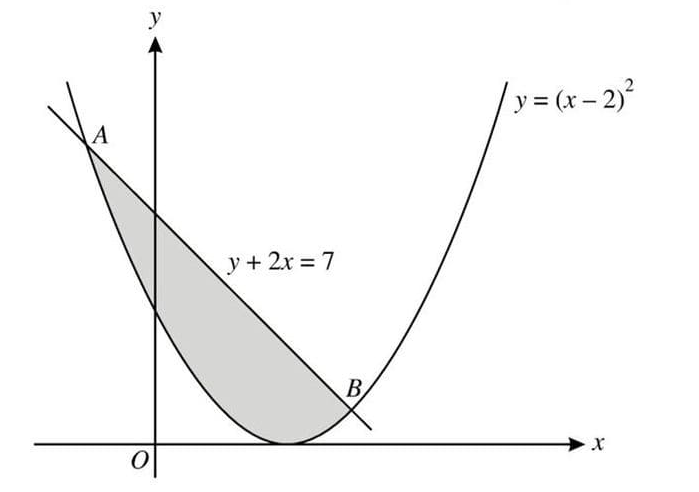
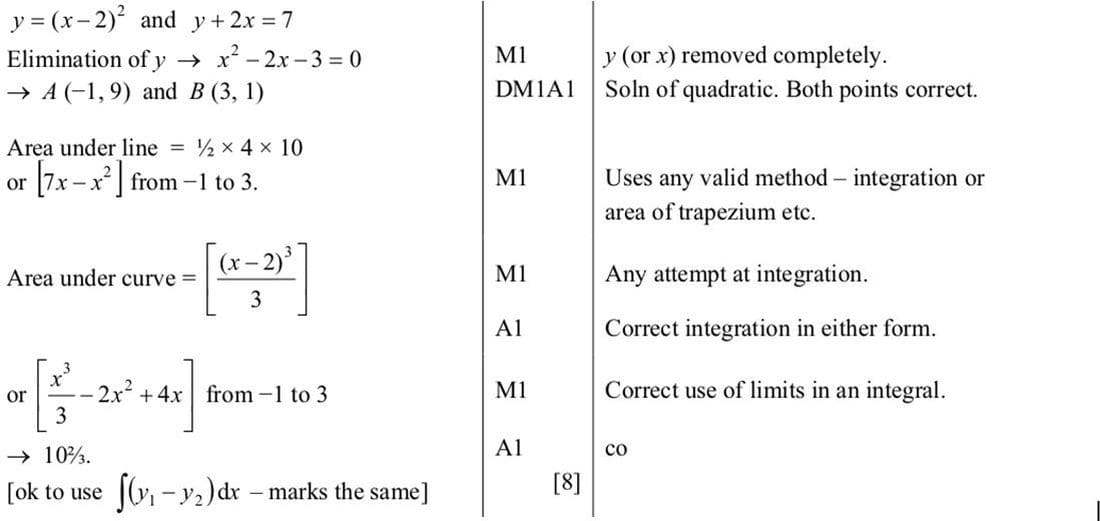
The diagram shows the curve \(y = (x-2)^2\) and the line \(y + 2x = 7\), which intersect at points \(A\) and \(B\). Find the area of the shaded region.
9709 P11 - Jun 2010 - Q4
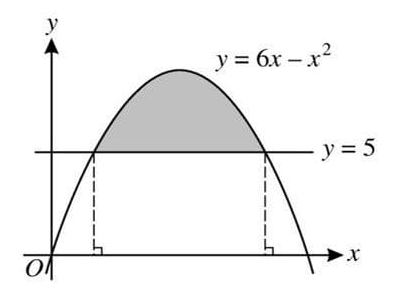
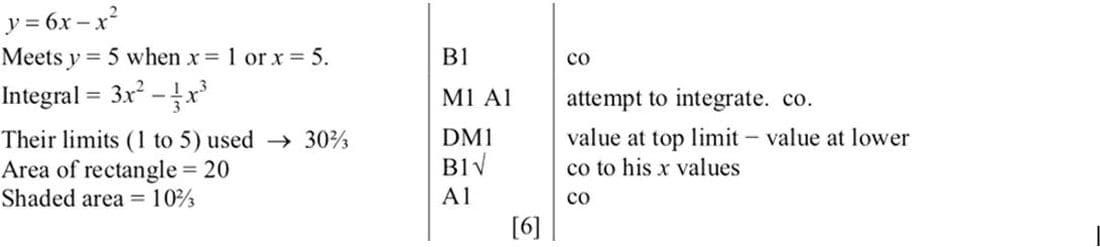
The diagram shows the curve \(y = 6x - x^2\) and the line \(y = 5\). Find the area of the shaded region.
9709 P12 - Jun 2023 - Q5
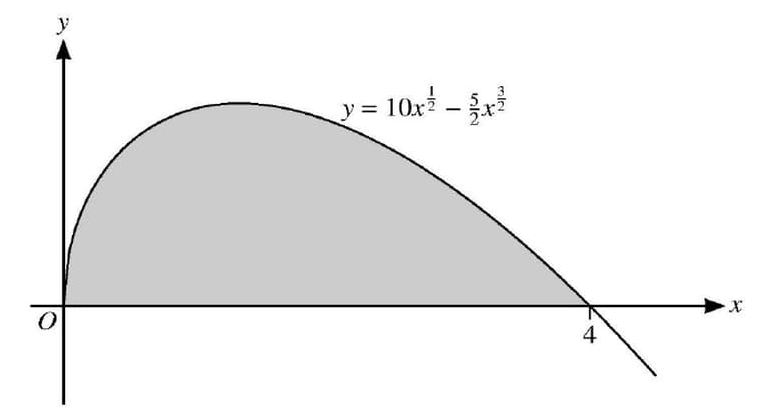
The diagram shows the curve with equation \(y = 10x^{\frac{1}{2}} - \frac{5}{2}x^{\frac{3}{2}}\) for \(x > 0\). The curve meets the x-axis at the points \((0, 0)\) and \((4, 0)\).
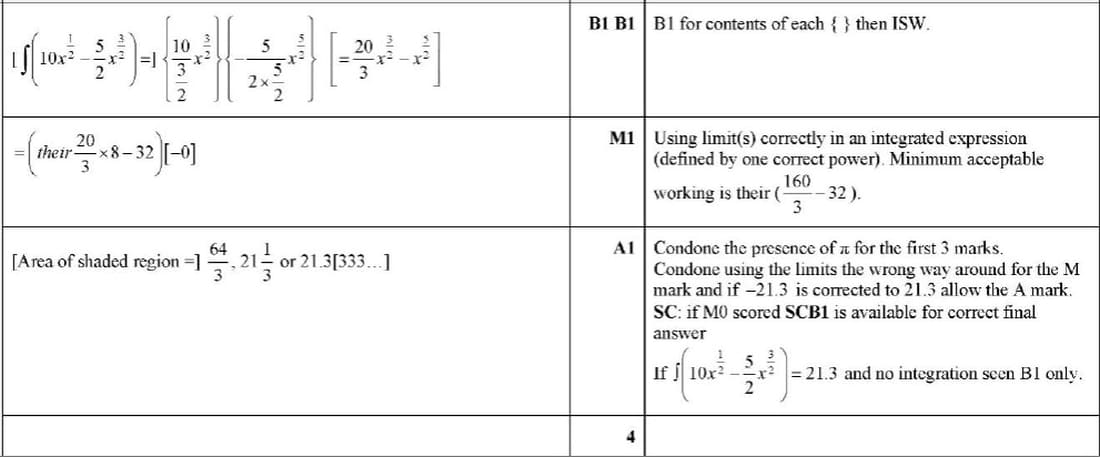
Find the area of the shaded region.
9709 P11 - Nov 2009 - Q4
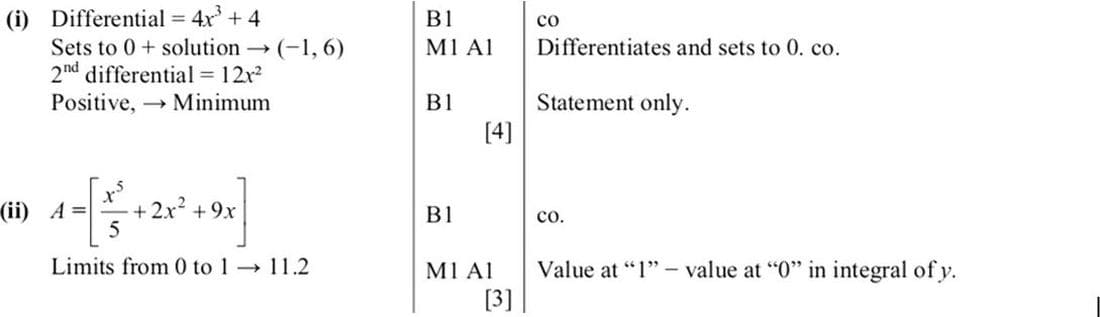
The equation of a curve is \(y = x^4 + 4x + 9\).
(i) Find the coordinates of the stationary point on the curve and determine its nature.
(ii) Find the area of the region enclosed by the curve, the x-axis and the lines \(x = 0\) and \(x = 1\).
9709 P1 - Jun 2009 - Q11
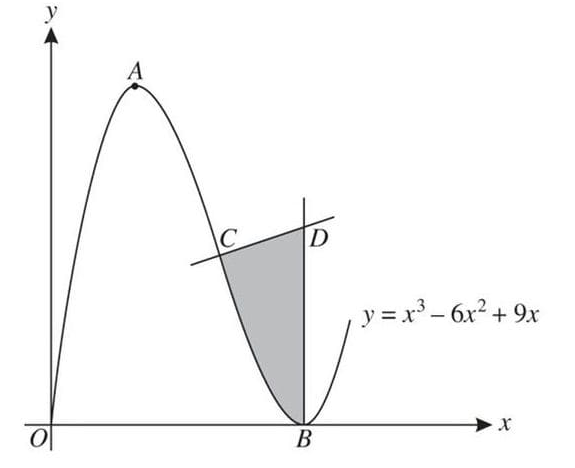
The diagram shows the curve \(y = x^3 - 6x^2 + 9x\) for \(x \geq 0\). The curve has a maximum point at \(A\) and a minimum point on the \(x\)-axis at \(B\). The normal to the curve at \(C (2, 2)\) meets the normal to the curve at \(B\) at the point \(D\).
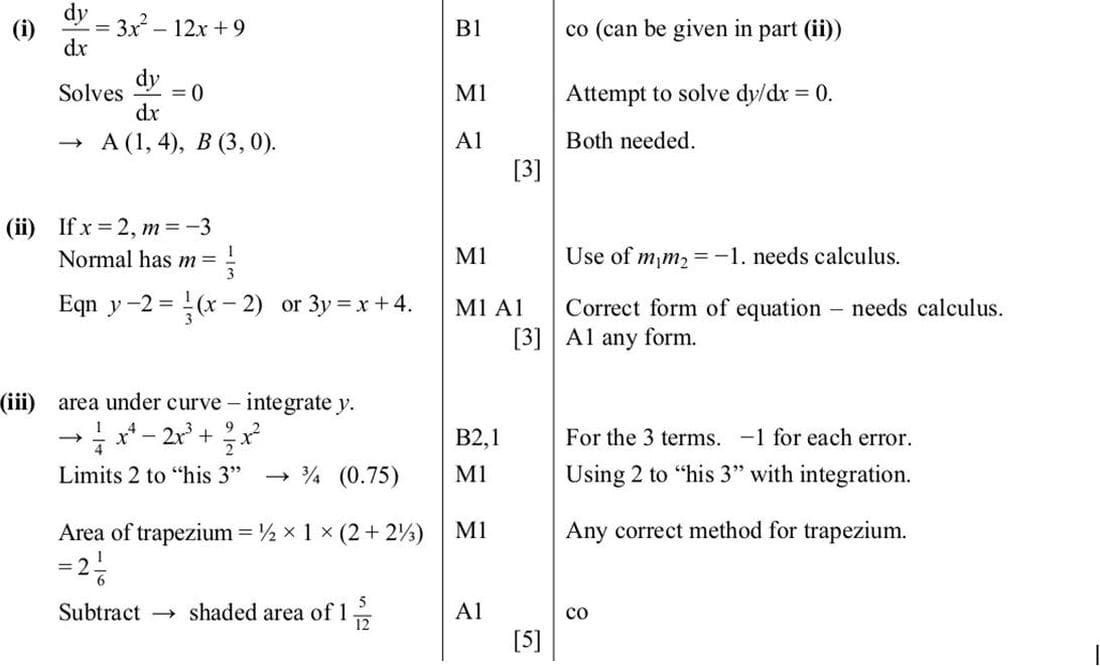
(i) Find the coordinates of \(A\) and \(B\).
(ii) Find the equation of the normal to the curve at \(C\).
(iii) Find the area of the shaded region.