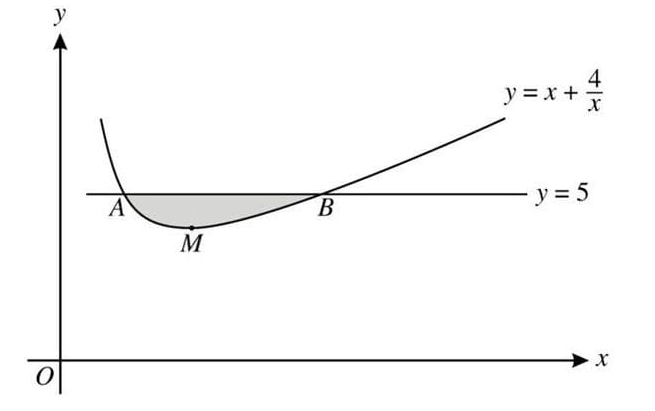
(i) To find the coordinates of \(A\) and \(B\), set \(y = x + \frac{4}{x} = 5\). Solving for \(x\), we get:
\(x + \frac{4}{x} = 5\)
\(x^2 - 5x + 4 = 0\)
\((x-1)(x-4) = 0\)
Thus, \(x = 1\) or \(x = 4\). Therefore, \(A(1, 5)\) and \(B(4, 5)\).
To find \(M\), differentiate \(y = x + \frac{4}{x}\):
\(\frac{dy}{dx} = 1 - \frac{4}{x^2}\)
Set \(\frac{dy}{dx} = 0\) to find the minimum point:
\(1 - \frac{4}{x^2} = 0\)
\(x^2 = 4\)
\(x = 2\)
Substitute \(x = 2\) into \(y = x + \frac{4}{x}\):
\(y = 2 + \frac{4}{2} = 4\)
Thus, \(M(2, 4)\).
(ii) The volume of the solid of revolution is given by:
\(V = \pi \int_{1}^{4} y^2 \, dx\)
\(y = x + \frac{4}{x}\), so \(y^2 = (x + \frac{4}{x})^2 = x^2 + 8 + \frac{16}{x^2}\)
Integrate:
\(\int (x^2 + 8 + \frac{16}{x^2}) \, dx = \frac{x^3}{3} + 8x - \frac{16}{x}\)
Evaluate from 1 to 4:
\(\left[ \frac{x^3}{3} + 8x - \frac{16}{x} \right]_{1}^{4} = \left( \frac{64}{3} + 32 - 4 \right) - \left( \frac{1}{3} + 8 - 16 \right)\)
\(= \left( \frac{64}{3} + 28 \right) - \left( \frac{1}{3} - 8 \right)\)
\(= \frac{64}{3} + 28 + 8 - \frac{1}{3}\)
\(= \frac{63}{3} + 36\)
\(= 21 + 36 = 57\)
Volume of cylinder: \(\pi \times 5^2 \times 3 = 75\pi\)
Volume of solid: \(75\pi - 57\pi = 18\pi\)