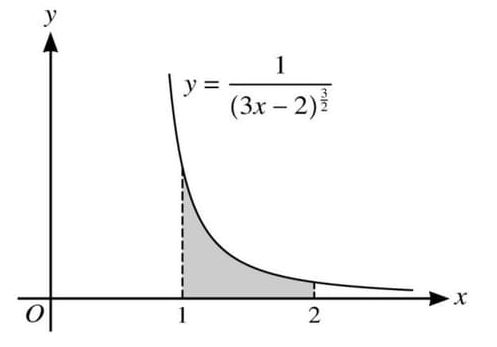
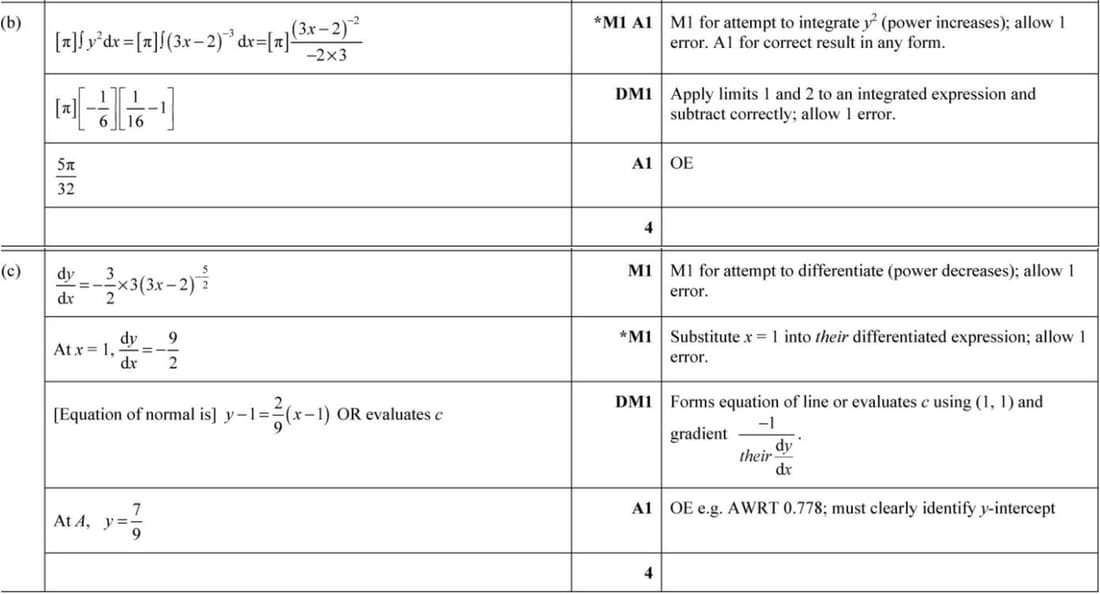
(b) To find the volume of revolution, use the formula:
\(V = \pi \int_{1}^{2} y^2 \, dx\)
Substitute \(y = \frac{1}{(3x - 2)^{\frac{3}{2}}}\) into the integral:
\(V = \pi \int_{1}^{2} \left( \frac{1}{(3x - 2)^{\frac{3}{2}}} \right)^2 \, dx = \pi \int_{1}^{2} (3x - 2)^{-3} \, dx\)
Integrate:
\(V = \pi \left[ \frac{(3x - 2)^{-2}}{-2 \times 3} \right]_{1}^{2}\)
\(V = \pi \left[ -\frac{1}{6(3x - 2)^2} \right]_{1}^{2}\)
Evaluate the definite integral:
\(V = \pi \left[ -\frac{1}{6 \times 16} + \frac{1}{6} \right] = \frac{5\pi}{32}\)
(c) Differentiate \(y = \frac{1}{(3x - 2)^{\frac{3}{2}}}\) to find \(\frac{dy}{dx}\):
\(\frac{dy}{dx} = -\frac{3}{2} \times 3(3x - 2)^{-\frac{5}{2}}\)
At \(x = 1\), \(\frac{dy}{dx} = -\frac{9}{2}\).
The gradient of the normal is \(-\frac{1}{\left( -\frac{9}{2} \right)} = \frac{2}{9}\).
The equation of the normal is:
\(y - 1 = \frac{2}{9}(x - 1)\)
Substitute \(x = 0\) to find the y-intercept:
\(y - 1 = \frac{2}{9}(0 - 1)\)
\(y = 1 - \frac{2}{9} = \frac{7}{9}\)