Browsing as Guest. Progress, bookmarks and attempts are disabled.
Log in to track your work.
June 2004 p1 q7
1362
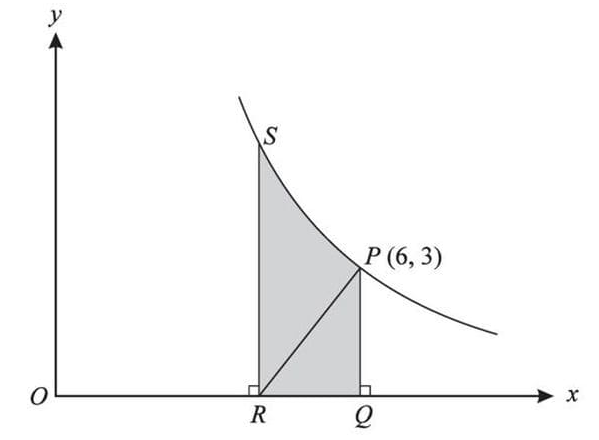
The diagram shows part of the graph of \(y = \frac{18}{x}\) and the normal to the curve at \(P(6, 3)\). This normal meets the \(x\)-axis at \(R\). The point \(Q\) on the \(x\)-axis and the point \(S\) on the curve are such that \(PQ\) and \(SR\) are parallel to the \(y\)-axis.
(i) Find the equation of the normal at \(P\) and show that \(R\) is the point \(\left(4\frac{1}{2}, 0\right)\).
(ii) Show that the volume of the solid obtained when the shaded region \(PQRS\) is rotated through \(360^\circ\) about the \(x\)-axis is \(18\pi\).
Solution
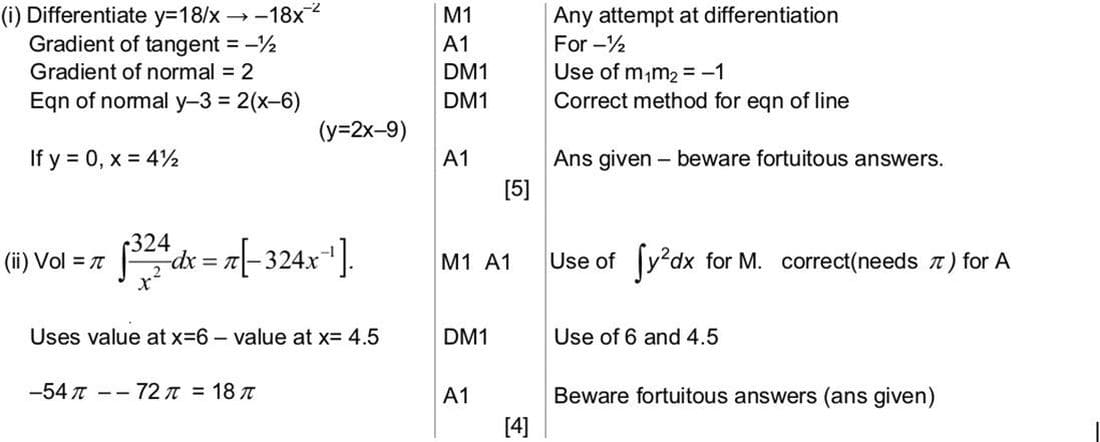
(i) Differentiate \(y = \frac{18}{x}\) to find the gradient of the tangent: \(\frac{dy}{dx} = -\frac{18}{x^2}\). At \(P(6, 3)\), the gradient is \(-\frac{1}{2}\). The gradient of the normal is the negative reciprocal, \(2\). The equation of the normal is \(y - 3 = 2(x - 6)\), simplifying to \(y = 2x - 9\). Setting \(y = 0\) to find \(R\), we get \(0 = 2x - 9\), so \(x = 4.5\). Thus, \(R\) is \(\left(4\frac{1}{2}, 0\right)\).
(ii) The volume of the solid is given by \(\pi \int_{4.5}^{6} \left(\frac{18}{x}\right)^2 \, dx\). This simplifies to \(\pi \int_{4.5}^{6} \frac{324}{x^2} \, dx = \pi \left[-\frac{324}{x}\right]_{4.5}^{6}\). Evaluating, we get \(\pi \left(-54 + 72\right) = 18\pi\).