Past Exam Questions
← Back9709 P12 - Jun 2018 - Q11
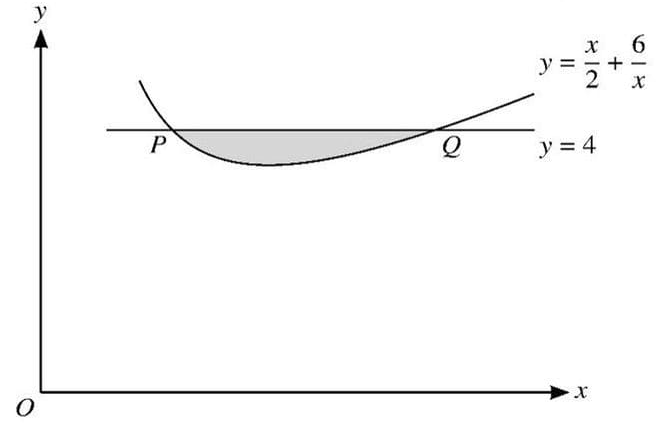
The diagram shows part of the curve \(y = \frac{x}{2} + \frac{6}{x}\). The line \(y = 4\) intersects the curve at the points \(P\) and \(Q\).
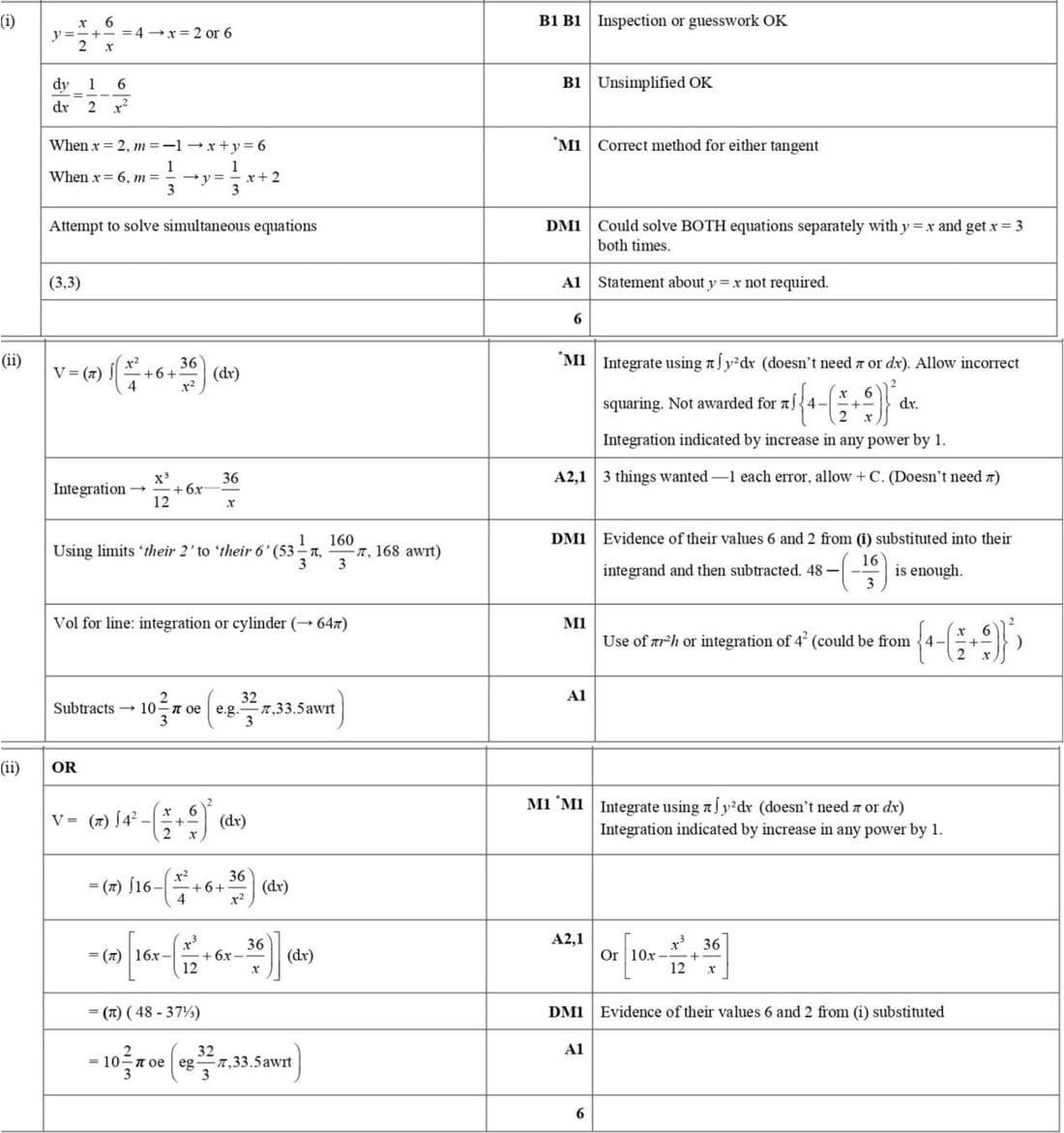
(i) Show that the tangents to the curve at \(P\) and \(Q\) meet at a point on the line \(y = x\).
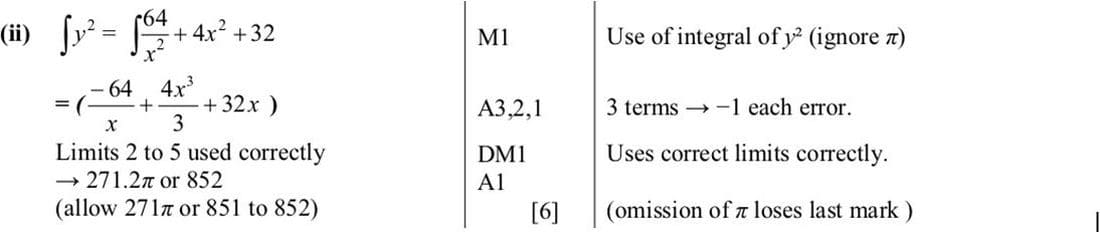
(ii) Find, showing all necessary working, the volume obtained when the shaded region is rotated through 360° about the \(x\)-axis. Give your answer in terms of \(\pi\).
9709 P11 - Nov 2017 - Q10
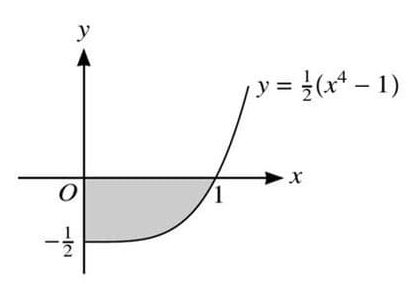
The diagram shows part of the curve \(y = \frac{1}{2}(x^4 - 1)\), defined for \(x \geq 0\).
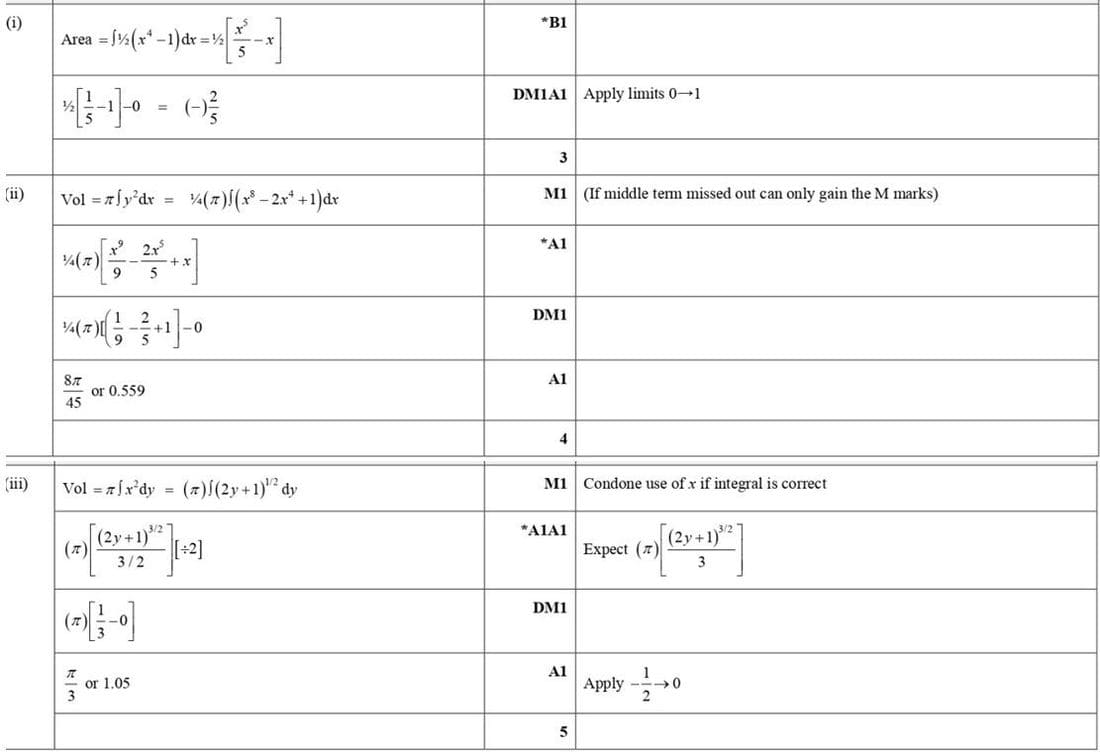
(i) Find, showing all necessary working, the area of the shaded region.
(ii) Find, showing all necessary working, the volume obtained when the shaded region is rotated through 360° about the x-axis.
(iii) Find, showing all necessary working, the volume obtained when the shaded region is rotated through 360° about the y-axis.
9709 P13 - Jun 2017 - Q10
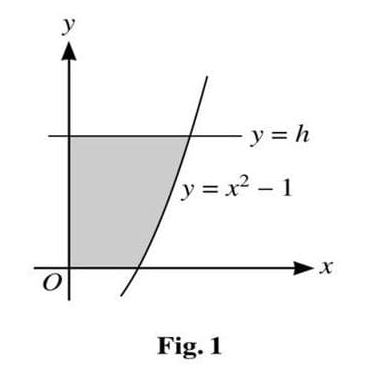
Fig. 1 shows part of the curve \(y = x^2 - 1\) and the line \(y = h\), where \(h\) is a constant.
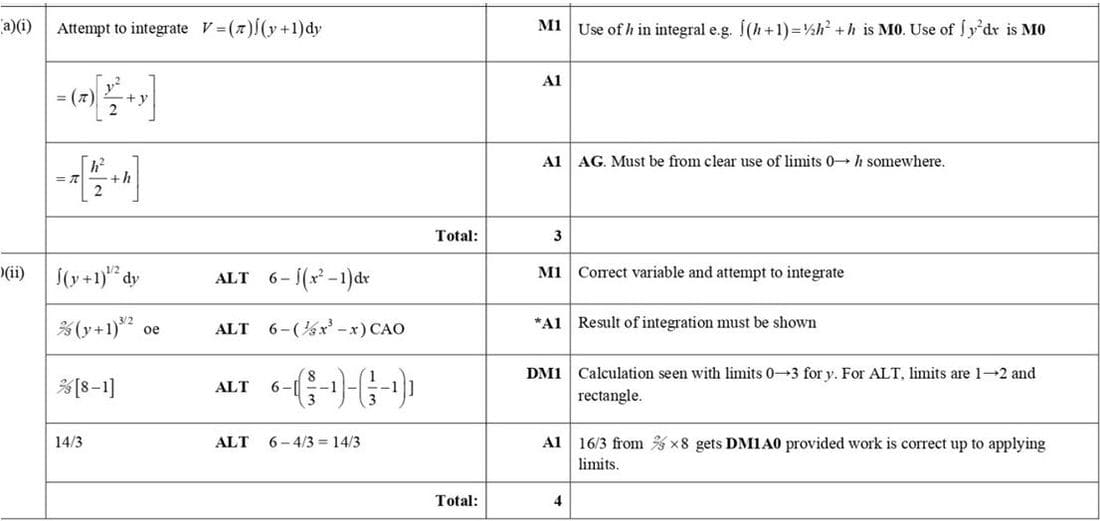
(i) The shaded region is rotated through 360° about the \(y\)-axis. Show that the volume of revolution, \(V\), is given by \(V = \pi \left( \frac{1}{2}h^2 + h \right)\).
(ii) Find, showing all necessary working, the area of the shaded region when \(h = 3\).
9709 P12 - Jun 2017 - Q6
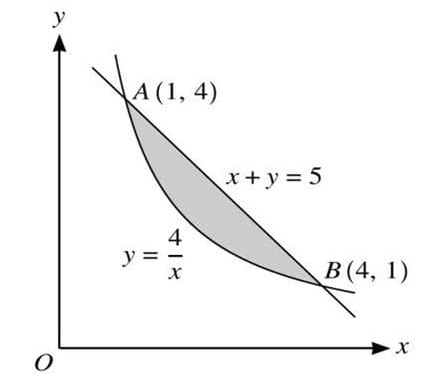
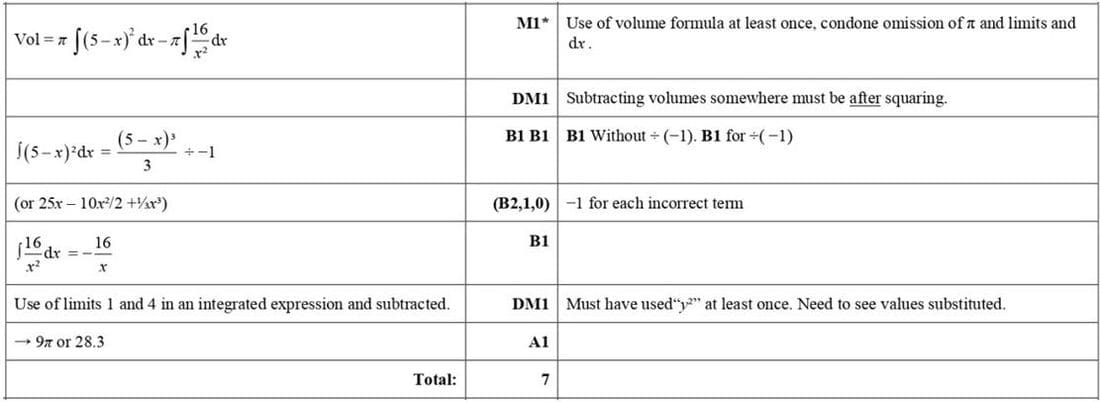
The diagram shows the straight line x + y = 5 intersecting the curve y = \frac{4}{x} at the points A (1, 4) and B (4, 1). Find, showing all necessary working, the volume obtained when the shaded region is rotated through 360° about the x-axis.
9709 P11 - Jun 2017 - Q10
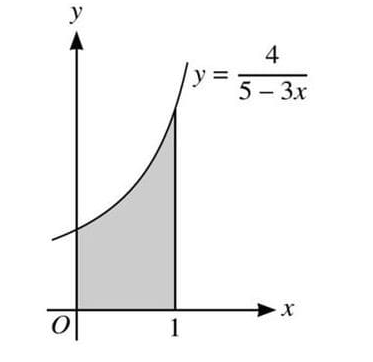
The diagram shows part of the curve \(y = \frac{4}{5 - 3x}\).
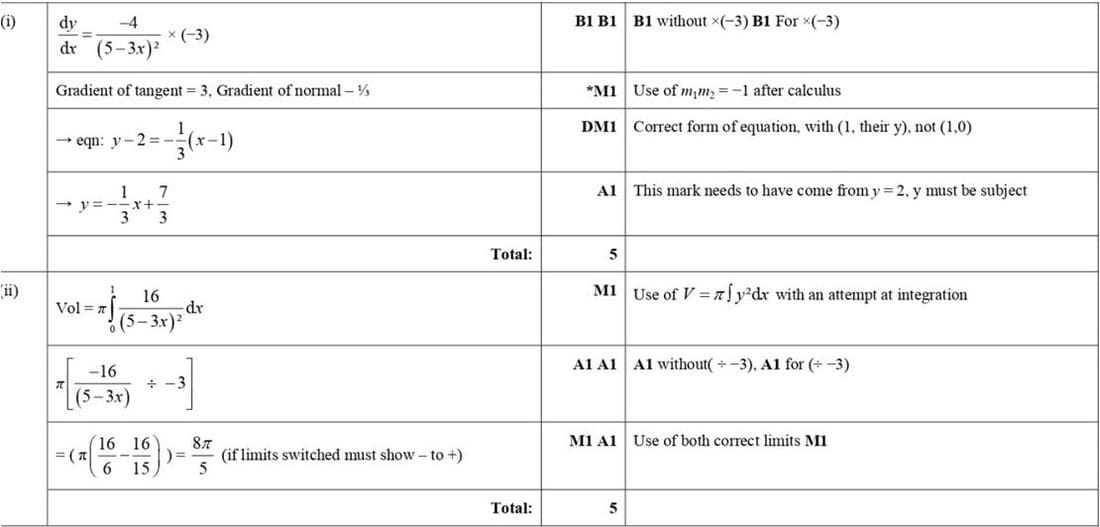
(i) Find the equation of the normal to the curve at the point where \(x = 1\) in the form \(y = mx + c\), where \(m\) and \(c\) are constants.
The shaded region is bounded by the curve, the coordinate axes and the line \(x = 1\).
(ii) Find, showing all necessary working, the volume obtained when this shaded region is rotated through 360° about the \(x\)-axis.
Question #1332
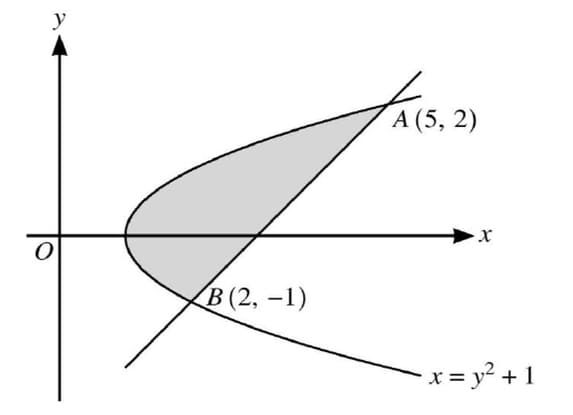
The diagram shows the curve with equation \(x = y^2 + 1\). The points \(A(5, 2)\) and \(B(2, -1)\) lie on the curve.
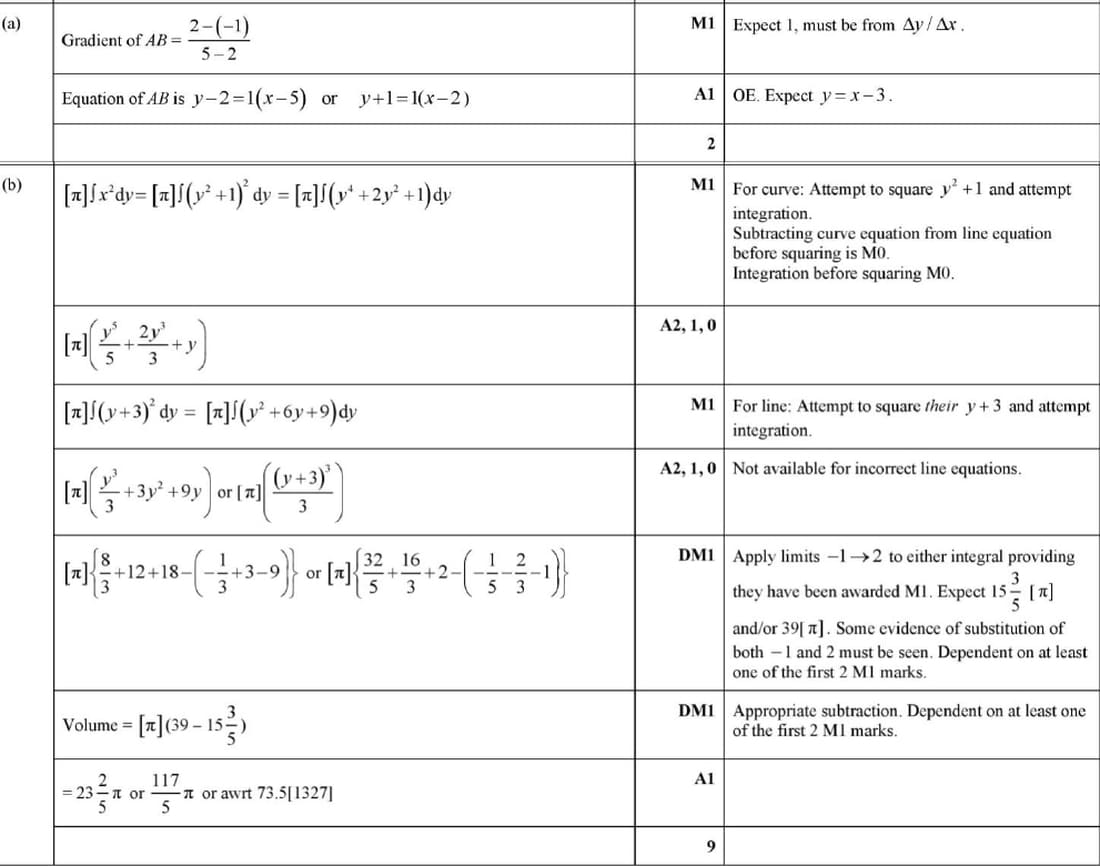
(a) Find an equation of the line \(AB\).
(b) Find the volume of revolution when the region between the curve and the line \(AB\) is rotated through 360° about the \(y\)-axis.
9709 P13 - Nov 2016 - Q11
A curve has equation \(y = (kx - 3)^{-1} + (kx - 3)\), where \(k\) is a non-zero constant.
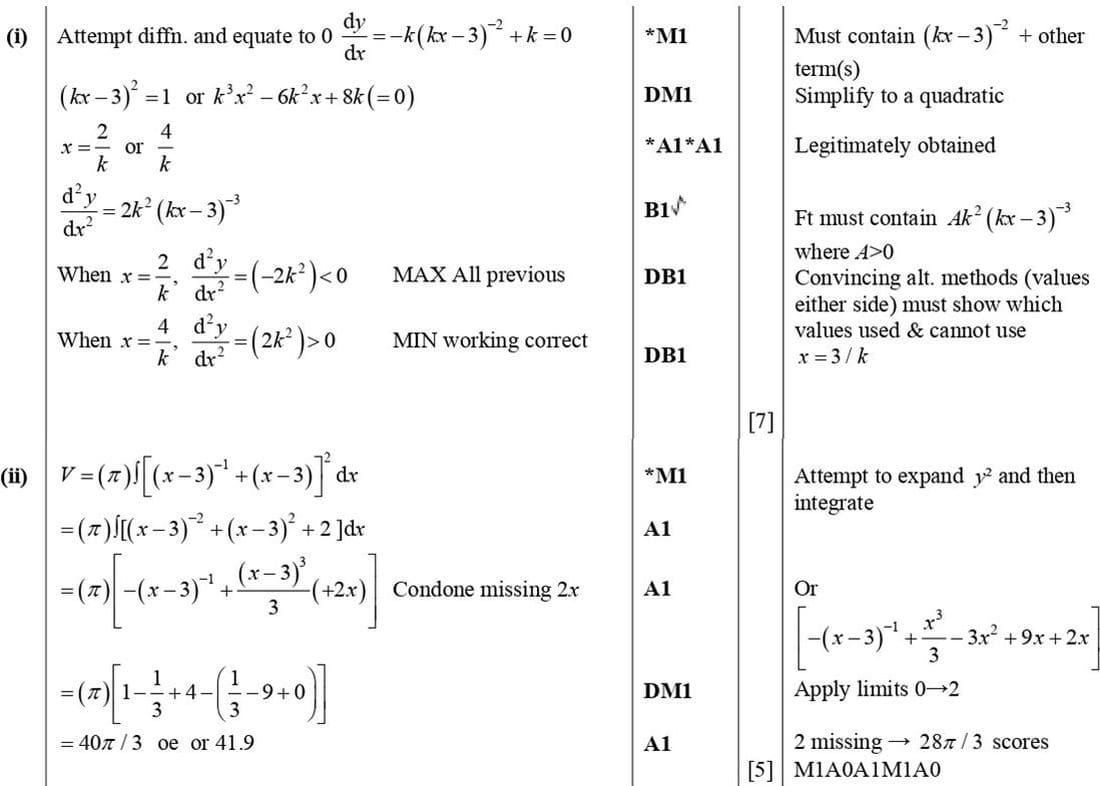
(i) Find the \(x\)-coordinates of the stationary points in terms of \(k\), and determine the nature of each stationary point, justifying your answers.
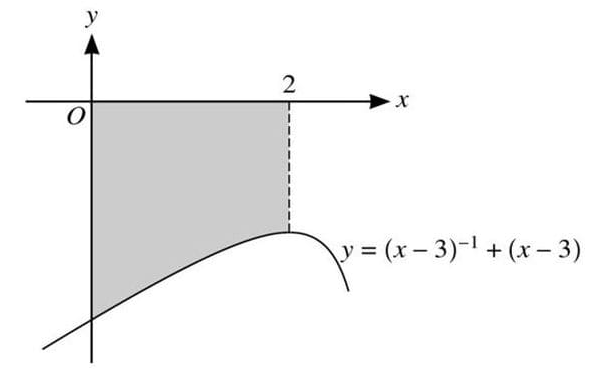
(ii) The diagram shows part of the curve for the case when \(k = 1\). Showing all necessary working, find the volume obtained when the region between the curve, the \(x\)-axis, the \(y\)-axis and the line \(x = 2\), shown shaded in the diagram, is rotated through 360° about the \(x\)-axis.
9709 P13 - Jun 2016 - Q2
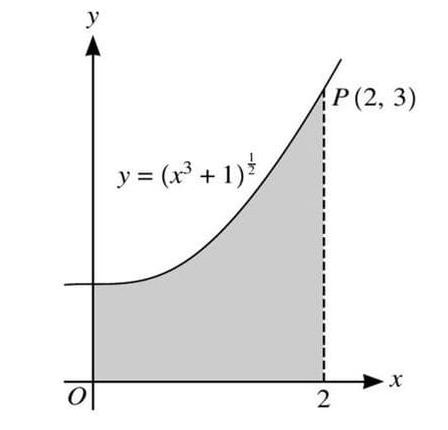
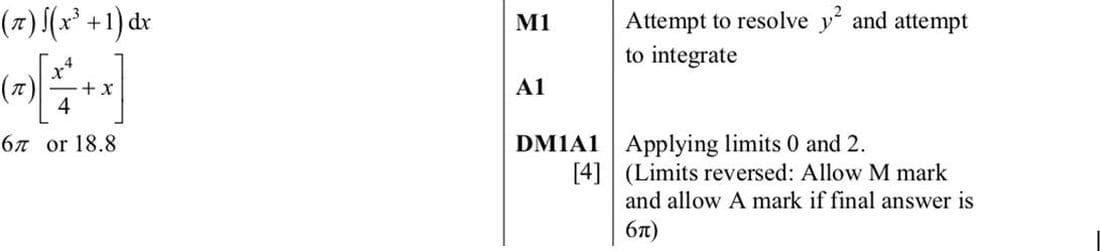
The diagram shows part of the curve \(y = (x^3 + 1)^{\frac{1}{2}}\) and the point \(P(2, 3)\) lying on the curve. Find, showing all necessary working, the volume obtained when the shaded region is rotated through 360° about the x-axis.
9709 P12 - Jun 2016 - Q10
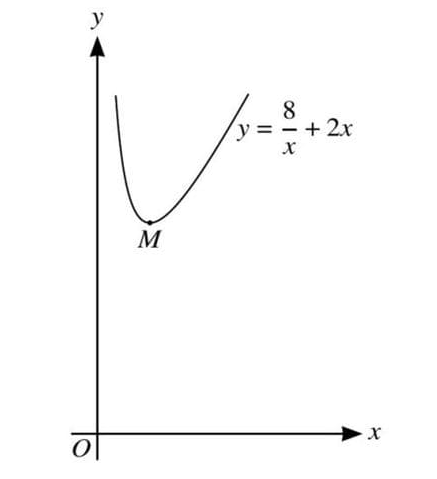
The diagram shows the part of the curve \(y = \frac{8}{x} + 2x\) for \(x > 0\), and the minimum point \(M\).
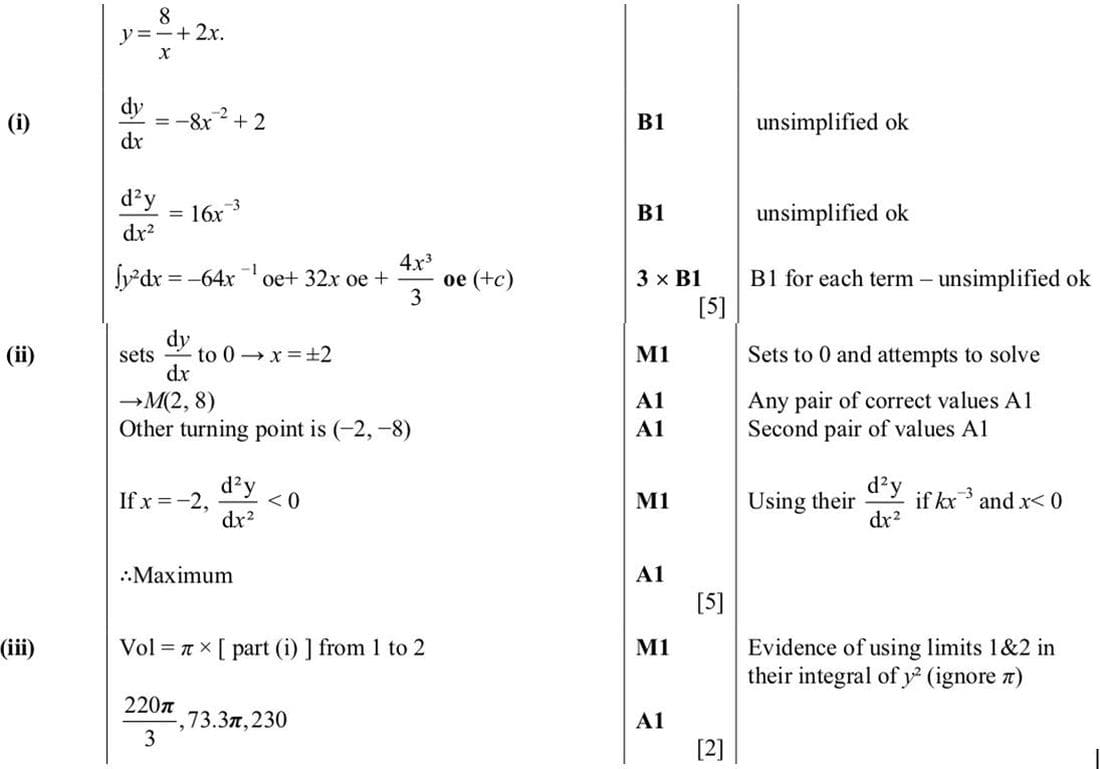
(i) Find expressions for \(\frac{dy}{dx}\), \(\frac{d^2y}{dx^2}\) and \(\int y^2 \, dx\). [5]
(ii) Find the coordinates of \(M\) and determine the coordinates and nature of the stationary point on the part of the curve for which \(x < 0\). [5]
(iii) Find the volume obtained when the region bounded by the curve, the \(x\)-axis and the lines \(x = 1\) and \(x = 2\) is rotated through 360° about the \(x\)-axis. [2]
9709 P11 - Jun 2016 - Q3
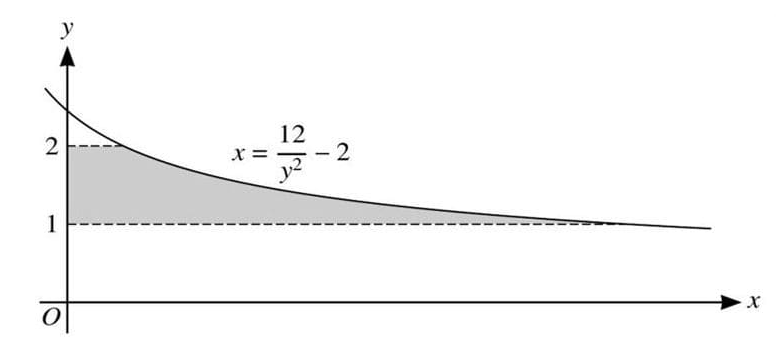
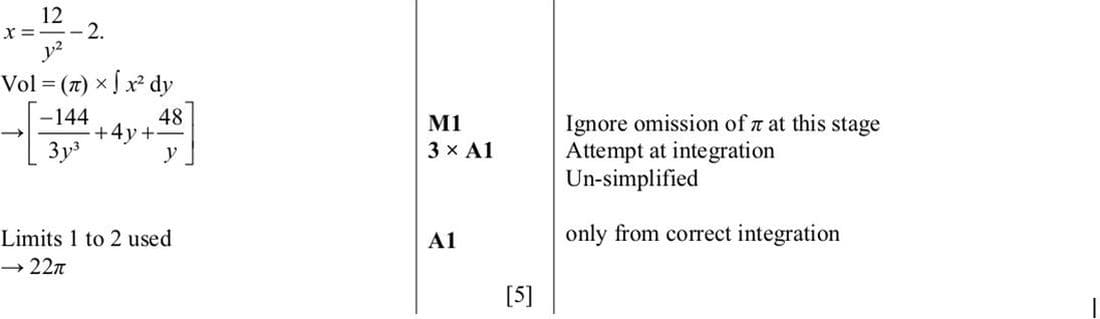
The diagram shows part of the curve \(x = \frac{12}{y^2} - 2\). The shaded region is bounded by the curve, the y-axis and the lines \(y = 1\) and \(y = 2\). Showing all necessary working, find the volume, in terms of \(\pi\), when this shaded region is rotated through 360° about the y-axis.
9709 P12 - Nov 2015 - Q10
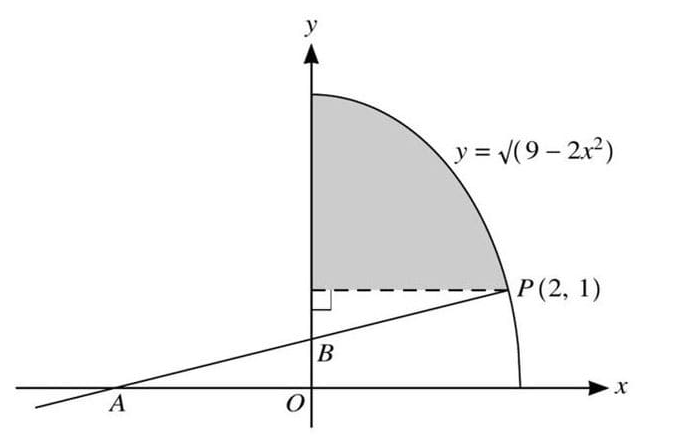
The diagram shows part of the curve \(y = \sqrt{9 - 2x^2}\). The point \(P(2, 1)\) lies on the curve and the normal to the curve at \(P\) intersects the \(x\)-axis at \(A\) and the \(y\)-axis at \(B\).
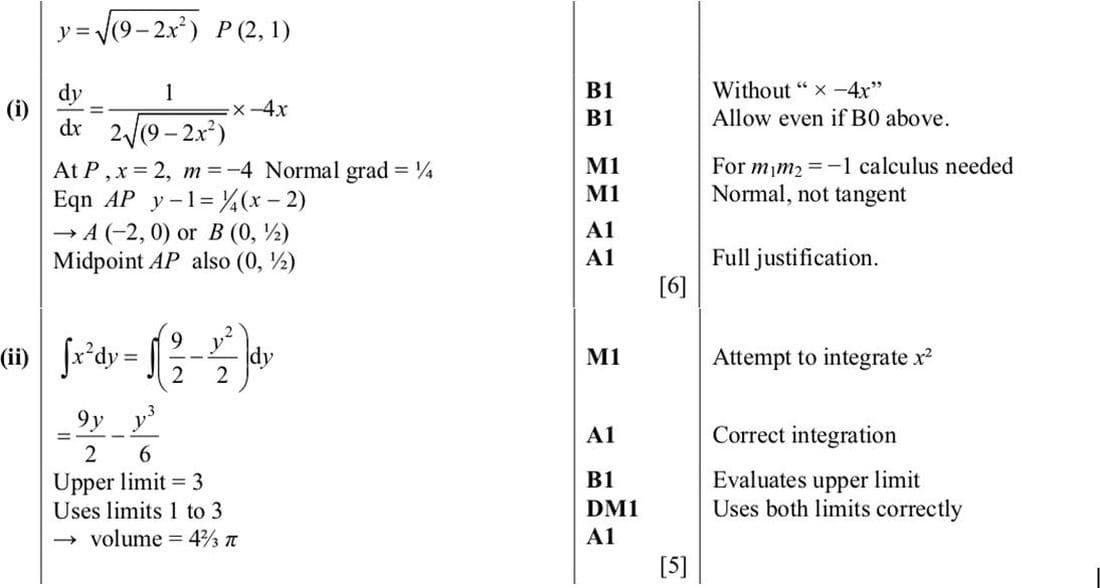
(i) Show that \(B\) is the mid-point of \(AP\).
The shaded region is bounded by the curve, the \(y\)-axis and the line \(y = 1\).
(ii) Find, showing all necessary working, the exact volume obtained when the shaded region is rotated through 360° about the \(y\)-axis.
9709 P11 - Nov 2015 - Q11
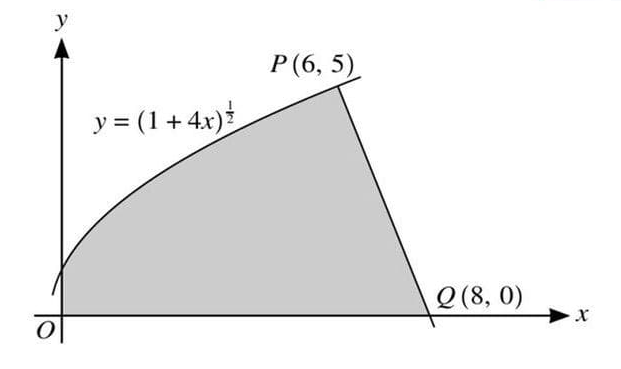
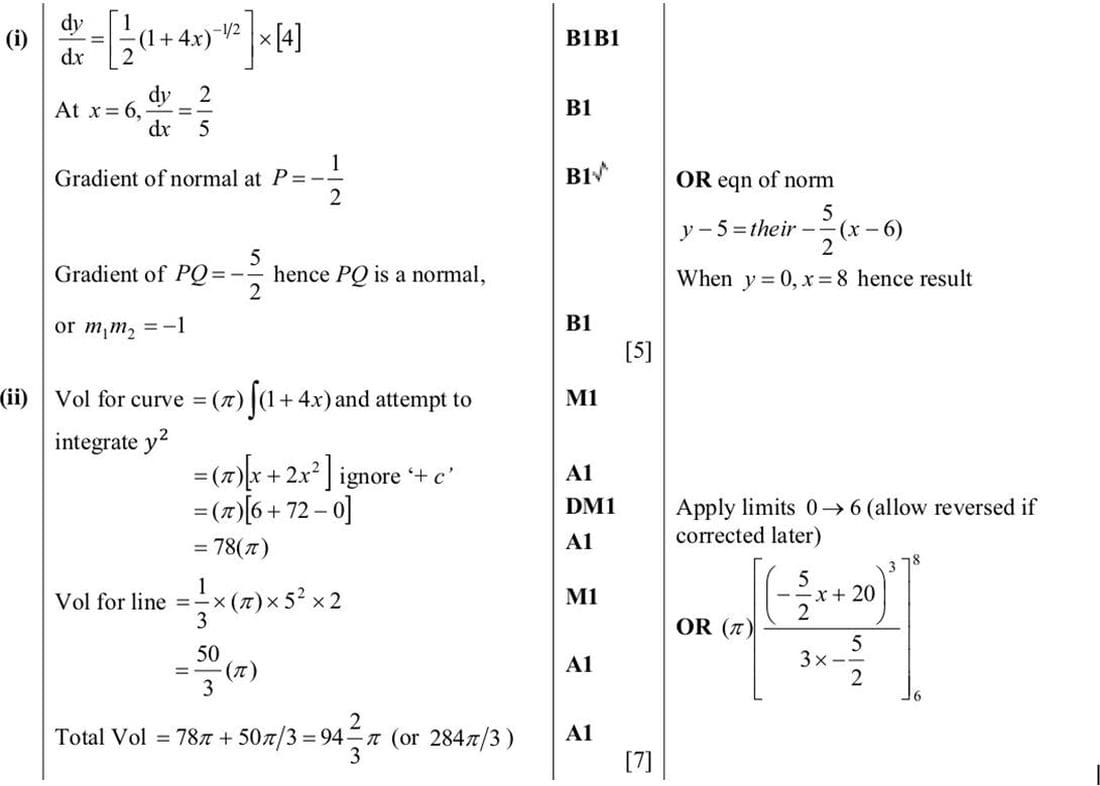
The diagram shows part of the curve \(y = (1 + 4x)^{\frac{1}{2}}\) and a point \(P(6, 5)\) lying on the curve. The line \(PQ\) intersects the \(x\)-axis at \(Q(8, 0)\).
(i) Show that \(PQ\) is a normal to the curve. [5]
(ii) Find, showing all necessary working, the exact volume of revolution obtained when the shaded region is rotated through \(360^\circ\) about the \(x\)-axis. [7]
[In part (ii) you may find it useful to apply the fact that the volume, \(V\), of a cone of base radius \(r\) and vertical height \(h\), is given by \(V = \frac{1}{3} \pi r^2 h\).]
9709 P12 - Jun 2015 - Q10
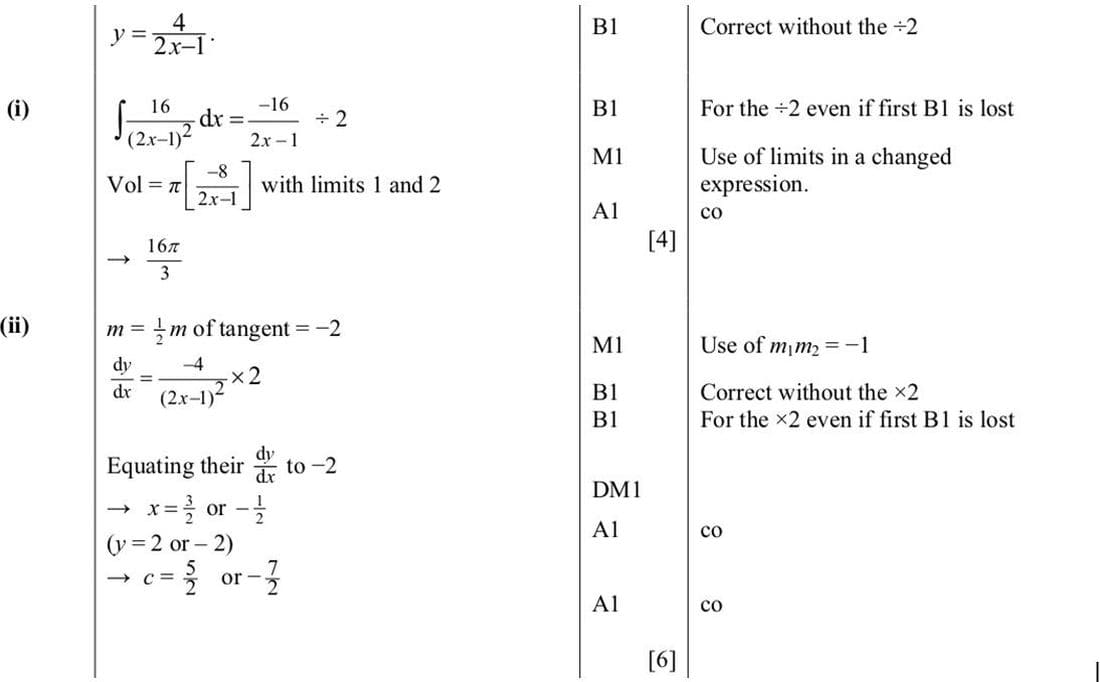
The equation of a curve is \(y = \frac{4}{2x-1}\).
(i) Find, showing all necessary working, the volume obtained when the region bounded by the curve, the \(x\)-axis and the lines \(x = 1\) and \(x = 2\) is rotated through 360° about the \(x\)-axis.
(ii) Given that the line \(2y = x + c\) is a normal to the curve, find the possible values of the constant \(c\).
9709 P12 - Nov 2014 - Q1
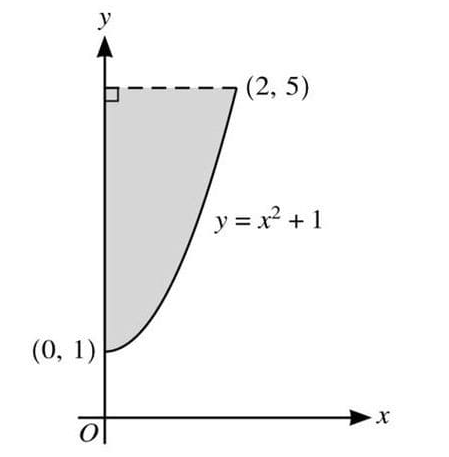
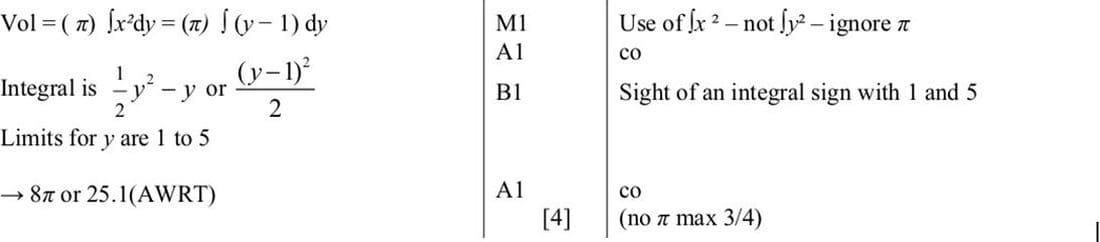
The diagram shows part of the curve \(y = x^2 + 1\). Find the volume obtained when the shaded region is rotated through 360° about the y-axis.
9709 P13 - Nov 2013 - Q11
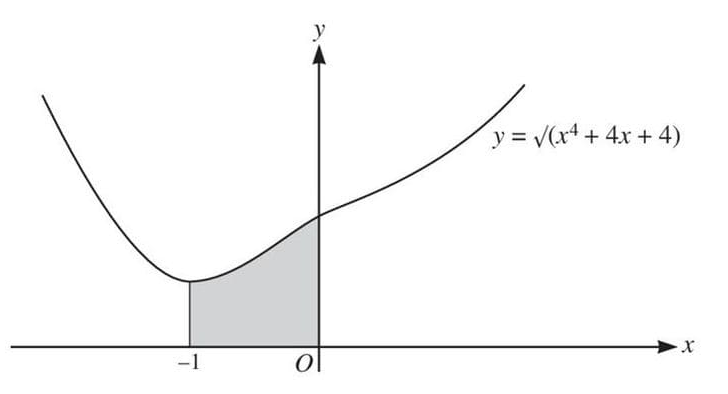
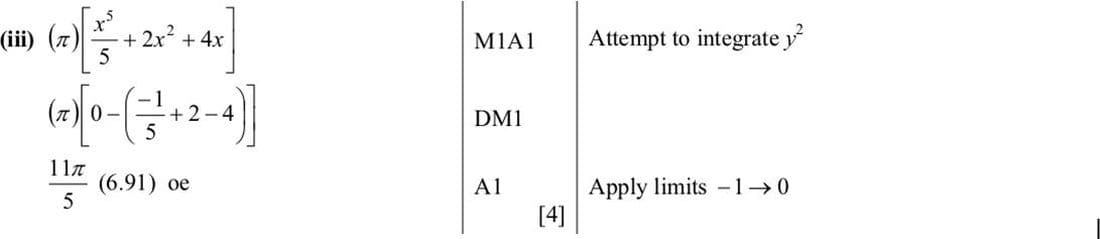
The diagram shows the curve \(y = \sqrt{x^4 + 4x + 4}\).
The region shaded in the diagram is rotated through 360° about the x-axis. Find the volume of revolution.
9709 P12 - Nov 2013 - Q9
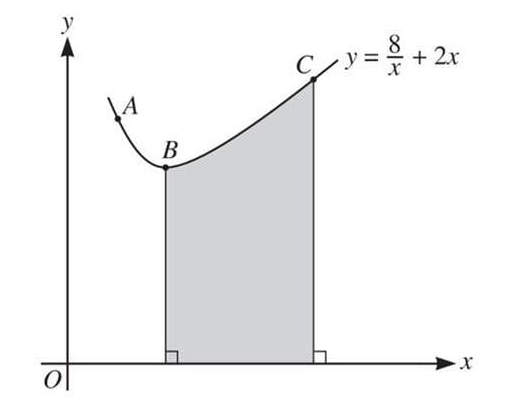
The diagram shows part of the curve \(y = \frac{8}{x} + 2x\) and three points \(A, B\) and \(C\) on the curve with \(x\)-coordinates 1, 2 and 5 respectively.
Find the volume obtained when the shaded region is rotated through 360° about the \(x\)-axis.
9709 P13 - Nov 2022 - Q10
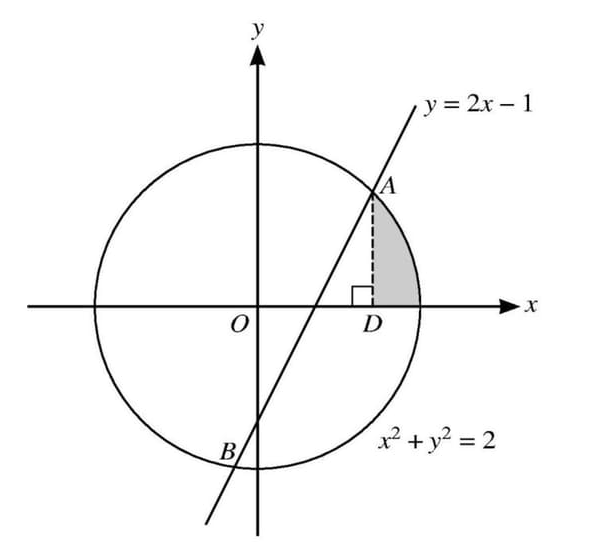
The diagram shows the circle \(x^2 + y^2 = 2\) and the straight line \(y = 2x - 1\) intersecting at the points \(A\) and \(B\). The point \(D\) on the \(x\)-axis is such that \(AD\) is perpendicular to the \(x\)-axis.
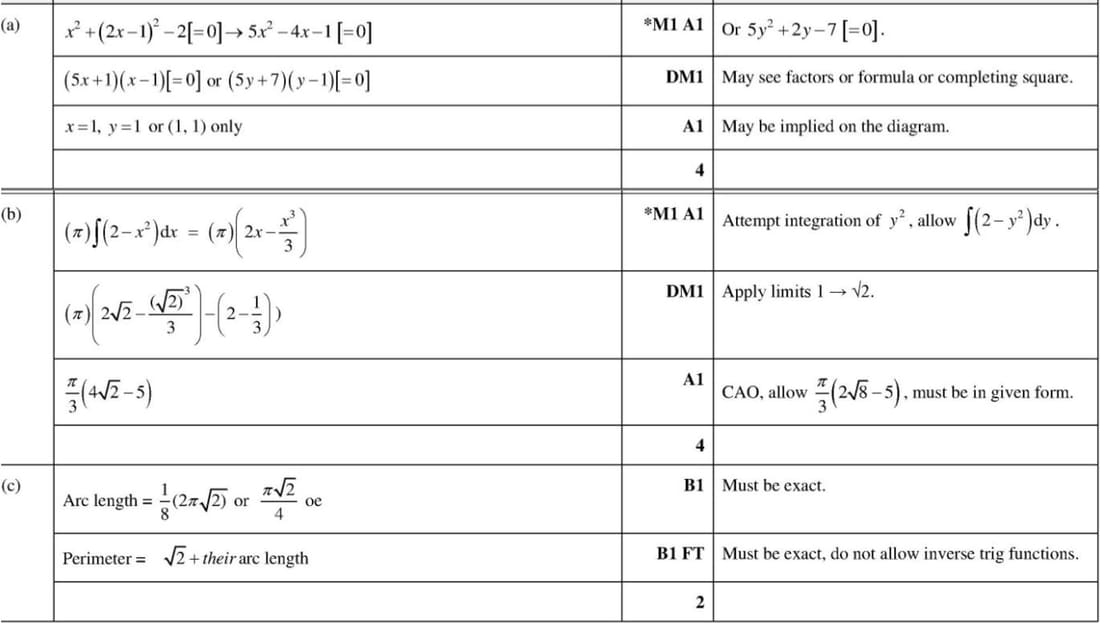
(a) Find the coordinates of \(A\).
(b) Find the volume of revolution when the shaded region is rotated through 360° about the \(x\)-axis. Give your answer in the form \(\frac{\pi}{a}(b\sqrt{c} - d)\), where \(a, b, c\) and \(d\) are integers.
(c) Find an exact expression for the perimeter of the shaded region.
9709 P12 - Jun 2012 - Q1
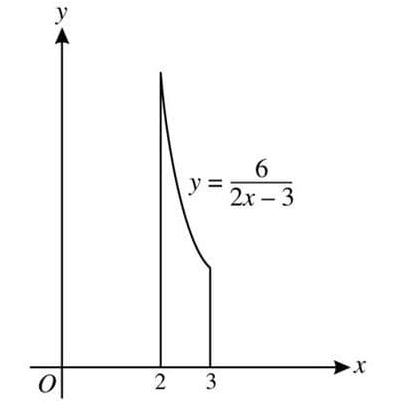
The diagram shows the region enclosed by the curve \(y = \frac{6}{2x-3}\), the x-axis and the lines \(x = 2\) and \(x = 3\). Find, in terms of \(\pi\), the volume obtained when this region is rotated through 360° about the x-axis.

9709 P11 - Jun 2012 - Q11
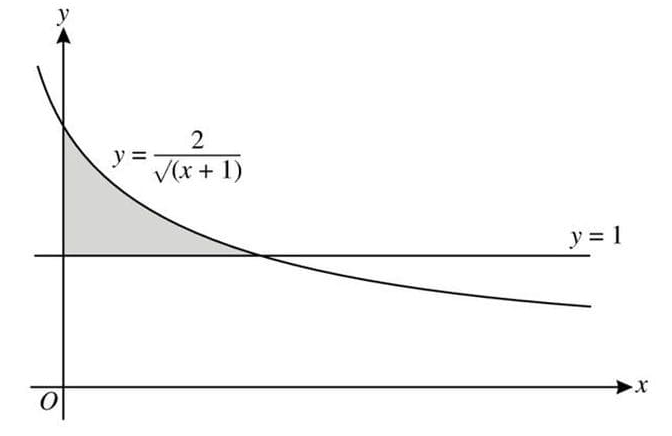
The diagram shows the line \(y = 1\) and part of the curve \(y = \frac{2}{\sqrt{x+1}}\).
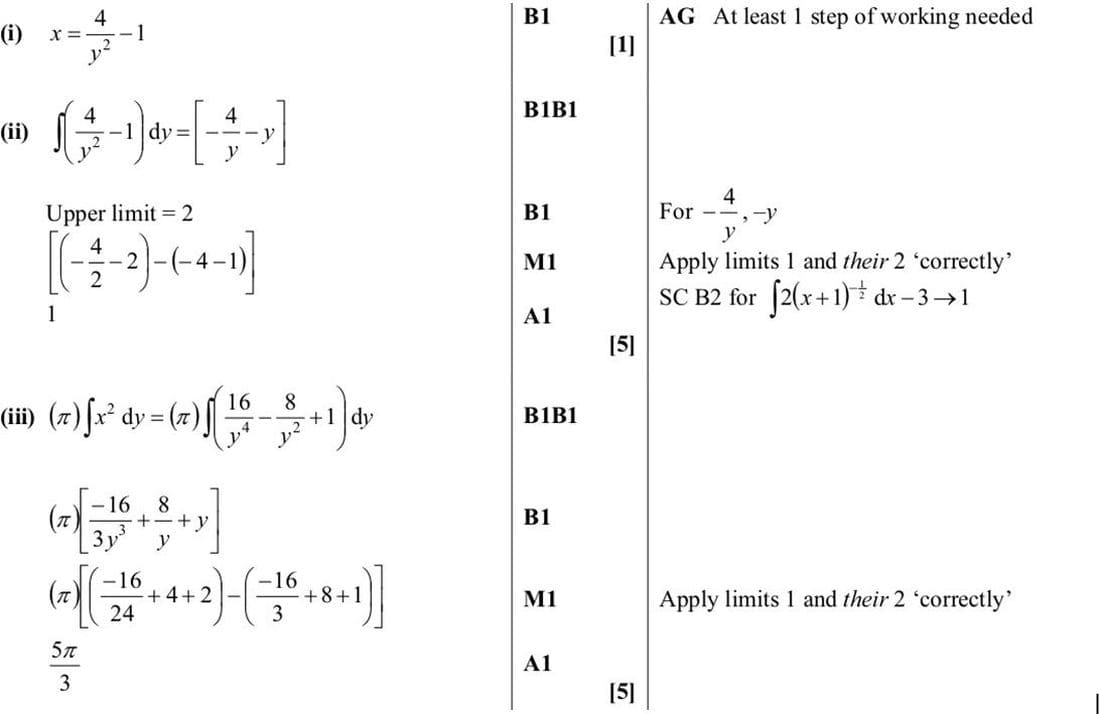
(i) Show that the equation \(y = \frac{2}{\sqrt{x+1}}\) can be written in the form \(x = \frac{4}{y^2} - 1\). [1]
(ii) Find \(\int \left( \frac{4}{y^2} - 1 \right) \, dy\). Hence find the area of the shaded region. [5]
(iii) The shaded region is rotated through 360° about the \(y\)-axis. Find the exact value of the volume of revolution obtained. [5]
9709 P13 - Nov 2011 - Q10
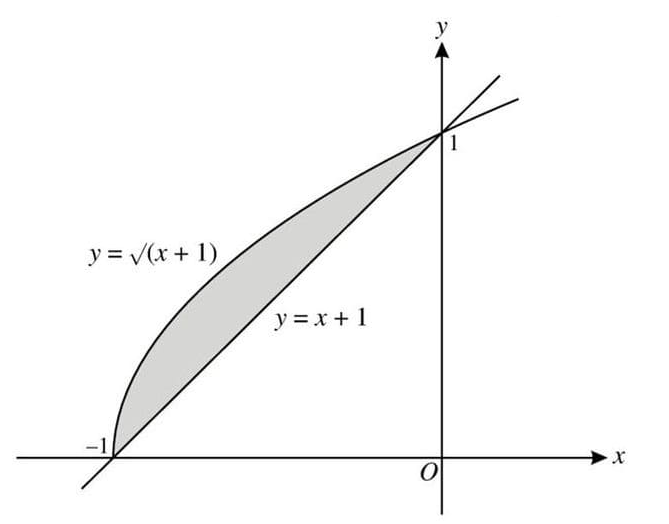
The diagram shows the line \(y = x + 1\) and the curve \(y = \sqrt{(x+1)}\), meeting at \((-1, 0)\) and \((0, 1)\).
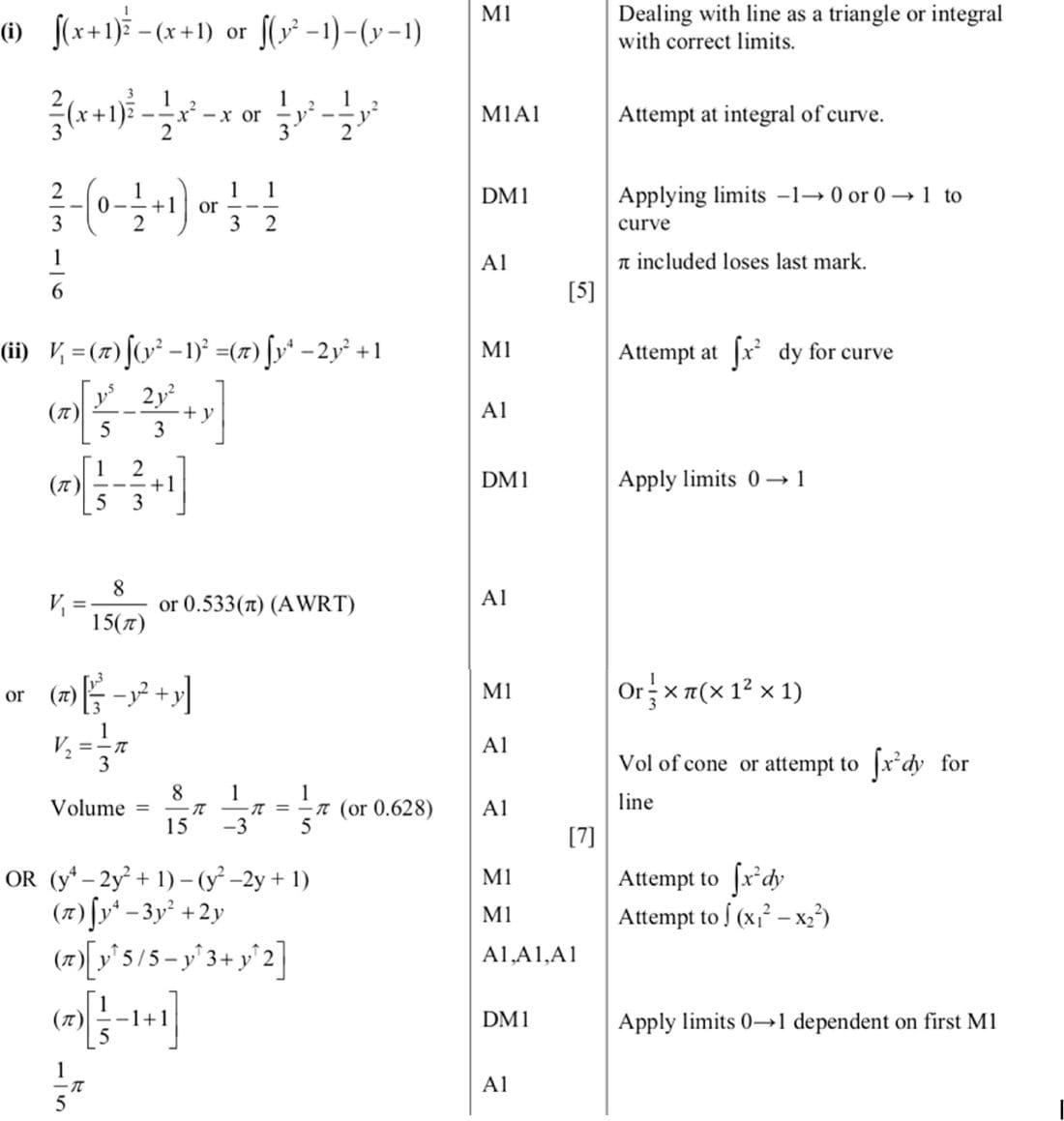
(i) Find the area of the shaded region.
(ii) Find the volume obtained when the shaded region is rotated through 360° about the y-axis.