Browsing as Guest. Progress, bookmarks and attempts are disabled.
Log in to track your work.
9709 P1 - Nov 2004 - Q7
1403
A curve is such that \(\frac{dy}{dx} = \frac{6}{\sqrt{4x - 3}}\) and \(P(3, 3)\) is a point on the curve.
(i) Find the equation of the normal to the curve at \(P\), giving your answer in the form \(ax + by = c\).
(ii) Find the equation of the curve.
Solution
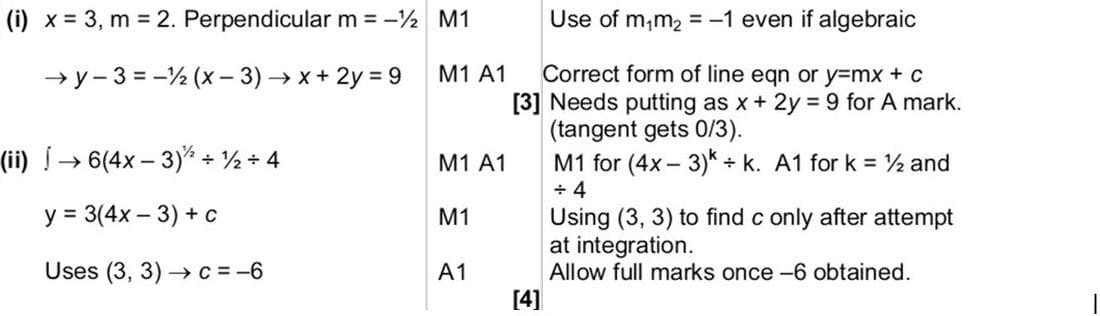
(i) To find the equation of the normal, first find the gradient of the tangent at \(P(3, 3)\). The gradient \(m\) is given by \(\frac{dy}{dx} = \frac{6}{\sqrt{4x - 3}}\). At \(x = 3\), \(\frac{dy}{dx} = \frac{6}{\sqrt{4(3) - 3}} = 2\). The gradient of the normal is the negative reciprocal, \(m = -\frac{1}{2}\). The equation of the normal is \(y - 3 = -\frac{1}{2}(x - 3)\), which simplifies to \(x + 2y = 9\).
(ii) To find the equation of the curve, integrate \(\frac{dy}{dx} = \frac{6}{\sqrt{4x - 3}}\). Let \(u = 4x - 3\), then \(du = 4dx\), so \(dx = \frac{1}{4}du\). The integral becomes \(\int \frac{6}{\sqrt{u}} \cdot \frac{1}{4} \, du = \frac{3}{2} \int u^{-1/2} \, du\). This integrates to \(3u^{1/2} + c\). Substituting back \(u = 4x - 3\), we get \(y = 3(4x - 3)^{1/2} + c\). Using the point \((3, 3)\), substitute to find \(c\): \(3 = 3(4(3) - 3)^{1/2} + c\), which gives \(c = -6\). Therefore, the equation of the curve is \(y = 3(4x - 3)^{1/2} - 6\).