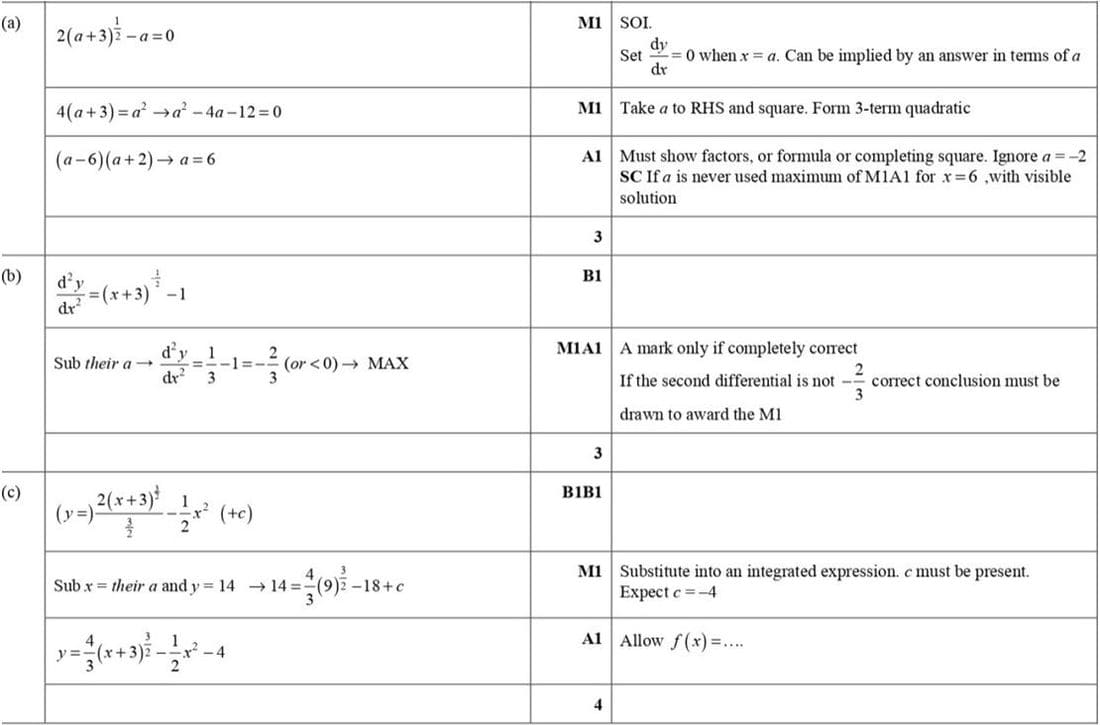
(a) To find the value of \(a\), set \(\frac{dy}{dx} = 0\) at \(x = a\):
\(2(a + 3)^{\frac{1}{2}} - a = 0\)
\(2(a + 3)^{\frac{1}{2}} = a\)
Square both sides:
\(4(a + 3) = a^2\)
\(a^2 - 4a - 12 = 0\)
Factorize:
\((a - 6)(a + 2) = 0\)
\(a = 6\) (since \(a\) is positive)
(b) To determine the nature of the stationary point, find the second derivative:
\(\frac{d^2y}{dx^2} = (x + 3)^{-rac{1}{2}} - 1\)
Substitute \(x = a = 6\):
\(\frac{d^2y}{dx^2} = (6 + 3)^{-rac{1}{2}} - 1 = \frac{1}{3} - 1 = -\frac{2}{3}\)
Since \(\frac{d^2y}{dx^2} < 0\), the stationary point is a maximum.
(c) To find the equation of the curve, integrate \(\frac{dy}{dx} = 2(x + 3)^{\frac{1}{2}} - x\):
\(y = \int (2(x + 3)^{\frac{1}{2}} - x) \, dx\)
\(y = \frac{4}{3}(x + 3)^{\frac{3}{2}} - \frac{1}{2}x^2 + c\)
Substitute \(x = 6\) and \(y = 14\):
\(14 = \frac{4}{3}(9)^{\frac{3}{2}} - 18 + c\)
\(14 = 36 - 18 + c\)
\(c = -4\)
Thus, the equation of the curve is:
\(y = \frac{4}{3}(x+3)^{\frac{3}{2}} - \frac{1}{2}x^2 - 4\)