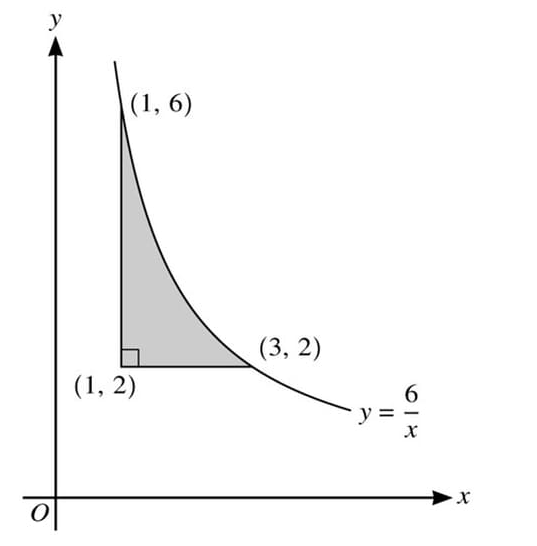
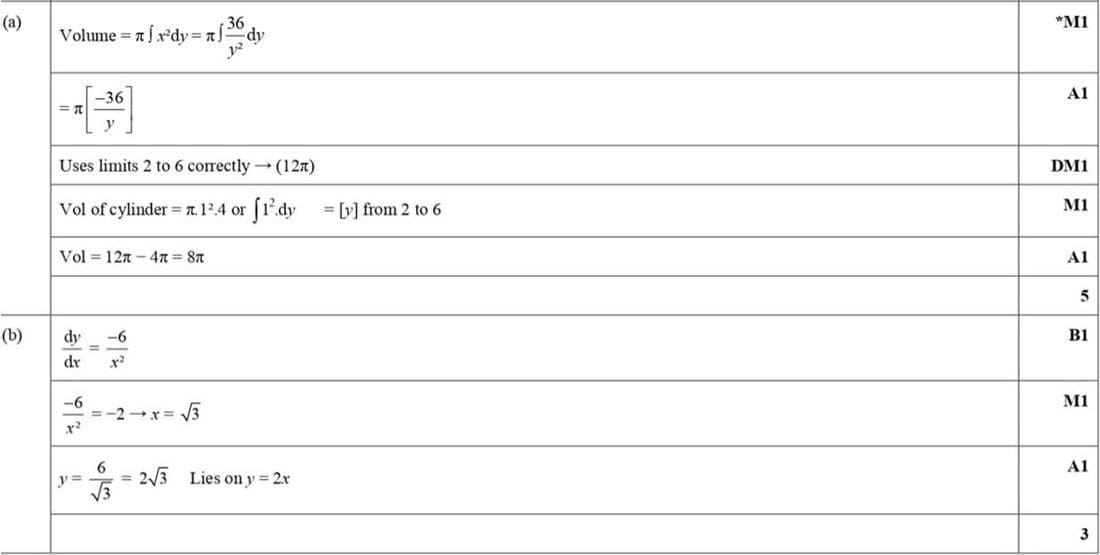
(a) To find the volume generated when the shaded region is rotated about the \(y\)-axis, we use the formula for the volume of revolution:
\(\text{Volume} = \pi \int x^2 \, dy\)
Given \(y = \frac{6}{x}\), we have \(x = \frac{6}{y}\). Therefore, \(x^2 = \left(\frac{6}{y}\right)^2 = \frac{36}{y^2}\).
Substitute into the integral:
\(\text{Volume} = \pi \int \frac{36}{y^2} \, dy\)
\(= \pi \left[ -\frac{36}{y} \right]\)
Evaluate from \(y = 2\) to \(y = 6\):
\(= \pi \left( -\frac{36}{6} + \frac{36}{2} \right)\)
\(= \pi ( -6 + 18 )\)
\(= 12\pi\)
Subtract the volume of the cylinder \(\pi \times 1^2 \times 4 = 4\pi\):
\(\text{Total Volume} = 12\pi - 4\pi = 8\pi\)
(b) The gradient of the curve \(y = \frac{6}{x}\) is given by differentiating:
\(\frac{dy}{dx} = -\frac{6}{x^2}\)
The gradient of the line \(y + 2x = 0\) is \(-2\). Set \(-\frac{6}{x^2} = -2\):
\(\frac{6}{x^2} = 2\)
\(x^2 = 3\)
\(x = \sqrt{3}\)
Substitute \(x = \sqrt{3}\) into \(y = \frac{6}{x}\):
\(y = \frac{6}{\sqrt{3}} = 2\sqrt{3}\)
Check if \(y = 2x\):
\(2\sqrt{3} = 2 \times \sqrt{3}\)
Thus, \(X\) lies on \(y = 2x\).