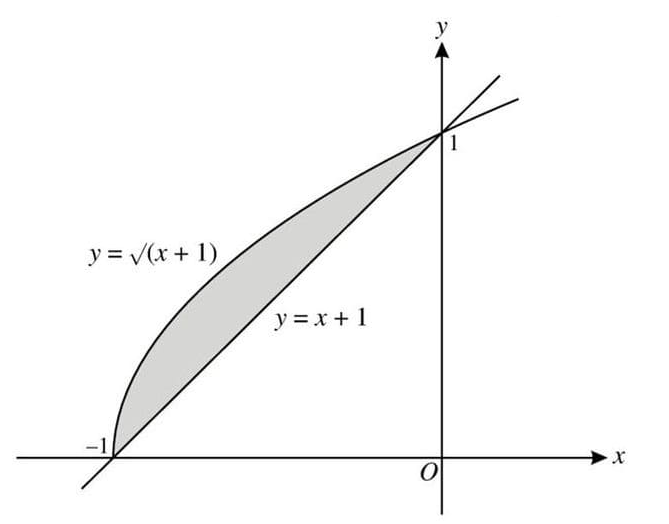
(i) To find the area of the shaded region, we calculate the integral of the difference between the curve and the line from \(x = -1\) to \(x = 0\):
\(\int_{-1}^{0} \left( (x+1)^{\frac{1}{2}} - (x+1) \right) \, dx\)
Calculate the integrals separately:
\(\int (x+1)^{\frac{1}{2}} \, dx = \frac{2}{3}(x+1)^{\frac{3}{2}}\)
\(\int (x+1) \, dx = \frac{1}{2}x^2 + x\)
Apply the limits:
\(\frac{2}{3}(0+1)^{\frac{3}{2}} - \left( \frac{1}{2}(0)^2 + 0 \right) - \left( \frac{2}{3}(-1+1)^{\frac{3}{2}} - \left( \frac{1}{2}(-1)^2 - 1 \right) \right)\)
\(= \frac{2}{3} - 0 - (0 - \frac{1}{2}) = \frac{1}{6}\)
(ii) To find the volume of the solid obtained by rotating the shaded region about the y-axis, use the method of cylindrical shells:
\(V = \pi \int_{0}^{1} \left( (y^2 - 1)^2 - (y-1)^2 \right) \, dy\)
Calculate the integrals:
\(\int (y^4 - 2y^2 + 1) \, dy = \frac{y^5}{5} - \frac{2y^3}{3} + y\)
Apply the limits:
\(\pi \left[ \frac{1}{5} - \frac{2}{3} + 1 \right] = \frac{8}{15} \pi\)
Alternatively, using the volume of a cone:
\(V = \frac{1}{3} \pi (x_1^2 - x_2^2)\)
\(= \frac{1}{5} \pi\)