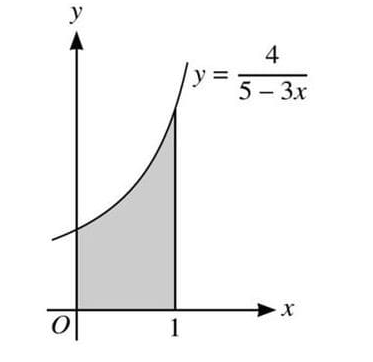
(i) To find the equation of the normal, first find the derivative \(\frac{dy}{dx}\) of the curve \(y = \frac{4}{5 - 3x}\).
\(\frac{dy}{dx} = \frac{-4}{(5 - 3x)^2} \times (-3) = \frac{12}{(5 - 3x)^2}\).
At \(x = 1\), \(\frac{dy}{dx} = \frac{12}{(5 - 3 \times 1)^2} = \frac{12}{4} = 3\).
The gradient of the tangent is 3, so the gradient of the normal is \(-\frac{1}{3}\).
The point on the curve at \(x = 1\) is \((1, 2)\).
The equation of the normal is \(y - 2 = -\frac{1}{3}(x - 1)\).
Simplifying gives \(y = -\frac{1}{3}x + \frac{7}{3}\).
(ii) The volume of the solid of revolution is given by \(V = \pi \int_{0}^{1} y^2 \, dx\).
\(V = \pi \int_{0}^{1} \left( \frac{4}{5 - 3x} \right)^2 \, dx = \pi \int_{0}^{1} \frac{16}{(5 - 3x)^2} \, dx\).
Let \(u = 5 - 3x\), then \(du = -3 \, dx\) or \(dx = -\frac{1}{3} \, du\).
Change the limits: when \(x = 0, u = 5\); when \(x = 1, u = 2\).
\(V = \pi \int_{5}^{2} \frac{16}{u^2} \left(-\frac{1}{3}\right) \, du\).
\(V = -\frac{16\pi}{3} \int_{5}^{2} \frac{1}{u^2} \, du\).
\(V = -\frac{16\pi}{3} \left[ -\frac{1}{u} \right]_{5}^{2}\).
\(V = \frac{16\pi}{3} \left( \frac{1}{2} - \frac{1}{5} \right)\).
\(V = \frac{16\pi}{3} \times \frac{3}{10} = \frac{8\pi}{5}\).