Browsing as Guest. Progress, bookmarks and attempts are disabled.
Log in to track your work.
June 2017 p13 q10
1329
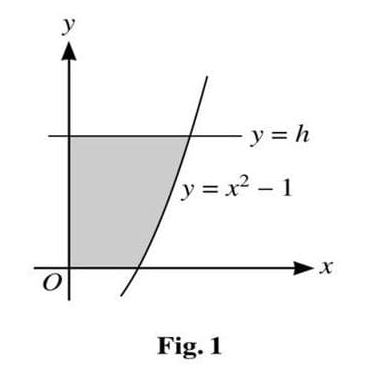
Fig. 1 shows part of the curve \(y = x^2 - 1\) and the line \(y = h\), where \(h\) is a constant.
(i) The shaded region is rotated through 360° about the \(y\)-axis. Show that the volume of revolution, \(V\), is given by \(V = \pi \left( \frac{1}{2}h^2 + h \right)\).
(ii) Find, showing all necessary working, the area of the shaded region when \(h = 3\).
Solution
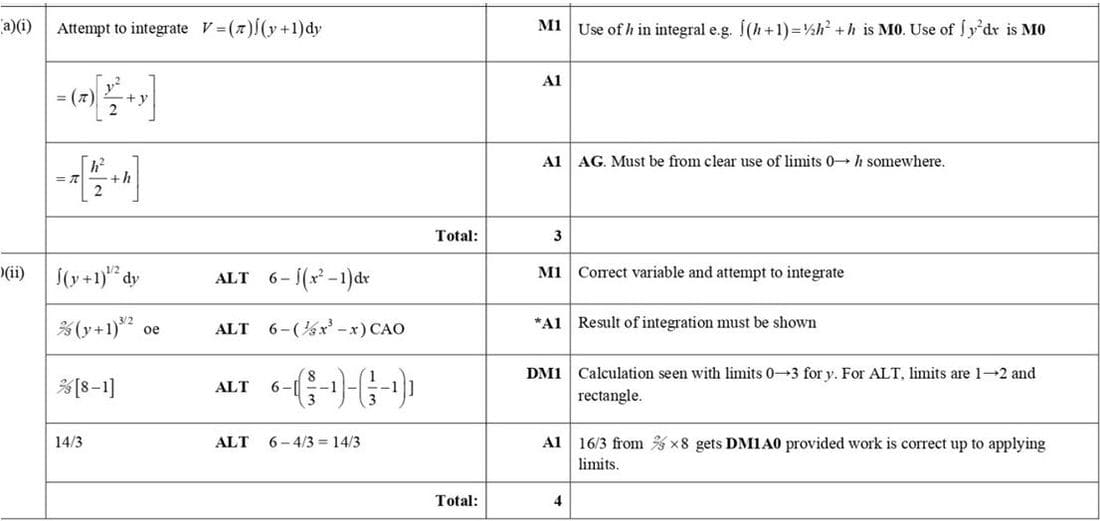
(i) To find the volume of revolution, we use the formula \(V = \pi \int (y + 1) \, dy\) from \(y = 0\) to \(y = h\).
Integrating, we have:
\(V = \pi \left[ \frac{y^2}{2} + y \right]_0^h\)
\(= \pi \left( \frac{h^2}{2} + h \right)\)
Thus, \(V = \pi \left( \frac{1}{2}h^2 + h \right)\).
(ii) To find the area of the shaded region when \(h = 3\), we calculate:
\(\int (y + 1)^{1/2} \, dy\) from \(y = 0\) to \(y = 3\).
Alternatively, \(6 - \int (x^2 - 1) \, dx\) from \(x = 1\) to \(x = 2\).