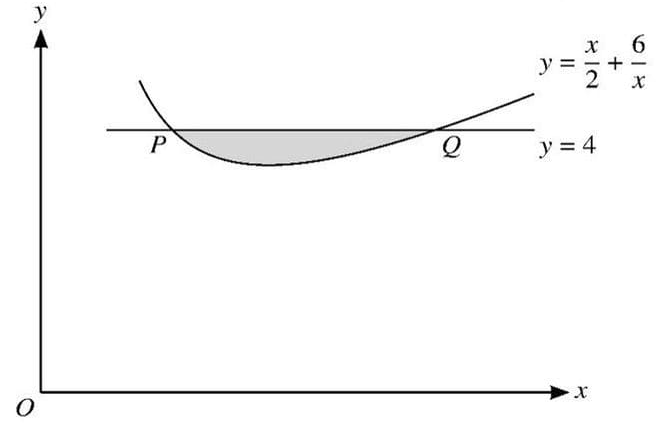
(i) To find the points \(P\) and \(Q\), set \(y = \frac{x}{2} + \frac{6}{x} = 4\). Solving gives \(x = 2\) and \(x = 6\). The points are \(P(2, 4)\) and \(Q(6, 4)\).
The derivative of \(y\) is \(\frac{dy}{dx} = \frac{1}{2} - \frac{6}{x^2}\).
At \(x = 2\), the slope \(m = \frac{1}{2} - \frac{6}{4} = -1\). The tangent line is \(y - 4 = -1(x - 2)\) or \(y = -x + 6\).
At \(x = 6\), the slope \(m = \frac{1}{2} - \frac{6}{36} = \frac{1}{3}\). The tangent line is \(y - 4 = \frac{1}{3}(x - 6)\) or \(y = \frac{1}{3}x + 2\).
Solving \(y = -x + 6\) and \(y = \frac{1}{3}x + 2\) gives \(x = 3\), \(y = 3\). The tangents meet at \((3, 3)\), which lies on \(y = x\).
(ii) The volume of revolution is given by \(V = \pi \int_2^6 \left(4^2 - \left(\frac{x}{2} + \frac{6}{x}\right)^2\right) \, dx\).
Integrate \(\pi \int_2^6 \left(16 - \left(\frac{x}{2} + \frac{6}{x}\right)^2\right) \, dx\).
\(= \pi \int_2^6 \left(16 - \left(\frac{x^2}{4} + 6 + \frac{36}{x^2}\right)\right) \, dx\)
\(= \pi \int_2^6 \left(\frac{-x^2}{4} + 10 - \frac{36}{x^2}\right) \, dx\)
Integrate to get \(\left[-\frac{x^3}{12} + 10x + \frac{36}{x}\right]_2^6\).
Calculate: \(\left(-\frac{6^3}{12} + 10 \times 6 + \frac{36}{6}\right) - \left(-\frac{2^3}{12} + 10 \times 2 + \frac{36}{2}\right)\)
\(= \left(-18 + 60 + 6\right) - \left(-\frac{8}{12} + 20 + 18\right)\)
\(= 48 - 37 = 11\)
Volume \(= \pi \times 11 = \frac{10}{3} \pi\) or approximately \(33.5 \pi\).