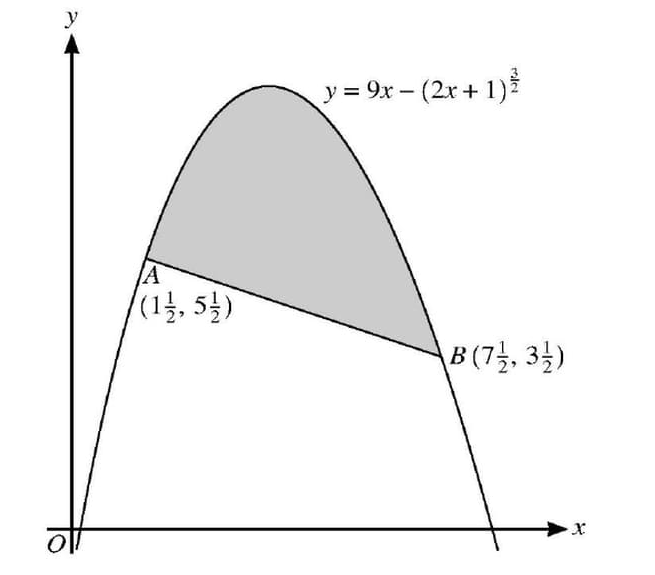
(a) To find the maximum point, differentiate the curve equation: \(\frac{dy}{dx} = 9 - \frac{3}{2}(2x+1)^{\frac{1}{2}} \times 2\).
Set \(\frac{dy}{dx} = 0\):
\(9 - 3(2x+1)^{\frac{1}{2}} = 0\)
\(2x+1 = 9 \Rightarrow x = 4\)
Substitute \(x = 4\) into the original equation to find \(y\):
\(y = 9(4) - (2(4) + 1)^{\frac{3}{2}} = 36 - 9 = 27\)
Thus, the maximum point is \((4, 9)\).
(b) The gradient of the curve at \(A\) is found by substituting \(x = 1\frac{1}{2}\) into \(\frac{dy}{dx}\):
\(\frac{dy}{dx} = 3\)
The gradient of \(AB\) is:
\(\frac{5\frac{1}{2} - 3\frac{1}{2}}{1\frac{1}{2} - 7\frac{1}{2}} = \frac{2}{-6} = -\frac{1}{3}\)
Since the product of the gradients is \(-1\), \(AB\) is the normal to the curve at \(A\).
(c) To find the area of the shaded region, integrate the curve equation from \(x = 1\frac{1}{2}\) to \(x = 7\frac{1}{2}\):
\(\int_{1\frac{1}{2}}^{7\frac{1}{2}} \left(9x - (2x+1)^{\frac{3}{2}}\right) \, dx\)
Calculate the definite integral and subtract the area of the trapezium formed by \(AB\):
\(Shaded area = 44.6 - 27 = 17.6\)