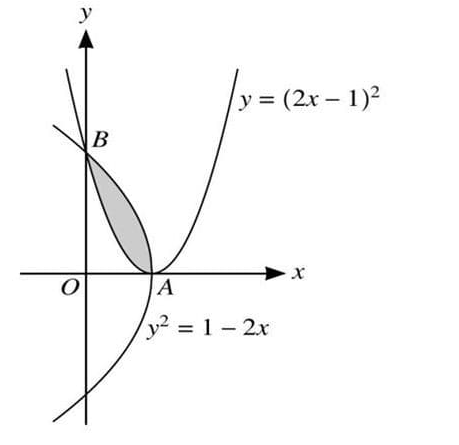
(i) To find the coordinates of \(A\), solve \(y = (2x - 1)^2\) and \(y^2 = 1 - 2x\) simultaneously. At \(A\), \(y = 0\), so substitute into \(y^2 = 1 - 2x\):
\(0^2 = 1 - 2x\)
\(0 = 1 - 2x\)
\(2x = 1\)
\(x = \frac{1}{2}\)
Thus, \(A = \left( \frac{1}{2}, 0 \right)\).
(ii) To find the area of the shaded region, integrate the difference between the curves from \(x = 0\) to \(x = \frac{1}{2}\).
First, integrate \(y^2 = 1 - 2x\):
\(\int (1 - 2x)^{1/2} \, dx = \left[ \frac{(1 - 2x)^{3/2}}{3/2} \right] \div (-2)\)
Evaluate from \(0\) to \(\frac{1}{2}\):
\(\left[ 0 - \left(-\frac{1}{3}\right) \right]\)
Next, integrate \(y = (2x - 1)^2\):
\(\int (2x - 1)^2 \, dx = \left[ \frac{(2x - 1)^3}{3} \right] \div 2\)
Evaluate from \(0\) to \(\frac{1}{2}\):
\(\left[ 0 - \left(-\frac{1}{6}\right) \right]\)
The area of the shaded region is:
\(\frac{1}{3} - \frac{1}{6} = \frac{1}{6}\).