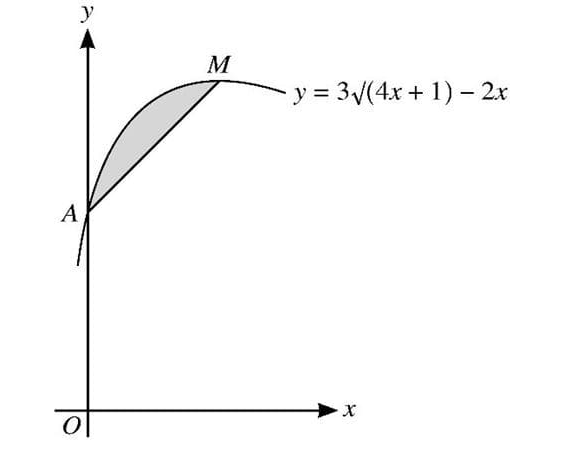
(i) To find \(\frac{dy}{dx}\), differentiate \(y = 3\sqrt{4x + 1} - 2x\).
\(\frac{dy}{dx} = \frac{3}{2}(4x+1)^{-\frac{1}{2}} \cdot 4 - 2\)
For \(\int y \, dx\), integrate \(y = 3\sqrt{4x + 1} - 2x\).
\(\int y \, dx = \frac{(4x+1)^{\frac{3}{2}}}{2} - x^2 + C\)
(ii) At \(M\), \(\frac{dy}{dx} = 0\).
Set \(\frac{dy}{dx} = 0\) and solve for \(x\):
\(\frac{3}{2}(4x+1)^{-\frac{1}{2}} \cdot 4 - 2 = 0\)
Solve to find \(x = 2\).
Substitute \(x = 2\) into \(y = 3\sqrt{4x + 1} - 2x\) to find \(y = 5\).
Coordinates of \(M\) are \((2, 5)\).
(iii) To find the area of the shaded region, calculate the area under the curve and subtract the area under the chord.
Area under the curve from \(x = 0\) to \(x = 2\):
\(\left[ \frac{1}{2}(4x+1)^{\frac{3}{2}} - x^2 \right]_0^2 = 9\)
Area under the chord (trapezium):
\(\frac{1}{2} \times 2 \times (3 + 5) = 8\)
\(Shaded area = 9 - 8 = 1\)